


BIOLOX ? Ceramics for Hip Arthroplasty

BIOLOX ? Ceramics for Hip Arthroplasty
Total hip replacement (THR) is a successful surgical procedure, but challenges like aseptic loosening due to wear particles persist. These particles, generated by the femoral ball head and cup inlay, lead to osteolysis and often require revision surgery.
Factors such as increased patient activity, material properties, wear couple diameter, surface roughness, and third body wear contribute to wear particle production. Real-life activity levels are higher than those assumed in simulator studies, highlighting the need for high-quality wear couples.
The aim is to minimize wear particle production, ensure favorable biological behavior, reduce osteolytic potential, and achieve a low coefficient of friction. Ceramic bearing surfaces, like BIOLOX®, are effective in preventing revision surgeries.
BIOLOX® components produce the lowest particle and osteolytic potential, have low biological activity, and are suitable for patients with metal hypersensitivity. They have been successfully used since 1974, with over 4.5 million components implanted worldwide.
BIOLOX®delta, a high-performance ceramic, offers enhanced mechanical properties and stability, allowing for new sizes and applications. It can be combined with BIOLOX®forte and polyethylene inserts.
Larger diameter wear couples increase range of motion (ROM) and stability, reducing the risk of dislocation. Clinical studies show decreased impingement and dislocation rates with larger ceramic wear couples.
Studies demonstrate that BIOLOX® ceramic components significantly reduce wear debris and loosening rates compared to metal-on-polyethylene couples. Long-term studies show high survival rates without revision.
BIOLOX® ceramic-on-ceramic articulations provide a reliable solution for younger, more active patients, offering reduced wear and increased longevity in total hip replacements.
BIOLOX® ceramics are noted for their exceptional wear reduction, biocompatibility, and stability. The material's hardness, second only to diamond, provides excellent scratch resistance and minimizes third-body wear, contributing to the longevity of total hip replacements.
Laboratory studies from the University of Leeds indicate that ceramic-on-ceramic bearings have lower functional biological activity and osteolytic potential than metal-on-crosslinked polyethylene combinations. Clinical studies by Bizot et al. and D’Antonio et al. show high survival rates for ceramic-on-ceramic systems, with significantly lower instances of osteolysis compared to metal-on-polyethylene systems.
Data from wear studies demonstrate that ceramic-on-ceramic articulations have a wear rate fifty times lower than metal-on-crosslinked polyethylene, supporting their use in reducing particle-induced osteolysis.
The document provides details on BIOLOX® ceramic components for hip arthroplasty, including femoral ball heads and inserts, with specifications on sizes and materials.
The document is intended for medical professionals and does not constitute medical advice. It emphasizes the need for individual patient examination and consultation.
A CD ROM accompanying the document contains further information, including references, presentations, and animations related to ceramics in orthopedics.
Catalog excerpts
BIOLOX® – Ceramics for Hip Arthroplasty Contains CD ROM with 3-D Animation It’s in Your Hands: The Low Wear Choice Against Osteolysis Scientific Information on Wear Couples
Open the catalog to page 1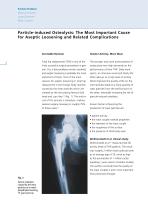
Particle Problem Material Answers Large Diameters Wear Couples Particle-induced Osteolysis: The Most Important Cause for Aseptic Loosening and Related Complications Inevitable Revision Total hip replacement (THR) is one of the The younger and more active patients of most successful surgical procedures in gen- today place very high demands on the eral. Yet, a few problems remain unsolved, performance of their THR. Daily work, and aseptic loosening is probably the most sports, an intensive social and family life important of them. One of the main often add up to a high level of activity. reasons...
Open the catalog to page 2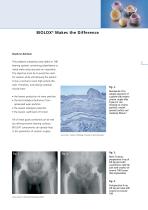
BIOLOX ® Makes the Difference Goals to Achieve The problems created by wear debris in THR bearing systems containing polyethyl ne or e metal make reducing wear an imperative. The objective must be to avoid the need for revision while still allowing the patient to live a normal or even high activity lifestyle. Therefore, articulating materials should have: Neocapsule of an autopsy specimen of a patient with ceramicceramic couple after 8 years in vivo showng no ceramic i particles, smooth syno ial surface and v moderate fibrosis.6 • the lowest production of wear particles • the best biological...
Open the catalog to page 3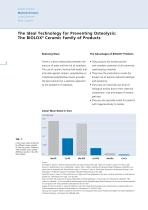
Particle Problem Material Answers Large Diameters Wear Couples The Ideal Technology for Preventing Osteolysis: The BIOLOX ® Ceramic Family of Products Reducing Wear There is a direct relationship between the The Advantages of BIOLOX® Products • They produce the lowest particle amount of wear and the risk of osteolysis. and osteolytic potential of all commonly The use of ceramic femoral ball heads that used bearing materials. articulate against ceramic, polyethylene or crosslinked polyethylene inserts provides the best solution for a selective approach to the problems of osteolysis. • They have...
Open the catalog to page 4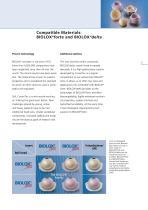
Compatible Materials: BIOLOX ®forte and BIOLOX ®delta Proven technology Additional options BIOLOX® has been in use since 1974. The new alumina matrix composite, More than 4,500,000 components have BIOLOX®delta, meets these increased been implanted since then all over the demands. It is a high performance ceramic world. The clinical results have been excel- developed by CeramTec as a logical lent. The material has proven its superior complement to our well-proven BIOLOX® properties and is considered the standard forte. It allows us to offer new sizes and by which all other ceramics used in ortho-...
Open the catalog to page 5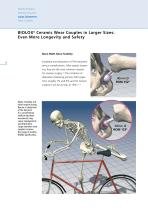
Particle Problem Material Answers Large Diameters Wear Couples BIOLOX ® Ceramic Wear Couples in Larger Sizes: Even More Longevity and Safety More ROM, More Stability Instability and dislocation of THR represent serious complications. After aseptic loosening, they are the most common reasons for revision surgery.26 The incidence of dislocation following primary THR ranges from roughly 1% and 5% and for revision surgery it can be as high as 10%.22, 28 Many everyday acti vities require strong flexion or abduction of the hip joint. In a conventional artificial hip these movements may cause impingement...
Open the catalog to page 6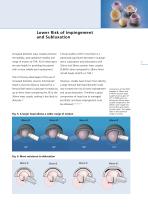
Lower Risk of Impingement and Subluxation Increased diameter wear couples enhance Clinical studies confirm that there is a the stability, post-operative mobility and statistically significant decrease in impinge- range of motion of THR. All of these gains ment, subluxation and dislocations with are very helpful in providing the patient 32mm and 36mm ceramic wear couples with a more reliable joint replacement. (0.88%) when compared to 28mm femo- ral ball heads (4.63%) in THR.33 One of the key advantages of the use of increased diameter ceramic femoral ball However, studies have shown that utilizing...
Open the catalog to page 7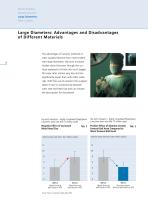
Particle Problem Material Answers Large Diameters Wear Couples Large Diameters: Advantages and Disadvantages of Different Materials The advantages of ceramic materials in wear couples become even more evident with large diameters. Hip joint simulator studies show that even though the sur faces exposed to friction are much bigger, the wear rates remain very low and are significantly lower than with other materials. With the use of ceramics the surgeon doesn’t have to compromise between wear rate and head size and can choose the best option for the patient. Hip Joint Simulator – Highly Crosslinked...
Open the catalog to page 8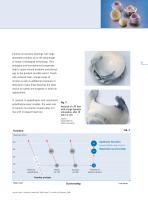
Ceramic-on-ceramic bearings with large diameters combine all of the advantages of today’s tribological technology. Their biological and biomechanical properties help to spare natural anatomy and physiology to the greatest possible extent. Drastically reduced wear, a large range of motion as well as additional resistance to dislocation make these bearings the ideal choice for safety and longevity in total hip replacement. In contrast to polyethylene and crosslinked polyethylene wear couples, the wear rate of ceramic-on-ceramic couples does not rise with increased head size.1 Fig. 7: Retrieval...
Open the catalog to page 9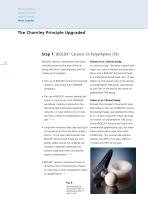
Particle Problem Material Answers Large Diameters Wear Couples The Charnley Principle Upgraded Step 1: BIOLOX ® Ceramic on Polyethylene (PE) 10 BIOLOX® ceramic components have been Zichner et al. Clinical Study: clinically proven by the test of time as In a clinical study34, the same surgical tech- being effective in reducing wear and the nique was used to implant the same pros- thesis with a BIOLOX® femoral ball head or a metal femoral ball head. At a 10 year • The use of BIOLOX ceramic femoral ball ® follow-up, the revision rate in the ceramic- heads in conjunction with UHMWPE on-polyethylene...
Open the catalog to page 10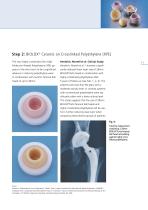
Step 2: BIOLOX ® Ceramic on Crosslinked Polyethylene (XPE) The new highly crosslinked Ultra High Hendrich, Martell et al. Clinical Study: Molecular Weight Polyethylene (XPE) ap- Hendrich, Martell et al.18 showed a signifi- pears in the short term to be a significant cantly reduced linear wear rate of 28mm advance in reducing polyethylene wear BIOLOX®forte heads in combination with in combination with ceramic femoral ball highly crosslinked polyethylene after patients were less than 60 years with a moderate activity level. In contrast patients with conventional polyethylene were significantly...
Open the catalog to page 11All CERAMTEC catalogs and technical brochures
 TOOLS FOR TURNING
188 Pages
 SYSTEM S3
56 Pages
 RAG
RAG37 Pages
 HARD TURNING
60 Pages
 CERAMIC INSERTS
96 Pages
 PERLUCOR® Transparent Ceramics
16 Pages
 Lasering of Ceramics
6 Pages


Archived catalogs
 Ceramic Materials
4 Pages
 SPK® PFK90-TN
132 Pages
 SPK Tools for hard materials
112 Pages
 CeramCool® Substrates
2 Pages
 Tools for Turning
188 Pages
 PcBn for cast iron Machining
24 Pages
 triduon thermo tames Temperature
16 Pages
 ALUTIT Aluminum Titanate
6 Pages
 ALOTEC
11 Pages
 Monolithic Multilayer Actuators
16 Pages
 New Milling Cutter Generation
36 Pages
 Materials for gas ignition
2 Pages
 SPK Tools for turning
340 Pages
 SPK Milling Tools
76 Pages


- Milling tool
- Solid milling cutter
- Steel milling cutter
- Milling tool with replaceable insert
- Clamping milling cutter
- Grade
- Face milling cutter
- Shell-end milling cutter
- Cutting milling cutter
- High-performance milling cutter
- Roughing milling cutter
- Shoulder milling cutter
- Turning grade
- Steel grade
- High-precision milling cutter
- Carbide grade
- CBN grade
- Milling cutter with negative insert
- Milling grade
- Cast iron grade