
- Catalogs
- CELSA MESSGERATE ESPAÑA S.L.
- 04-Analogue instruments

- Company
- Products
- Catalogs
- News & Trends
- Exhibitions
04-Analogue instruments

04-Analogue instruments
Celsa Messgerate España S.L. manufactures analogue measuring instruments designed for continuous value display using a pointer on a scale. These instruments are favored for their ability to show trends and instabilities quickly, though they are less precise than digital instruments for exact numerical values.
The instruments come in standardized dimensions (48x48mm, 72x72mm, 96x96mm, 144x144mm) and measure a wide range of electrical values. They comply with IEC 60051 and UNE-EN 60051 accuracy standards, with overload capacities and power consumption varying by model.
Suitable for indoor use, these instruments operate between -10 to 55°C and can be stored between -25 to 65°C. Constructed from self-extinguishing thermoplastic, they offer protection levels from IP40 to IP54.
Standard vertical mounting is available, with options for horizontal or inclined positions. Instruments are flush-mounted with a 650 V insulation voltage and withstand a test voltage of 2 kV.
Scales are black on white with coarse-fine graduation, and pointers match the scale color. Interchangeable scales allow for easy adjustments.
Compliant with various DIN and VDE standards, these instruments are CE certified and adhere to low tension and EMV rules.
- Moving Iron Instruments: Used for AC currents and voltages, calibrated for sinusoidal AC, suitable for panel boards with DIN rail mounting.
- Moving Coil Instruments with Rectifier: Suitable for sinusoidal AC currents and voltages, with options for direct measurement or transformer connection.
- Torque and Suspension: Features pivot suspension with spring-loaded jewel bearings for enhanced vibration and shock resistance.
- Scales: Range from 90º to 240º, with voltmeters under 40V having compressed scales at the beginning.
- Standard Measuring Ranges: AC voltage ranges from 6V to 600V, AC current ranges from 1mA to 10A, with transformer connection options.
Includes diagrams for connecting voltmeters and ammeters, with specific instructions for models using external transformers.
- Three-phase Voltmeters: Measure voltages between phases, frequency range of 25 to 100 Hz, overload capacity per DIN 43780.
- Moving Iron Voltmeters: Silicone oil damping, designed to measure rms voltage values with minimal harmonic impact.
- Maximum Demand Indicators: Use bimetallic spirals for temperature compensation, averaging rms current over 15 minutes.
- Wattmeters: Measure active power in single-phase and three-phase systems, with ferrodynamic system and eddy-current damping.
Specify primary voltage, final scale value, and connection type (direct or via transformers) when ordering. Ensure overload protection with saturating current transformers.
Celsa Messgerate España S.L. offers a robust range of analogue measuring instruments for accurate electrical measurements, suitable for various industrial applications.
- Varmeters: Measure reactive power in AC systems, available for balanced and unbalanced loads, with ferrodynamic system and eddy-current damping.
- Power Factor Meters: Measure power factor in AC systems, with DPQ and EPA models offering different scale options.
- Phase Sequence Indicators: Determine phase sequence in three-phase networks, available for permanent connections.
- Frequency Meters: Measure frequencies in power supplies, utilizing moving-coil instruments with electronic transducers.
- Designed for AC systems with a frequency of 50 or 60 Hz, classified as Class 1.5.
- Front frame dimensions and scale lengths vary by model, with weights provided for each type.
- Ensure proper connection to voltage transformers, indicating transformer ratio when ordering.
- Use appropriate terminal covers for protection according to VBG 4 standards.
Celsa Messgerate España S.L. provides a comprehensive range of analogue measuring instruments characterized by accuracy, durability, and adaptability to different measurement requirements.
Celsa Messgerate España S.L. is located at Els Francs 7, 46116 Masias-Moncada, Valencia, Spain. Contact via telephone at +34 961 309 378 or through their website at www.celsamessgerate-spain.com.
Catalog excerpts

Analogue Measuring Instruments
Open the catalog to page 1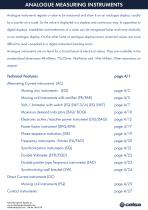
ANALOGUE MEASURING INSTRUMENTS Analogue instruments register a value to be measured and show it on an analogue display, usually by a pointer on a scale. So the value is displayed in a stepless and continuous way. In opposition to digital displays, instabilities and tendencies of a value can be recognized faster and more intuitively on an analogue display. On the other hand at analogue displays exact numerical values are more difficult to read compared to a digital instrument (reading error). Analogue instruments are on hand for a broad band of electrical values. They are available in the standardized...
Open the catalog to page 2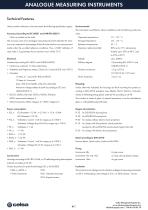
ANALOGUE MEASURING INSTRUMENTS Technical Features Unless another indication in the instrument, the following specification apply: Environmental This instrument is suitable for indoor installations with the following characte- Accuracy (according to IEC 60051 and UNE-EN 60051) Class: as marked on the scale Operation temperature: The accuracy class of an analogue measuring instrument indicates the maxi- Storage temperature: mun error expresed in percentage of the full-scale value for any measurement Reference temperature: made under the so-called reference conditions. Thus, a 500V voltmeter of...
Open the catalog to page 3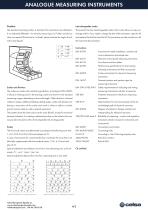
ANALOGUE MEASURING INSTRUMENTS Interchangeable scales The standard mounting position is standard. The instruments are calibrated - The product line has interchangeable scales. Such scales allows an easy ex- if not indicated differently - for vertical purpose (pos.2). If other mountin po- change and fix. If you need to change the dial of the instrument, open the lid sitios are required (horizontal or inclined), please indicate the angle of incli- and replace the dial the close the lid. This procedure must be carried out with cut-out dimensions and sample size DIN 43701 Electrical control panel...
Open the catalog to page 4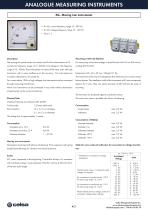
ANALOGUE MEASURING INSTRUMENTS EQ - Moving iron instruments • For AC current frequency range 15 - 400 Hz • For AC voltages frequecny range 15 - 100 Hz • Class 1.5 Description The moving-iron panel meters are mainly used for the measurement of AC For measuring current and voltage in panel boards with 35 mm DIN rail ac- currents for frequency range of 15...400Hz and voltages in the frequency range of 15...100Hz. They indicate the rms value of the wave, even with high harmonics, with a minor ininfluence on the accuracy. Our instruments are normally calibrated for sinusoidal AC. The instruments of...
Open the catalog to page 5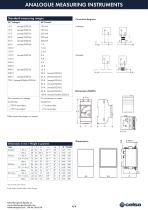
ANALOGUE MEASURING INSTRUMENTS Standard measuring ranges Connection diagrams 25 A (except EQ35n) 30 A (except EQ35n) 40 A (except EQ35n) 50 A (except EQ35n) 60 A (except EQ35n) 100 A (except EQ48n/EQ35n) For connection to voltage Other measuring ranges on request. *26 mm with screw clamps Fixing clamps included without extra charge Celsa Messgerate España S.L. www.celsamessgerate-spain.com [email protected] / +34 96 130 93 78 Dimensions in mm / Weight in gramme
Open the catalog to page 6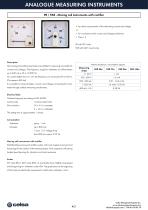
ANALOGUE MEASURING INSTRUMENTS PR / PAR - Moving coil instruments with rectifier • For direct measurement of the alternating current and voltage or • For connection at the current and voltage transformer • Class 1.5 PR with 90º scale PAR with 240º round scale Description The moving-coil rectifier panel meter are suitable for measuring sinusoidal AC currents and voltages. The frequency range for voltmeters an milliammeters up to 600 mA is 25 to 10.000 Hz. For current higher than 1A - 5A, the frequency can not exceed 50 or 60 Hz. (On request: 400 Hz). It is possible to measure higher currents and...
Open the catalog to page 7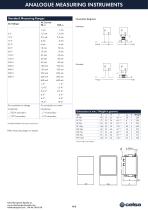
ANALOGUE MEASURING INSTRUMENTS Standard Measuring Ranges AC Voltage Connection diagrams Dimensions in mm / Weight in gramme Typ PR 48n PR 72n PR 96n PR 144n PAR 48n PAR 72n PAR 96n PAR 144n *At PR48n/PAR48n with external transformers Other measuring ranges on request. *26 mm with screw clamps Celsa Messgerate España S.L. www.celsamessgerate-spain.com [email protected] / +34 96 130 93 78
Open the catalog to page 8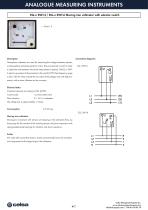
ANALOGUE MEASURING INSTRUMENTS EQ..n SWT-3 / EQ..n SWT-6 Moving iron voltmeter with selector switch Connection diagrams Three-phase voltmeters are used for measuring the voltages between phases, or phase-phase and phase-neutral in a line. They incorporate a switch in order to select the wires between which the measurement is desired. The EQ..n SWT3 also has a position of disconnection in the switch (OFF). Their frequency range is 25 to 100 Hz. They indicate the rms value of the voltage, even with high harmonics, with a minor influence on the accuracy. Electrical data Overload capacity according...
Open the catalog to page 9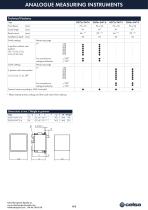
ANALOGUE MEASURING INSTRUMENTS Technical Features EQ72n SWT-6 Front frame Scale length Panel cut-out Installatiom depth (mm) Switch settings Switch settings 3 position with zero position For connection to voltage transformer L1-L3, L2-L3, L1-L2, OFF For connection to voltage transformer Terminal cover according to VGB 4 included * Please indicate primary voltage and final scale value when ordering Dimensions in mm / Weight in gramme a b c d e 72 - 53 68 68 +0,7 96 - 53 68 92 +0,8 Measuring range Celsa Messgerate España S.L. www.celsamessgerate-spain.com [email protected] / +34 96 130 93 78
Open the catalog to page 10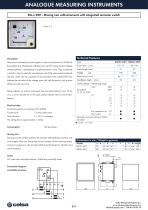
ANALOGUE MEASURING INSTRUMENTS EQ..n SWT - Moving iron voltinstruments with integrated ammeter switch Technical Features They are an ammeter for measuring the current in each phase of a 50-60 Hz three-phase line. Three-phase voltmeters are used for measuring the voltages between phases, or phase-phase and phase-neutral in a line. They incorporate a switch in order to select the wires between which the measurement is desired. The EQ..n SWT also has a position of disconnection in the switch (OFF). They indicate the rms value of the voltage, even with high harmonics, with a minor Installation depth...
Open the catalog to page 11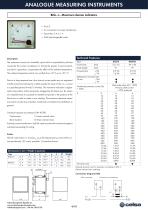
ANALOGUE MEASURING INSTRUMENTS BIQ...n - Maximum deman indicators • Class 3 • For connection to current transformers • Secondary 5 A or 1 A • With interchangeable scale Technical Features Description The movement consists of a bimetallic spiral which is expanded by the heat caused by the current circulating in it, driving the pointer. A second spiral, mounted in opposition, compensates the effect of the ambient temperature. The ambient temperature which can oscillate from -10°C up to +55 °C. Due to its long response time, shor interval current peaks are not registered and the instrument indicates...
Open the catalog to page 12All CELSA MESSGERATE ESPAÑA S.L. catalogs and technical brochures
 02-Digital instruments
11 Pages
 CATALOGUE CELSA MESSGERATE ESPAÑA SL
166 Pages
 10-Accesories
5 Pages
 06-Shunts
5 Pages
 07-Transducers
21 Pages
 03-Counters
5 Pages
 05-Current Transformers
59 Pages
 09-LED
15 Pages


- Dry transformer
- Digital indicator
- Panel panel meter
- IEC transformer
- Multipole switch
- Digital gauge
- Multimeter
- Industrial transformer
- Digital multimeter
- Low-voltage transformer
- Rotary electric switch
- Industrial measuring module
- Portable multimeter
- Instrument transformer
- Power meter
- Analog indicator
- Industrial multimeter