
- Catalogs
- CEC Vibration Products
- Vibration Transducer 4-128

Vibration Transducer 4-128

Vibration Transducer 4-128
- Aircraft Engines
- Industrial Turbines
- Test Cells
- Self-generated, high-level, low impedance output
- Operates up to +700°F
- Weighs only 2 ounces
The CEC 4-128 Vibration Transducer is designed for turbine applications, particularly in high-temperature environments where other transducers may fail. It offers a simplified system with low impedance and high-level output, eliminating the need for special amplifiers. The transducer is lightweight and adaptable to various mounting configurations, making it suitable for space-limited applications.
Technical Specifications- Sensitivity: Varies by model, refer to Table 1
- Dynamic Range: Frequency 45 Hz to 1500 Hz, Amplitude 0.10 inch peak-to-peak, Acceleration 0.5 g to 50 g
- Frequency Response: ±6% of mean sensitivity
- Temperature Range: -65°F to +700°F
- Weight: 2.0 oz nominal
The transducer uses a seismic magnet moving on precision bearings, with a coil attached to the case. Movement between the magnet and coil generates the output signal, proportional to velocity. The system is air-damped and operates above its natural frequency.
Ordering InformationWhen ordering, specify the type number and any optional cable and connector assemblies. Mating connectors and cable assemblies are not included and must be ordered separately.
Approvals- North America: CSA C/US Class I, Division I & II, Groups A, B, C, and D
- European: ATEX EEx ia IIB or IIC T6 - T1, EEx nA II T6 - T1 X
Catalog excerpts
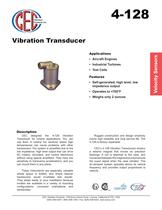
4-128 Applications • Aircraft Engines • Industrial Turbines • Test Cells Features • Self-generated, high level, low impedence output • Operates to +700°F • Weighs only 2 ounces Description CEC designed the 4-128 Vibration Transducer for turbine applications. You can use them in turbine hot sections where high temperatures can cause problems with other transducers. The system is simplified due to the low impedence, high level output that can drive AC meters, recorders, and control electronics without using special amplifiers. They have low sensitivity to transverse accelerations, and you can mount them in any plane. These instruments are especially valuable where space is limited, and where heavier transducers would invalidate test results. They adapt easily to your installation because models are available in a variety of mounting configurations, connector orientations and sensitivities. Rugged construction and design simplicity insure high reliability and long service life. The 4-128 is factory repairable. CEC’s 4-128 Vibration Transducers employ a seismic magnet that moves on precision bearings. A coil is attached to the case, and movement between the magnet and coil produces the ouput signal when the case vibrates. This air-damped system operates above its natural frequency and provides output proportional to velocity. CEC Vibration Products • 746 Arrow Grand Circle • Covina, California 91722 • USA (626) 938-0200 • (800) 468-1345 • Fax: (626) 938-0202 www.cecvp.com ISO 9001:2000 AS9100 Certified Velocity Sensors Vibration Transducer
Open the catalog to page 1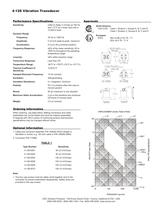
4-128 Vibration Transducer Performance Specifications Sensitivity: Approvals (refer to Table 1) mV/ips at 100 Hz and +77°F at 2 in/sec (ips) into a 10,000 Ω load. North America CSA C/US Class I, Division I, Groups A, B, C and D Class I, Division 2, Groups A, B, C and D Frequency: 45 Hz to 1500 Hz Amplitude: 0.10 inch peak-to-peak, maximum European ATEX EEx ia IIB or IIC T6 - T1 EEx nA II T6 - T1 X Acceleration: 0.5 g to 50 g (vertical position) Dynamic Range Frequency Response: ±6% of the mean sensitivity, 45 to 1500 Hz throughout the operating temperature range Linearity: ±6% within dynamic...
Open the catalog to page 2All CEC Vibration Products catalogs and technical brochures
 4-130-0128
2 Pages
 1-117
1-1172 Pages
 6800 series
2 Pages
 1-809
1-8092 Pages
 1-830
1-8302 Pages
 Vibration Transducer 4-138
2 Pages
 Vibration Transducer 4-131
2 Pages
 Vibration Transducer 4-125
2 Pages
 Vibration Transducer 4-123
2 Pages
 Vibration Transducer 4-118
2 Pages
 Strain Gage Accelerometer
2 Pages
 Vibration Sensor/Transmitter
2 Pages
 Accelerometer, Top Exit
2 Pages
 Piezoelectric Accelerometer
2 Pages
 REMOTE CHARGE AMPLIFIER
2 Pages
 Portable Vibration Meter
2 Pages
 Precision Signal Source
2 Pages
 Vibration Switch
2 Pages
 Vibration Transmitter
2 Pages


