
- Catalogs
- CEC Vibration Products
- 4-130-0128

4-130-0128

4-130-0128
- Aircraft Turbines Engines
- Test Cells
- Civil & Military Aircraft Ground Support
- New bearing materials provide exceptional service life
- Self-generated, high level, low impedance output
- CEC’s smallest velocity sensor
The CEC Vibration Products introduces the 4-130-0128, a self-generating, low impedance, velocity output vibration transducer. It is designed for turbine applications where temperature and noise can affect other sensors. The transducer can be mounted in tight spaces to ensure accurate engine vibration analysis. It simplifies analysis systems by providing a high-level AC mV output that does not require special pre-amplifiers or costly low-noise cables.
- Sensitivity: 100 mV/in/sec ±3%
- Dynamic Range:
- Frequency: 35Hz to 2000Hz
- Amplitude: 0.10 inch peak-to-peak, maximum
- Acceleration: 0.3g to 50g, mounted vertically; 1.0g to 50g, mounted horizontally
- Frequency Response:
- Vertically Mounted: 35 to 45Hz, ±10% max; 45 to 2,000Hz, ±6% max
- Other: 35 to 2,000Hz, ±10% max
- Linearity:
- Vertically Mounted: 35 to 2,000Hz, ±8% max
- Other: 35 to 2,000Hz, ±10% max
- Transverse Sensitivity: 2% maximum
- Temperature Range:
- Operating: -65°F to +500°F (-54°C to +260°C)
- Error: ±0.02%/°F from reference +77°F
- Excitation: Self-generating
- Insulation Resistance: 0.1 megaohm minimum @ +500°F
- Shock: 50g’s maximum in any direction
- Sealing Method: Unit is of welded construction
- Weight: 2.7 oz
- Mounting: 1/4-28 stud
Specify Type 4-130-0128 when ordering. Specifications may change without notice due to product improvement policies.
- North America: CSA C/US Class I, Division I, Groups A, B, C and D; Class I, Division 2, Groups A, B, C and D
- European: ATEX EEx ia IIB or IIC T6 - T1; EEx nA II T6 - T1 X
Catalog excerpts

4-130-0128 Applications • Aircraft Turbines Engines • Test Cells • Civil & Military Aircraft Ground Support Features • New bearing materials provide exceptional service life • Self-generated, high level, low impedance output • CEC’s smallest velocity sensor CEC Vibration Products is proud to present the newest addition to the very successful 4-130 family of self- generating, low impedence, velocity output vibration transducers. CEC velocity transducers simplify your analysis system because low impedence, high level AC mV output does not require special preamplifiers or costly low-noise cables. Designed for use on turbine applications where temperature and noise can cause other sensors to malfunction, the 4-130-0128 can be mounted in tight-fit locations to assure that only actual engine vibrations are transmitted for analysis. The 4-130-0128 velocity transducer provides a direct calibrated AC mV/inch/sec output that can be transmitted via standard cable uninterrupted to the monitoring systems. CEC Vibration Products • 746 Arrow Grand Circle • Covina, California 91722 • USA (626) 938-0200 • (800) 468-1345 • Fax: (626) 938-0202 www.cecvp.com Rev. 13182 • Velocity Sensors Vibration Transducer
Open the catalog to page 1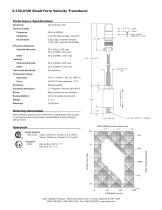
4-130-0128 Small Form Velocity Transducer Performance Specifications Sensitivity: Dynamic Range Frequency: 0.10 inch peak-to-peak, maximum 0.3g to 50g, mounted vertically 1.0g to 50g, mounted horizontally Frequency Response Vertically Mounted: Linearity: Vertically Mounted: Transverse Sensitivity: Temperature Range Operating: Insulation Resistance: Sealing Method: Unit is of welded construction Ordering Information When ordering, specify Type 4-130-0128. In keeping with CEC’s policy of continuing product improvement, specifications may be changed without notice. Approvals North America CSA C/US...
Open the catalog to page 2All CEC Vibration Products catalogs and technical brochures
 1-117
1-1172 Pages
 6800 series
2 Pages
 1-809
1-8092 Pages
 1-830
1-8302 Pages
 Vibration Transducer 4-138
2 Pages
 Vibration Transducer 4-131
2 Pages
 Vibration Transducer 4-128
2 Pages
 Vibration Transducer 4-125
2 Pages
 Vibration Transducer 4-123
2 Pages
 Vibration Transducer 4-118
2 Pages
 Strain Gage Accelerometer
2 Pages
 Vibration Sensor/Transmitter
2 Pages
 Accelerometer, Top Exit
2 Pages
 Piezoelectric Accelerometer
2 Pages
 REMOTE CHARGE AMPLIFIER
2 Pages
 Portable Vibration Meter
2 Pages
 Precision Signal Source
2 Pages
 Vibration Switch
2 Pages
 Vibration Transmitter
2 Pages


