

LINEAR HEAT DETECTOR CABLES - HDC

LINEAR HEAT DETECTOR CABLES - HDC
The document provides technical specifications and applications for Cavicel's Linear Heat Detector Cables (HDC), which are designed for fire detection and alarm systems. These cables are compliant with EN 54-28 standards and are suitable for various industrial applications.
Specifications
The HDC cables are continuous heat detectors that detect heat along their entire length. They consist of two copper-covered steel wires insulated with a thermosensitive polymer. When the rated temperature is reached, the insulation melts, causing a short circuit that triggers an alarm. The cables are available in four temperature alarm levels: 68°C, 88°C, 105°C, and 138°C. Key specifications include:
- Outer sheath colors: Red, White, Black, Blue
- Conductor: Copper-covered steel wire, diameter 0.95 mm
- Insulation: Special thermosensitive polymer
- Outer diameter: 4.5 mm
- Weight: 25 kg/km
- Max ambient temperature: 40°C
- Voltage rating: 100 V d.c.
- Conductor resistance: 300 Ω/km at 20°C
- Dielectric test: 500 V ac for 1 minute
- Water and oil sheath resistance: Good
- Flame propagation: IEC 60332-1/VW1/FT1
- Fire reaction: CPR Eca - EN 13501-6
- RoHS II 2011/65/EU and CE 2014/35/EU compliant
Features and Benefits
The HDC cables offer several advantages, including ease of installation and maintenance, fast substitution of shorted circuit cable sectors, suitability for dangerous or difficult-to-access areas, short response times, minimal false alarms, and simple integration with fire extinguishing systems.
Applications
The cables are suitable for a wide range of applications, including:
- Pipelines
- Storage Tanks
- Cable Trays
- Aircraft Hangars
- Control Rooms
- Warehouses
- Bridges and Tunnels
- Mines
- Cooling Towers
- Escalators
Contact Information
Headquarters and factory are located in Pioltello, Italy, with additional offices in Dubai and Hong Kong. Contact details are provided for each location.
Conclusion
Cavicel's HDC cables are reliable and economical tools for monitoring abnormal heat increases, often a preliminary stage of a fire event. They are designed to meet international safety standards and are suitable for various industrial environments.
Catalog excerpts
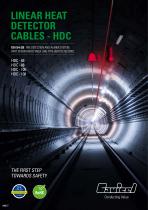
LINEAR HEAT DETECTOR CABLES - HDC EN 54-28 FIRE DETECTION AND ALARM SYSTEM. PART 28 NON-RESETTABLE LINE-TYPE HEAT DETECTORS. THE FIRST STEP TOWARDS SAFETY CPR COMPLIANT Construction Products Regulation Conducting Value
Open the catalog to page 1
Pipelines Storage Tanks Cable Trays Aircraft Hangars Control Rooms Warehouses Bridges and Tunnels Mines Cooling Towers Escalators The HDC sensor cable detects heat anywhere along its length: it is a continuous heat detector unlike the standard point detector. The HDC sensor cable is composed by two copper covered steel wires, individually insulated with a thermosensitive polymer. At the rated temperature the polymer insulation melts, thus permitting the conductors to short-circuit and generate an alarm signal. Four temperature alarm levels are available: 68 °C, 88 °C, 105 °C and 138 °C. Ease...
Open the catalog to page 2All Cavicel catalogs and technical brochures
 FIRECEL SR 114H
1 Page
 HIGH VALUE CABLES
8 Pages
 CONDUCTING VALUE
29 Pages
 FIRECEL SR 114 - 109/15
10 Pages
 FIRECEL SR 104 - 110/1
2 Pages


- Electrical cable
- Copper cable
- Copper electrical cable
- Power cable
- Insulated cable
- Insulated electrical cable
- Multi-strand cable
- Multi-wire electrical cable
- Industrial cable
- Optical cable
- Flame-retardant cable
- Optical data cable
- Single-conductor cable
- Solid electrical cable
- Distribution cable
- IEC optical cable
- Copper optical cable
- Multimode optical cable
- Category 5e cable
- Flame-retardant optical cable