

FIRECEL GENERAL CATALOGUE - 100/8a

FIRECEL GENERAL CATALOGUE - 100/8a
Cavicel is a company specializing in the design and manufacture of fire-resistant cables, focusing on environmentally friendly products that comply with EU RoHS and REACH regulations. With over 30 years of experience, Cavicel develops cables that maintain circuit integrity during fires while reducing toxic gas emissions and smoke.
The fire-resistant cables are designed to maintain circuit integrity during fires, essential for systems like fire alarms and emergency lighting. They are flame retardant, preventing fire spread, and feature low smoke emission and halogen-free materials to minimize toxic gas production.
Cavicel conducts rigorous testing to ensure compliance with standards such as BS 6387, BS EN 50200, BS 8434-2, BS 8491:2008, and IEC 60331. These tests assess fire resistance, circuit integrity under fire, mechanical shocks, and water spray resistance at high temperatures.
Tests measure hydrochloric acid emission and gas corrosivity to ensure low harmful emissions. Smoke density tests ensure light transmittance remains above 60% or 80% during a fire.
Fire-resistant cables use LSZH (Low Smoke Zero Halogen) materials for sheathing to prevent toxic gas emissions. Armouring options include galvanized steel for mechanical protection. Insulation materials like ceramified silicone-rubber and mica-glass tape ensure integrity during fires.
The document details specifications for various fire-resistant cables, including solid and stranded conductors with different cross-sectional areas. The cables meet standards such as BS 7629-1, BS 6387, and BS EN 50200, ensuring fire resistance, flame retardancy, and low smoke emission.
FIRECEL cables are intended for fire detection and alarm systems, emergency lighting, and voice communication systems, suitable for environments where fire resistance and system integrity are critical.
The cables comply with international standards, including BS 5839-1, BS 5266-1, and BS 8519, and are approved by LPCB and BASEC for specific applications.
The cables operate within a temperature range of -40°C to +90°C, with varying minimum bending radii depending on armouring.
Electrical characteristics such as capacitance and inductance/resistance ratios are provided for different cross-sectional areas, ensuring performance criteria for data and voice transmission during a fire.
The document includes specifications for fibre optic cables, detailing tube diameter, outer diameter, and weight for various fibre counts. These cables are suitable for safety systems, critical connections, and outdoor installations in offshore, oil & gas, and marine applications.
Cavicel's fire-resistant cables are engineered to provide reliable performance in critical safety applications, adhering to stringent international standards to ensure minimal risk in fire-prone environments.
Catalog excerpts

Conducting Value The Last Cable Standing
Open the catalog to page 1
CORPORATE VIDEO MANAGEMENT SYSTEMS Our commitment to environmentally friendly products. CAVICEL is committed to providing our customers with environmentally friendly products in compliance with the European Union (EU) RoHS Directive (Restriction of Hazardous Substances) and REACH Regulation (Registration, Evaluation, Authorization and Restriction of Chemicals).
Open the catalog to page 2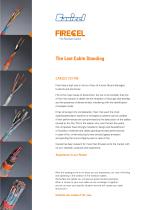
Fire Resistant Cables The Last Cable Standing CABLES VS FIRE Fires have a high cost in terms of loss of human life and damages to plants and structures. Fire is the major cause of destruction, but we must consider that one of the main causes of death are the inhalation of toxic gas that develop and the presence of dense smoke, interfering with the identification of escape routes. It has to be kept into consideration, then, that even the most sophisticated alarm systems or emergency systems can be useless if their performances are compromised by the destruction of the cables caused by the fire....
Open the catalog to page 3
Fire Performance CABLES HAVE TO BE PROPERLY DESIGNED, MANUFACTURED AND ALSO TESTED. The tests are part of R&D, an extremely strategic activity for a Company and this is the reason why CAVICEL has invested in this field. You can find here the main tests concerning the behaviour of cables under fire conditions, and our main test equipments. It is important to verify all required performances and give the customers the full compliance to the requirements. CAVICEL is proud of its own laboratories and customers are always welcome to visit them.
Open the catalog to page 5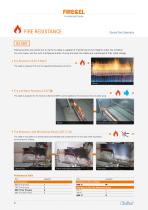
Fire Resistant Cables FIRE RESISTANCE Cavicel Fire Laboratory BS 6387 Following tests are carried out to verify if a cable is capable of maintaining circuit integrity under fire condition, fire with water, and fire with mechanical shocks. During the tests the cables are maintained at their rated voltage. ► Fire Resistance (CAT. A B C S) The cable is exposed to fire at the specified temperature and time. ► Fire and Water Resistance (CAT. W) The cable is exposed for 15 minutes to flame at 650°C and for additional 15 minutes to fire and water spray. ► Fire Resistance with Mechanical Shocks (CAT....
Open the catalog to page 6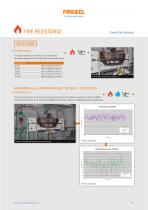
Fire Resistant Cables FIRE RESISTANCE Cavicel Fire Laboratory BS EN 50200 Fire Resistance This test is carried out to verify the circuit integrity of cables exposed to fire at 830°C and mechanical shocks. CLASSIFICATION PH 15 Flame and mechanical shock BS EN 50200 annex E (STANDARD CABLE - BS 5839-1 - CLAUSE 26.2D) Fire Resistance This test is carried out to verify circuit integrity during a fire. The cable is exposed to a flame at 830°C and mechanical shocks for 15 minutes and additional 15 minutes to flame, mechanical shocks and water spray. Temperature graph - BS EN 50200 900 800 Temperature...
Open the catalog to page 7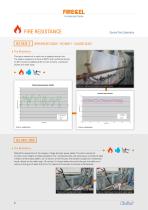
Fire Resistant Cables Cavicel Fire Laboratory (ENHANCED CABLE - BS 5839-1 - CLAUSE 26.2E) Fire Resistance This test is carried out to verify circuit integrity during a fire. The cable is exposed to a flame at 930°C and mechanical shocks for 60 minutes and additional 60 minutes to flame, mechanical shocks and water spray. Difference between temperature - BS 8434-2 Flame, mechanical shock and water spray Delta Temperature Limit down Limit down Limit up Flame calibration Time ( hours ) Time ( hours ) Flame calibration BS 8491:2008 Fire Resistance Method for assessment of fire integrity of large...
Open the catalog to page 8
Fire Resistant Cables FIRE RESISTANCE Cavicel Fire Laboratory CLASSIFICATION CEI 20-36/2-1 - IEC 60331-21 - Electrical cables up to 0,6/1 kV CEI 20-36/2-3 - IEC 60331-23 - Data cables CEI 20-36/2-5 - IEC 60331-25 - Fibre optic cables COPPER CABLE FIBER CABLE Flame After test Cavicel, Conducting Value
Open the catalog to page 9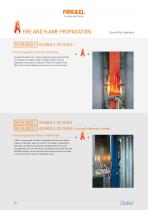
Fire Resistant Cables FIRE AND FLAME PROPAGATION Cavicel Fire Laboratory BS EN 60332-3 IEC 60332-3, CEI 20-22/3 Fire propagation test on bunched cables Samples of cables 3,5 m long in quantities required by standard are installed on a ladder inside a metallic cabinet. They are subjected to the action of a flame at 750°C for a specific time (20 or 40 minutes). Cables must not burn for more than 2,5 m. BS EN 60332-1 IEC 60332-1, CEI 20-35/1 BS EN 60332-2 IEC 60332-2, CEI 20-35/2, for small diameter cables Flame Propagation Test on a Single Cable A 60 cm long sample of cable is vertically fixed...
Open the catalog to page 10
Fire Resistant Cables GAS EMISSION Cavicel Fire Laboratory Each non metallic material of the cable (—1.0 g) is burnt into a tube furnace up to 800 °C. A controlled air flow rate absorbs the generated gases in a appropriate solution. The tritation of the solution allows to determine the developed hydrochloric acid (HCl) amount. BS EN 60754-2 IEC 60754-2, CEI 20-37/2-2 ► Gas Corrosivity This test allows estimation of corrosiveness against metals of gases released when cables burn. Materials composing the cable are burnt into a tubular oven with temperature higher than 935 °C. A controlled air flow...
Open the catalog to page 11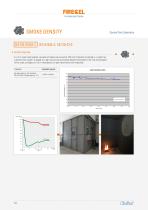
Fire Resistant Cables SMOKE DENSITY Cavicel Fire Laboratory BS EN 61034-2 IEC 61034-2, CEI 20-37/3 ► Smoke Density In a 3 m cube metal cabinet, samples of cables are burned by 100 cm3 of alcohol contained in a metal tray. A photometric system is based on a light source and a photocell placed horizontally in the mid vertical plane of the cube, at height of 2.15 m. Absorbance or light transmission are measured. REQUIRED VALUES Time ( hours )
Open the catalog to page 12
Fire Resistant Cables FIRE RESISTANT CABLES
Open the catalog to page 13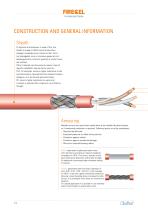
CONSTRUCTION AND GENERAL INFORMATION Sheath To optimize the behaviour in case of fire, the sheath is made of LSZH (Lows Smoke Zero Halogen) materials since, thanks to that, fire is not propagated, toxic or corrosive gases are not developed and a minimum quantity of white fumes are emitted. Other materials can obviously be used in case of specific installation requirements, such as: PVC, for example, where a higher resistance to oils and chemicals is required (but this material contains halogens, so it emits acid gas and smoke). PE, when a higher resistance to water and moisture is required (this...
Open the catalog to page 14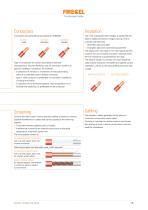
Conductors Conductors can generally be according to EN 60228: CLASS 1 CLASS 2 CLASS 5 solid stranded flexible Type of conductors are chosen according to electrical characteristics, required flexibility, type of connection systems or specific installation conditions, for example: in presence of vibration or movement or reduced bending radius it is preferable class 5 flexible conductor, • class 1 solid conductor is preferable for permanent installation, crimping termination, • in presence of corrosive atmosphere, high temperature or to facilitate the soldering it is preferable tinned conductor....
Open the catalog to page 15All Cavicel catalogs and technical brochures
 FIRECEL SR 114H
1 Page
 HIGH VALUE CABLES
8 Pages
 CONDUCTING VALUE
29 Pages
 FIRECEL SR 114 - 109/15
10 Pages
 FIRECEL SR 104 - 110/1
2 Pages


- Copper electrical cable
- Power cable
- Insulated cable
- Insulated electrical cable
- Multi-strand cable
- Multi-wire electrical cable
- Industrial cable
- Optical cable
- Flame-retardant cable
- Optical data cable
- Single-conductor cable
- Solid electrical cable
- Distribution cable
- IEC optical cable
- Copper optical cable
- Multimode optical cable
- Category 5e cable
- Flame-retardant optical cable