
- Catalogs
- Caterpillar Global Mining
- Armored Face Conveyors (AFCs)


- Products
- Catalogs
- News & Trends
- Exhibitions
Armored Face Conveyors (AFCs)

Armored Face Conveyors (AFCs)
Caterpillar's Armored Face Conveyors (AFCs) are recognized for their advanced technology and reliability, playing a crucial role in high-capacity mining since the 1940s. They are utilized in eight of the world's ten most productive mines, highlighting their efficiency.
Specifications and Performance
AFC systems are engineered for high-capacity operations, with capabilities of handling faces up to 470 meters and producing up to 5,000 tonnes per hour. The PF range, including PF3 to PF6, caters to varying capacity needs, with PF6 managing up to 5,000 tonnes per hour.
Engineering and Design
Components like shearer haulage systems, drive frames, and gearboxes are designed for durability and efficiency, ensuring easy maintenance and long service life. The systems are optimized for seam undulations and high torque handling.
Drive Systems
Drive modules are easily replaceable and available in various sizes to meet power requirements. The GR sprocket design enhances power transmission and longevity, while tensionable tail drives maintain optimal chain tension.
Chains and PowerChain
Caterpillar's chains, including the PowerChain, are designed for high performance and low wear, with the largest size accommodating up to 1,800 kW power.
Entry Conveyors and Belt Tailpieces
These components are designed to match AFC capacity, preventing bottlenecks, and include automated chain tensioning adaptable to various belt dimensions.
Line Pans
Made from rolled steel, line pans reduce friction and wear. The PF6 line pan combines rolled and cast designs with replaceable parts for durability.
Conclusion
Caterpillar's AFC systems are built to meet modern mining demands, offering high capacity, durability, and efficiency, making them a reliable choice for longwall mining operations.
By 2011, over 15,000 PF6 line pans were manufactured, attributed to their innovative design.
Separation of Wear and Structural Parts
The PF6 design uses wear-resistant materials for wear parts and high-strength steel for structural parts, allowing easy replacement and extended service life.
Optimized Contact Surfaces
The PF6's bottom race design nearly doubles the contact surface, reducing wear and noise.
Maximum Pan Stability
The frame's construction ensures high stability and effective force transmission, accommodating high lateral forces.
Customization
PF6 components are customizable to meet specific requirements, ensuring optimal performance.
Rolled Steel Surfaces and Robot Welding
Smooth surfaces and robot welding minimize friction and power loss, extending the substructure's service life significantly.
For more information, visit Caterpillar's website.
Catalog excerpts
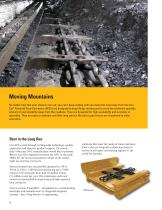
Moving Mountains No matter how fast your shearer can cut, you can’t keep cutting until you move the coal away from the face. Cat® Armored Face Conveyors (AFCs) are designed to keep things moving and to carry the maximum possible amount of coal smoothly away from the coalface. They are designed for high availability and economy in operation. They are easy to maintain and offer long service life and a great return on investment to mine operators. Best in the Long Run Cat AFCs excel through cutting-edge technology, quality, experience and superior product support. Of course, that’s what any AFC...
Open the catalog to page 2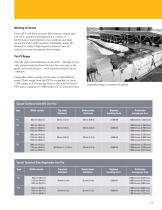
Meeting all Needs From AFC tail drive to entry belt conveyor return end, Cat AFC systems are designed for a variety of performance requirements in low, medium and high seams, for short and long faces. Caterpillar meets the demand of today’s high-capacity shearers and, of course, our own automated plow systems. The PF Range The line pan is the backbone of the AFC– literally. It not only conveys material from the face, but also acts as the guide rail for the shearer – with traction forces of up to 1 000 kN. Caterpillar offers a range of line pans to suit different needs. These range from the PF3...
Open the catalog to page 3
Engineered to Perfection There are many parts to an Armored Face Conveyor: shearer haulage system, drives, drive frames and sprockets, gearboxes, line pans, chain conveyors as well as entry conveyors and belt tailpieces. Each of these components has to be engineered to perfection, but also has to work together optimally with the other parts of the system. 3D-Simulation of a shearer on a Cat PF6 face conveyor at the head end under extreme bending Cat AFC components achieve this. Each is designed for powerful, reliable and economical operation with low maintenance over a long service life, promoting...
Open the catalog to page 4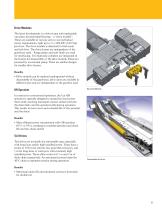
Drive Modules The latest development is a drive frame with replaceable one-piece sprocket/shaft/bearing – a “drive module”. These are available in various sizes to suit individual power requirements, right up to 2 x 1 800 kW (2,412 hp) per drive. The drive module is identical for both main and tail drive. The drive frames are independent of the gearboxes used – flange plates and stub shafts are used for interfacing. Two hydraulic cylinders are integrated in the frames for disassembly of the drive module. These are powered by an external pump. There are similar designs for smaller drive frames....
Open the catalog to page 5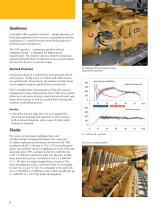
Gearboxes Caterpillar offers gearbox solutions – simple planetary or bevel-spur gearboxes for low-power requirements and the installation of a clutch between motor and gearbox for medium-power installations. The UEL gearbox – a planetary gearbox with an integrated clutch – is designed for higher-power requirements. This friction clutch is closed through face support hydraulic fluid. A hydraulic control system allows the clutch to be set to a certain torque. Overload Protection Overload protection is achieved by measuring the slip of each gearbox. In the event of a chain stall, both motors are...
Open the catalog to page 6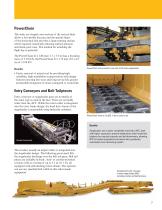
PowerChain The wide, arc-shaped cross-section of the vertical links allows a low-profile line pan and the special shape of the horizontal link provides a large running surface where required, drastically reducing surface pressure and chain-joint wear. The method for attaching the flight bar is patented. The PowerChain 42 x 140 mm (1.7 x 5.5 in) has a breaking force of 2 370 kN, the PowerChain 52 x 175 mm (2.0 x 6.9 in) of 3 610 kN. Benefits PowerChain and sprocket in use with a Cat beam stageloader •• Faster removal of mined coal by providing highreliability, high-availability transportation...
Open the catalog to page 7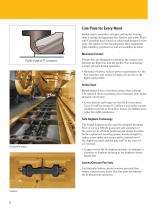
Line Pans for Every Need Rolled steel is smoother, stronger and harder-wearing than a casting and generates less friction and noise. That’s why Caterpillar has focused on rolled steel designs for line pans. All aspects of the line pans have been engineered with reliability, productivity and serviceability in mind. Maximum Contact Profile shape of PF conveyors The profiles are designed to maximize the contact area between the flight bar and the profile, thus minimizing contact pressure during operation. •• inimizes friction, reduces power requirements for the M face conveyor and results in longer...
Open the catalog to page 8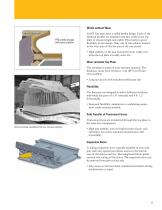
Welds without Wear PF5 profile design with wear pattern Cat PF line pans have a rolled profile design. Each of the identical profiles are attached with two welds to the top plate of chosen length and width. This results in great flexibility in pan design. Only one of the welds is located in the wear area of the line pan in the top strand. •• High stability of the pan ensured by three welds even when the top plate is totally worn out Wear-resistant Top Plate The top plate is made of wear-resistant material. The thickness varies from 30 mm (1.2 in) (PF3) to 50 mm (2.0 in) (PF5). •• Long service...
Open the catalog to page 9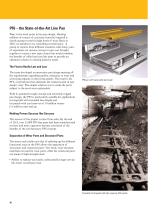
PF6 – the State-of-the-Art Line Pan Wear is the weak point in line pan design. Hauling millions of tonnes of coal away from the longwall is clearly going to result in high levels of wear. Back in 2002, we decided to try something revolutionary. A group of experts from different countries with many years of experience on various conveyor types was brought together to create a new type of pan that would combine the benefits of rolled and cast line pans to provide an optimum solution to mining industry needs. The First to Really Last and Last The team developed an innovative pan design meeting all...
Open the catalog to page 10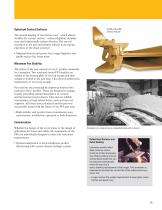
Optimized Contact Surfaces Profile of the PF6 shearer line pan The special shaping of the bottom race – which almost doubles the contact surface – reduces flightbar shoulder wear and substantially reduces friction. The curved transition at the pan ends greatly reduces noise during operation of the chain conveyor. •• Minimal friction and power loss, longer flightbar and profile service life, lower noise Maximum Pan Stability The frame of the pan consists of two C profiles connected by a baseplate. Two tried-and-tested PF5 profiles are welded to the bottom plate of the top trough and then welded...
Open the catalog to page 11All Caterpillar Global Mining catalogs and technical brochures
 D9 DOZER
20 Pages
 745
74528 Pages
 725C2
725C228 Pages
 Cat ® 621K
4 Pages
 D9T
D9T20 Pages
 D8T
D8T20 Pages
 735B Articulated Truck
20 Pages
 725 Articulated Truck
20 Pages
 777D
777D28 Pages
 775G
775G32 Pages
 773E
773E24 Pages
 772G
772G28 Pages
 772
77232 Pages
 770
77032 Pages
 16M
16M24 Pages
 14M
14M28 Pages
 795F AC
24 Pages
 793D
793D32 Pages
 789D
789D28 Pages
 789C
789C28 Pages
 HW300
HW30016 Pages
 785D
785D24 Pages
 AEXQ1170 ShovelsBrochure
32 Pages
 D11T/D11T CD
28 Pages
 D10T
D10T20 Pages
 MD6240 Rotary Drill
28 Pages
 Cat ® Rock Flow System
2 Pages
 LHD Vehicles Product Line
8 Pages
 Mining Truck (797F)
28 Pages
 Motor Grader (16M)
24 Pages
 Off-Highway Truck (773G)
32 Pages
 Off-Highway Truck (777G)
36 Pages
 Open Bowl Scraper (627G)
24 Pages
 Open Bowl Scraper (627H)
20 Pages
 Open Bowl Scraper (623H)
20 Pages
 Open Bowl Scraper (631G)
24 Pages
 Open Bowl Scraper (621H)
20 Pages
 Open Bowl Scraper (657G)
24 Pages
 Longwall Mining Equipment
12 Pages
 LHD Vehicles
8 Pages
 CTS Drive Systems
8 Pages
 Cat® Trucks: The ONE for Mining
28 Pages
 Belt Systems - Underground
12 Pages
 Longwall Automation
12 Pages
 Cat® track drills MD5150
28 Pages
 Electric Rope Shovels 7182
3 Pages
 Cat® track drills MD5125
4 Pages
 Cat® track drills MD5050 T
4 Pages
 Cat® track drills MD5090
4 Pages
 Cat® track drills MD5075
4 Pages
 Electric Rope Shovels 7295
3 Pages
 Electric Rope Shovels 7395
3 Pages
 Cat® track drills MD5050
4 Pages
 Cat® Rotary drills MD6750
4 Pages
 Cat® Rotary drills MD6640
4 Pages
 Electric Rope Shovels 7495
3 Pages
 Cat® 8750 DRAGLINE RANGE
28 Pages
 Master Idler
399 Pages
 Cat® 8200 DRAGLINE RANGE
2 Pages
 Cat® 8200-127 Dragline
2 Pages
 Cat® 8200-126 Dragline
2 Pages
 Cat® 8200-125 Dragline
2 Pages
 Cat® 8200-124 Dragline
2 Pages
 Cat® 8200-123 Dragline
2 Pages
 Cat® 8200-113 Dragline
2 Pages
 740B EJ articulated track
24 Pages
 740B articulated track
20 Pages
 730 ejector articulated track
20 Pages
 730 articulated track
20 Pages
 Feeder Breakers
4 Pages
 Belt Systems & Belt Products
8 Pages


Archived catalogs
 Draglines
8 Pages
 988H Wheel Loader
24 Pages
 844H Wheel Dozer
20 Pages
 Scoops
8 Pages
 Face Haulers
12 Pages
 Continuous Miners
8 Pages
 Longwall Shearers
16 Pages
 Roof Support Carriers
12 Pages
 Roof Support Systems
8 Pages
 Automated Plow Systems
12 Pages
 Jumbo Drills
12 Pages
 Rotary Blasthole Drills
8 Pages
 Hydraulic Track Drills
8 Pages
 Hydraulic Shovels
12 Pages
 Highwall Mining System
8 Pages
 Electric Rope Shovels
12 Pages
 Surface Belt Structure
8 Pages
- Crane
- Mobile crane
- Drilling rig
- Cat excavator
- Cat diesel excavator
- Lifting crane
- Rotary drilling rig
- Cat crawler excavator
- Construction boom excavator
- Construction crane
- Mobile drilling rig
- Boom crane
- Cat loader
- Crawler drilling rig
- Cat rubber-tired loader
- Medium boom excavator
- Road roller
- Truck
- Cat compact excavator
- Cat mini-excavator