

EXPANSION VALVES FOR REFRIGERATING SYSTEMS

EXPANSION VALVES FOR REFRIGERATING SYSTEMS
- Calculate pressure drop: Δptot = 9.76 bar.
- Determine valve capacity: ΔTsub = 15°C, Fsub = 0.83, Qsub = 2.324 kW.
- Application correction: Fev = 1.25, Qev = 2.91 kW.
- Select orifice size: Use capacity table for R404A with a pressure drop of 9.76 bar and evaporating temperature of -5°C to select orifice 04.
Catalog excerpts
EXPANSION VALVES FOR REFRIGERATING SYSTEMS FROM QUALITY OUR NATURAL DEVELOPMENT Achieved the goal of fty years working in the industry of Refrigeration and Air Conditioning, Castel Quality Range of Products is well known and highly appreciated all over the world. Quality is the main issue of our Company and it has a special priority, in every step, all along the production cycle. UNI EN ISO 9001:2008, issued by ICIM, certies the Quality System of the Factory. Moreover Castel Products count a number of certications in conformity with EEC Directives and with European and American Quality Approval. We produce on high tech machinery and updated automatic production lines, operating in conformity with the safety and environment standards currently enforced. Castel oers to the Refrigeration and Air Conditioning Market and to the Manufacturers fully tested products suitable with HCFC and HFC Refrigerants currently used in the Refrigeration & Air Conditioning Industry. Expansion valves 1
Open the catalog to page 1
Expansion valves
Open the catalog to page 2
INDEX THERMOSTATIC EXPANSION VALVES SERIES 22 PWM SOLENOID EXPANSION VALVES EXTERNAL LEAKAGE All the products illustrated in this Handbook are submitted, one by one, to tightness tests besides to functional tests. Allowable external leakage, measurable during the test, agrees to the denition given in Par. 9.4 of EN 12284 : 2003 Standard: “During the test, no bubbles shall form over a period of at least one minute when the specimen is immersed in water with low surface tension, …”. PRESSURE CONTAINMENT All the products illustrated in this Handbook, if submitted to hydrostatic test, guarantee a...
Open the catalog to page 3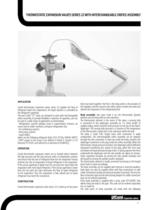
THERMOSTATIC EXPANSION VALVES SERIES 22 WITH INTERCHANGEABLE ORIFICE ASSEMBLY APPLICATION Castel thermostatic expansion valves series 22 regulate the ow of refrigerant liquid into evaporators; the liquid injection is controlled by the refrigerant superheat. e new Castel “22” series are designed to work with interchangeable orice assembly, to provide exibility in selection of capacities, and can be used in a wide range of applications as listed below: - Refrigeration systems (display cases in supermarkets, freezers, ice cream and ice maker machines, transport refrigeration etc). - Air conditioning...
Open the catalog to page 5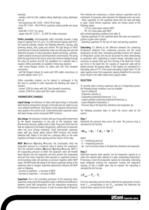
materials: - stainless steel for bulb, capillary tubing, diaphragm casing, diaphragm and rod - hot forged brass EN 12420 – CW 617N for body - brass EN 12164 – CW 614N for superheat setting spindle and spring holder - steel DIN 17223-1 for spring - copper tube EN 12735-1 – Cu DHP for solder connection Orice assembly: interchangeable orice assembly provides a wide range of capacity from 0,5 up to 15,5 kW (nominal capacity with R22). e external cartridge contains the following elements: housing, plug (metering device), seat, spring and strainer. e rigid design of orice assembly and its internal...
Open the catalog to page 7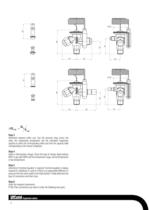
40 43 35 66 42 Ø 39 42 29 40 Q sub Qe Fsub Step 3 Determine required orice size. Use the pressure drop across the valve, the evaporating temperature and the calculated evaporator capacity to select the corresponding orice size from the capacity table corresponding to the chosen refrigerant. Step 4 Select a thermostatic charge. Chose the type of charge, liquid without MOP or gas with MOP, and the temperature range, normal temperature or low temperature. Step 5 Determine if external equalizer is required. External equalizer is always required if a distributor is used or if there is an appreciable...
Open the catalog to page 8
- Body assembly (see tabs 1a/1b) - Orice assembly, completed with strainer (see tab 2) If ODS connections you have to order the following three parts: - Body assembly (see tabs 1a/1b) - Orice assembly, completed with strainer (see tab 2) - Solder adapter (see tab. 3) SIZING EXAMPLE - Type of refrigerant R134a - Evaporator capacity, Qe 6 kW - Evaporating temperature/pressure, Te - 10 °C - Lowest possible condensing temperature/pressure, Tc +30 °C - Liquid refrigerant temperature, Tl + 20 °C - Pressure drop in the liquid line, distributor and evaporator, Δp 1,5 bar Table 2: Orice Assemblies - Rated...
Open the catalog to page 9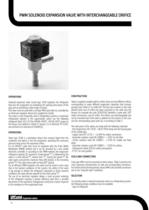
PWM SOLENOID EXPANSION VALVE WITH INTERCHANGEABLE ORIFICE OPERATIONS CONSTRUCTION Solenoid expansion valve Castel type 2028 regulates the refrigerant ow into the evaporator by modulating the opening time phase of the plug and so permitting a wide range of power. is valve must be used with a coil type HM4 (see table 2), controlled by an electronic regulator device (not supplied by Castel). is valve is most frequently used in refrigeration systems, in particular refrigerated cabinets in the supermarket, which use the following refrigerant uids: R22, R134a, R404A, R407C ; R410A, R507 proper to the...
Open the catalog to page 14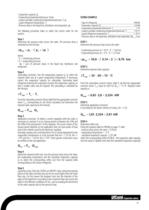
- Evaporating temperature/pressure, Te/pe - Lowest possible condensing temperature/pressure, Tc/pc - Liquid refrigerant temperature, T, - Pressure drop in the liquid line, distributor and evaporator, Ap The following procedure helps to select the correct valve for the Determine the pressure drop across the valve. The pressure drop is - Ap = sum of pressure drops in the liquid line, distributor and Subcooling correction. Use the evaporating capacity Qe to select the required valve size at a given evaporating temperature. If necessary, correct the evaporator capacity for subcooling. Subcooling...
Open the catalog to page 15All CASTEL catalogs and technical brochures
 CASTEL - 2013 General Catalogue
105 Pages
 VALVES FOR REFRIGERATING SYSTEMS
34 Pages
 REFRIGERATING SYSTEMS PROTECTORS
38 Pages
 OIL CONTROL SYSTEM
22 Pages
 PRODUCTS FOR CO2 SYSTEMS
7 Pages
 Products catalogue
101 Pages


Archived catalogs
 Expansion valves
16 Pages
 Solenoid valves
18 Pages
 Safety devices
16 Pages
 Check valves
6 Pages
 Water regulating valves
6 Pages
 Dehydrators and Filters
28 Pages
 Oil separators
6 Pages
 Valves
20 Pages
 Threaded brass fittings
10 Pages
 Products Catalogue 2008
84 Pages
