

Hose

Hose
Standard Series Fittings for Flexible Hoses with External Peeling:
1. Cut the hose to the desired length using a disc cutter and clean the edges.
2. Remove the external cover to the specified length without damaging the metal reinforcement.
3. Insert the sleeve to cover the exposed hose section.
4. Insert the fitting stem until it contacts the sleeve.
5. Press the sleeve using clamps as per pressing tables.
6. Check the fitting hole collapse with appropriate tools; hoses outside tolerance are unusable.
Series Interlock Fittings for Flexible Hoses with External and Internal Peeling:
1. Follow similar steps as the standard series, with additional internal substrate removal.
2. Ensure no damage to the metal reinforcement and remove machining residues.
3. Check fitting hole collapse; non-compliant hoses must be remade.
Tightening Torques:
Tables provide torque values for various fittings, including light and heavy series, and different thread types. Values are indicative and may vary based on materials and tolerances.
Installation Prescriptions According to DIN 20066:
1. Avoid axial torques and ensure no tensile stress beyond hose weight.
2. Maintain minimum bending radius and use elbow fittings if necessary.
3. Protect hoses from external damage and ensure proper assembly position.
4. For moving parts, calculate hose length to maintain bending radius and avoid tensile stress.
Length and Orientation of Assembled Hoses:
1. Measure hose length at connection ends for straight fittings; consider interaxes for elbows.
2. Account for potential length changes under pressure.
3. Determine fitting orientation for correct assembly, considering observer's position.
Tolerances:
Length and orientation tolerances are specified for hoses assembled according to DIN 20066.
Catalog excerpts

CHOICE OF FLEXIBLE HOSE SIZE The graph below can be used for the correct choice of the flexible hose. It lets you calculate the tube dimension according to the flow value and speed of the fluid. To find out the dimension of the right hose, draw a straight line connecting the known values of flow and speed. The intersection of this line on the middle of the picture determines the value of the diameter of the hose to be chosen. In case the value found does not correspond with one of the diameters DN indicated, the highest value must be chosen. Use the speeds suggested for intake and return pressure...
Open the catalog to page 2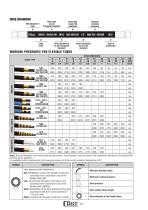
Hose type Hose type Nominal Manufacturer’s as per as per US working logo European standard standard pressure Code hose Hose dimension as per European standard Hose dimension as per US standard
Open the catalog to page 3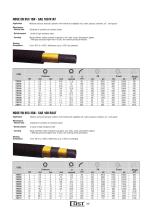
Application Manufacture: - Internal tube - Reinforcement - Covering Working temperature Medium pressure hydraulic systems with mineral and vegetable oils, water, aqueous solutions, air*, inert gases*. Substrate of synthetic oil resistant rubber. 1 braid of high resistance steel. Black synthetic rubber resistant to abrasion, oils, fuels, ozone, atmospheric agents. * With gas pressures higher than 15 bars, the covering needs perforation. from -40°C to +100°C, differences up to +120°C are tolerated. HOSE EN 853 2SN - SAE 100 R2AT Application Manufacture: - Internal tube - Reinforcement - Covering...
Open the catalog to page 4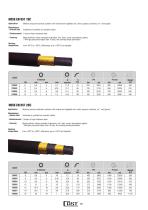
Application Manufacture: - Internal tube - Reinforcement - Covering Medium pressure hydraulic systems with mineral and vegetable oils, water, aqueous solutions, air*, inert gases*. Substrate of synthetic oil resistant rubber. 1 braid of high resistance steel. Black synthetic rubber resistant to abrasion, oils, fuels, ozone, atmospheric agents. * With gas pressures higher than 15 bars, the covering needs perforation. Working temperature from -40°C to +100°C, differences up to +120°C are tolerated. HOSE EN 857 2SC Application Manufacture: - Internal tube - Reinforcement - Covering Medium pressure...
Open the catalog to page 5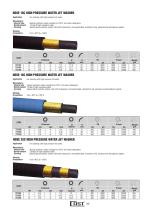
Manufacture: - Internal tube - Reinforcement - Covering For cleaning with high pressure hot water. Special synthetic rubber resistant to 150°C, hot water, detergents. 1 braid of high resistance steel. Special black synthetic rubber with cloth impression, microperforated, resistant to oils, abrasion and atmospheric agents. Application For cleaning with high pressure hot water. Manufacture: - Internal tube Special synthetic rubber resistant to 150°C, hot water, detergents. - Reinforcement 1 braid of high resistance steel. - Covering Special black synthetic rubber with cloth impression, microperforated,...
Open the catalog to page 6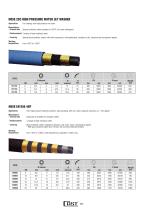
Application For cleaning with high pressure hot water. Manufacture: - Internal tube Special synthetic rubber resistant to 150°C, hot water, detergents. - Reinforcement 2 braids of high resistance steel. - Covering Special black synthetic rubber with cloth impression, microperforated, resistant to oils, abrasion and atmospheric agents. Working temperature from -40°C to +150°C HOSE EN 856 4SP Application Manufacture: - Internal tube - Reinforcement - Covering Working temperature Very high pressure hydraulic systems, also pulsating, with oils, water, aqueous solutions, air*, inert gases*. Substrate...
Open the catalog to page 7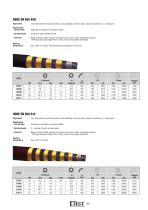
Application Manufacture: - Internal tube - Reinforcement - Covering Working temperature Very high pressure hydraulic systems, also pulsating, with oils, water, aqueous solutions, air*, inert gases*. Substrate of synthetic oil resistant rubber. 4 spirals of high resistance steel. Black synthetic rubber resistant to abrasion, oils, fuels, ozone, atmospheric agents. * With gas pressures higher than 15 bars, the covering needs perforation. from -40°C to +100°C, with discontinuous operation +120°C max. HOSE EN 856 R13 Application Manufacture: - Internal tube - Reinforcement - Covering Working temperature...
Open the catalog to page 8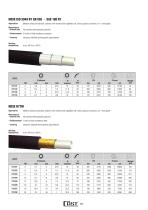
Application Manufacture: - Internal tube - Reinforcement - Covering Medium pressure hydraulic systems with mineral and vegetable oils, water, aqueous solutions, air*, inert gases*. Oil resistant thermoplastic polymer. 2 braids of high resistance polyester. abrasion resistant thermoplastic polyurethane. Working temperature from -40°C to +100°C. HOSE R7TM Application Manufacture: - Internal tube - Reinforcement - Covering Medium pressure hydraulic systems with mineral and vegetable oils, water, aqueous solutions, air*, inert gases*. Oil resistant thermoplastic polymer. 1 braid of high resistance...
Open the catalog to page 9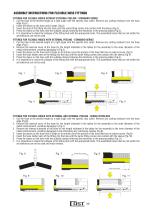
ASSEMBLY INSTRUCTIONS FOR FLEXIBLE HOSE FITTINGS FITTINGS FOR FLEXIBLE HOSES WITHOUT EXTERNAL PEELING - STANDARD SERIES 1. Cut the hose at the desired length at a right angle with the specific disc cutter. Remove any cutting residues from the hose edge (Fig.1). 2. Insert the sleeve on the hose until it stops (Fig.3). 3. Insert the stud of the fitting into the hose until the same fitting comes into contact with the sleeve (Fig.4). 4. Press the sleeve on the hose with the suitable clamps following the directions in the pressing tables (Fig.5). 5. It is imperative to check the collapse of the fitting...
Open the catalog to page 10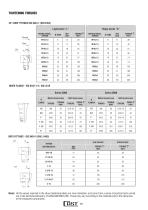
Notes: All the values reported in the above tightening tables are mere indication, and come from a series of practical tests carried out in the technical laboratory of CASALGRASSO (CN). These may vary according to the materials and to the tolerances of the employed components.
Open the catalog to page 11
THREAD UNF/UN BSPP THREAD Notes: All the values reported in the above tightening tables are mere indication, and come from a series of practical tests carried out in the technical laboratory of CASALGRASSO (CN). These may vary according to the materials and to the tolerances of the employed components.
Open the catalog to page 12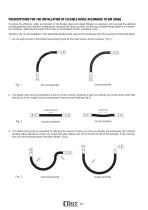
PRESCRIPTIONS FOR THE INSTALLATION OF FLEXIBLE HOSES ACCORDING TO DIN 20066 To ensure the efficiency, safety and duration of the flexible hoses and related fittings it is necessary not to exceed the admitted working pressures and maximum temperatures, assemble the hoses correctly, use the most suitable fittings based on the assembly conditions, determine the length of the hoses in consideration of their movement, if any. Therefore, the correct installation of the assembled flexible hoses requires the compliance with the prescriptions described below. 1. Do not apply torques to the flexible hoses...
Open the catalog to page 13All CAST spa catalogs and technical brochures


- Piping
- Hydraulic fitting
- Screw-in fitting
- Metal fitting
- Stainless fitting
- Neoprene® hose
- Abrasion-resistant hose
- Water hose
- Poppet fitting
- Chemical product hose
- Oil-resistant hose
- Hydraulic hose
- Hose for high-pressure applications
- Pneumatic flexible piping
- Oil hose
- Synthetic rubber hose
- Fitting with O-ring
- Gas hose
- High-pressure fitting