

B3-B4

B3-B4
1. Ensure the tube does not rotate with the nut during tightening; proper elasticity is indicated by the ring's ability to rotate post pre-assembly. Indentation should cover 80% of the cutting ring front side.
2. For thin wall tubes, especially mild or RILSAN, use suitable reinforcement before tightening and assess working pressure carefully.
3. Align tube and fitting before assembly; fittings should not correct misalignment or support tubes. Use supports for long or stressed tubes to prevent vibrations.
4. Proper lubrication is essential; use mineral oils or anti-seizing compounds for carbon and stainless steel fittings.
5. Fittings and valves are for fluid-dynamic connections only; mixing carbon and stainless steel components is prohibited.
1. Use high-quality tubes for carbon steel fittings: calibrated, seamless, cold drawn, and threaded tubes with a maximum hardness of 75 HRB.
2. Pre-assemble tubes over 10 mm diameter using specific machines or hardened blocks; oil threads, nuts, and rings.
3. For stainless steel fittings, use calibrated, polished, cold drawn seamless tubes with a maximum hardness of 85 HRB; pre-assemble using specific machines or hardened blocks.
1. Quality Assurance System complies with UNI EN ISO 9001:2008; product homologation obtained from various registers.
2. Metrology and testing labs ensure quality and safety control; static and dynamic tests up to 4000 bars are conducted.
3. Component testing includes dimensional checks, tightness, and fatigue tests; certificates of tests can be issued upon request.
1. Safety factor is 4:1 for static load and specified temperatures; for stud couplings with metal seals, the factor is 2.5:1.
2. Product guarantee applies only if full connection is made with company products.
1. Steels used are of high quality, purchased from leading European steelworks.
2. Allowed temperatures: Carbon Steel -40°C to +120°C, Stainless Steel -60°C to +200°C.
3. Pressure reductions apply for stainless steel fittings based on temperature.
4. Gaskets and o-rings are made of NBR or VITON®, with specific hardness and temperature ranges.
5. Surface treatments for carbon steel include zinc plating and FINIGARD 460 top coat for corrosion resistance.
6. Stainless steel fittings undergo chemical cleaning and heat treatment for surface hardening.
1. Anti-pollution measures are in place to prevent contamination during production.
2. Lubrication of stainless steel threads is crucial to avoid problems during assembly.
3. Anti-seizing compounds (Nickel Basis) are used to protect threads and facilitate assembly.
The document provides detailed specifications for various threaded connections, including UNF, UN, BSPT, NPT, and NPTF threads, with dimensions, pressure capacities, and sealing characteristics for each type.
Performance metrics such as pressure capacity, sealing characteristics, and safety factors are outlined for different sealing types, including straight and swivel seals, with a safety factor of 4:1 for excellent sealing and 2.5:1 for low-medium sealing.
Detailed assembly instructions are provided according to DIN 3859-2 standards, including ensuring tool compliance, proper tube cutting, lubrication, and pre-assembly checks to ensure safety and functionality.
Guidelines for the installation of rigid tubes in oleo-dynamic systems emphasize the use of high-quality materials, correct alignment, and adherence to pressure and temperature limits.
The document describes the operation and technical characteristics of Cast S.p.A. non-return valves, including their use in various fluid systems and the importance of maintaining nominal working pressures for effective sealing.
Liability is discussed in terms of compliance with manufacturer instructions and the legal implications of negligence or product alteration.
General guidelines emphasize the importance of using compatible components, adhering to assembly instructions, and maintaining system integrity to prevent accidents and ensure product functionality.
The document provides specifications for tightening torques on swivel cones and fittings according to DIN standards, including tables with torque values in Newton Meters (Nm) for various metric threads and tube sizes, applicable to both carbon and stainless steel materials.
- Assembly Instructions for Swivel Cone Series DIN 2353: Steps include checking tool parameters, cleaning and lubricating components, aligning parts, and tightening to metal contact. Repeated assembly does not affect functionality.
- Assembly Instructions for Adjustable Fittings: Instructions for ISO 6149 metric threads and other thread types include lubricating the o-ring, positioning the back-up sleeve, and securing the hexagonal nut.
The document references DIN 2353, DIN 3861, and DIN 3865 standards for fittings and sealing systems, emphasizing high pressure, tightness, and low torque requirements.
For optimal sealing, the document suggests using the "B4" cutting ring for a double sealing system, combining metal and elastomeric sealing.
The tables provide torque values for different series and tube sizes, with specific values for both L and S series. The "BP" cutting ring specifications are also detailed, including working pressure and dimensions.
The document discusses the "Finished Elements Method" for structural calculations, highlighting its use in mechanical engineering to analyze strain and deformation.
Catalog excerpts

CARBON STEEL AND STAINLESS STEEL PRODUCT
Open the catalog to page 1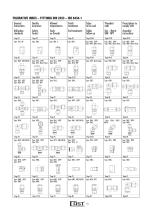
FIGURATIVE INDEX – FITTINGS DIN 2353 – ISO 8434-1 General instructions Quality assurance Allowed temperatures Finish treatments Threaded ends Prescriptions to comply with Utilisation standards Safety factors Assembly instructions Type: 1015.. BSPP Type: 1013.. BSPP Type: 1014.. Metric Paral. Type: 1016.. Page 25-26 Type: 1003.. BSPP Type: 1004.. Metric Paral. Type: 1005.. BSPP Type: 1007.. BSPP Type: 1006.. Metric Paral. Type: 1008.. Metric Paral. Type: 1017.. BSPT Type: 1018.. NPT Type: 1019.. Metric Taper Type: 1021.. NPT Type: 1022.. Metric Taper Type: 1025.. BSPT Type: 1026.. NPT Type: 1030.....
Open the catalog to page 2
FIGURATIVE INDEX – FITTINGS DIN 2353 – ISO 8434-1 Type: 6043.. BSPP Type: 6044.. Metric Paral. Type: 6047.. BSPP Type: 6048.. Metric Paral. Type: 6051.. BSPP Type: 6053.. . Type: 6052.. Metric Paral. Type: 5002.. BSPP Type: 5004.. BSPP Type: 5003.. Metric Paral. Type: 5005.. Metric Paral. Type: 5006.. BSPT Type: 5007.. NPT Type: 5008.. BSPT Type: 5009.. NPT Compatible fluids table Page 352-356 ASSEMBLY TOOLS DIN 2353 - ISO 8434-1 PREASSEMBLY MACHINE Ordering Machine MANDREL MACHINE PLATFORM MACHINE MANUAL PREASSEMBLY TOOL Ordering Mandrel Ordering Platform Ordering Preassembly
Open the catalog to page 3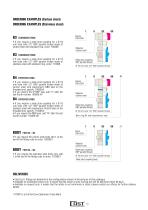
ORDERING EXAMPLES (Carbon steel) ORDERING EXAMPLES (Stainless steel) 1 Standard Ring • If you require a male stud coupling for a Ø 18 mm tube with 1/2” BSP parallel thread made of carbon steel with standard ring, order: 100309 Standard Lo B3tato dell’Arte for a Ø 18 S you require aRing stud coupling • If male mm tube with 1/2” BSP parallel thread made of stainless steel with standard ring, order: 110309 Material carbon steel Male stud coupling BSP parallel thread Ø 18 mm tube 1/2” BSP parallel thread Patented Ring • If you require a male stud coupling for a Ø 18 mm tube with 1/2” BSP parallel...
Open the catalog to page 4
Prodotto in ACCIAIO AL CARBONIO CARBON STEEL AND STAINLESS STEEL PRODUCT STANDARD DOUBLE CUTTING EDGE RING ASSEMBLED ON e in ACCIAIO INOssidabile ALL CAST PRODUCTION TO ASSURE SEALING AND SAFETY. AVAILABLE IN CARBON AND STAINLESS STEEL
Open the catalog to page 5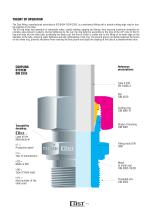
THEORY OF OPERATION The Cast fitting, manufactured according to ISO 8434-1/DIN 2353, is a mechanical fitting with a double cutting edge ring for double stapling on the tube. The B3 ring helps fast assembly of removable tubes, avoids welding, tapping and flaring, thus assuring maximum simplicity for complex oleo-dynamic systems. During tightening by the nut, the ring deforms according to the bore of the 24° cone of the fitting and bites into the steel tube, producing two deep cuts, the first of which is visible due to the lifting of an outer edge on the diameter of the tube, ensuring water tightness...
Open the catalog to page 6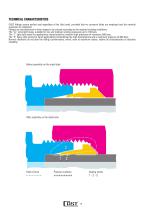
TECHNICAL CHARACTERISTICS CAST fittings assure perfect seal regardless of the fluid used, provided that no corrosive fluids are employed and the nominal pressures be respected. Fittings are manufactured in three ranges to be chosen according to the required working conditions. The “LL” extra light range, suitable for low and medium working pressures up to 100 bars. The “L” light duty series for applications characterised by medium high pressures of maximum 500 bars. The “S” heavy duty series for harsh applications characterised by high temperatures and a maximum pressure of 800 bars. Normal vibrations...
Open the catalog to page 7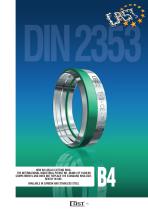
NEW SIX-SEALS CUTTING RING. THE INTERNATIONAL INDUSTRIAL PATENT NR. 864061 OF 10/03/99 COMPLEMENTS AND DOES NOT REPLACE THE STANDARD RING CURRENTLY IN USE. AVAILABLE IN CARBON AND STAINLESS STEEL
Open the catalog to page 8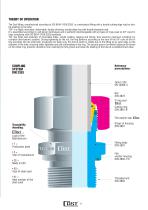
THEORY OF OPERATION The Cast fitting, manufactured according to ISO 8434-1/DIN 2353, is a mechanical fitting with a double cutting edge ring for double stapling on the tube. “B4” is a highly innovative, deformable, double clinching, double edge ring with double elastomer seal. It is assembled according to well-known techniques and is perfectly interchangeable with all types of rings used on 24° cone fittings complying with ISO 8434-1/DIN 2353 standards. The ring helps fast assembly of removable tubes, avoids welding, tapping and flaring, thus assuring maximum simplicity for complex oleo-dynamic...
Open the catalog to page 9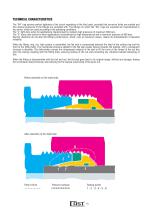
TECHNICAL CHARACTERISTICS The “B4” ring assures perfect tightness of the circuit regardless of the fluid used, provided that corrosive fluids are avoided and the nominal pressures of the fittings are complied with. The fittings on which the “B4” rings are mounted are manufactured in two series, which are used according to the operating conditions. The “L” light duty series for applications characterised by medium high pressures of maximum 500 bars. The “S” heavy duty series for harsh applications characterised by high temperatures and a maximum pressure of 800 bars. Normal vibrations do not alter...
Open the catalog to page 10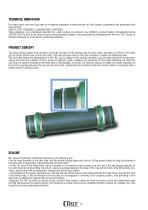
TECHNICAL INNOVATION For many years now there has been an increasing imperative market demand for fluid system components that guarantee three main factors: SAFETY, EASY ASSEMBLY, LEAKAGE-FREE TIGHTNESS. These elements, now considered essential for a safe working environment (Law 626/94), product liability (Presidential Decree 224-EEC 85/374) and for the entire environmental protection system, have promoted the development of the new “B4” ring as an effective response to all the above-mentioned problems. PRODUCT CONCEPT The most original aspect of the product is that the structure of the existing...
Open the catalog to page 11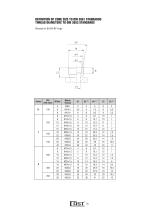
DEFINITION OF CONE SIZE TO DIN 3861 STANDARDS THREAD DIAMETERS TO DIN 3853 STANDARDS Allowed for B3-B4-BP rings
Open the catalog to page 12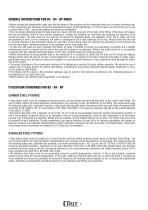
GENERAL INSTRUCTIONS FOR B3 - B4 - BP RINGS • Before starting the preassembly make sure that the pierce of the machine and the hardened blocks are in perfect working order. Further inspections are necessary during the preassembly (every 30-50 tightenings). For this purpose we recommend you to use a control buffer 1000… pierce and replace any block out of tolerance. • Over the whole tightening phase the tube must be in touch with the inner part of the body of the fitting. If this does not happen, the ring will advance with the tube without indenting it, making the coupling not functional and requiring...
Open the catalog to page 13All CAST spa catalogs and technical brochures


- Piping
- Hydraulic fitting
- Screw-in fitting
- Metal fitting
- Neoprene® hose
- Abrasion-resistant hose
- Water hose
- Poppet fitting
- Chemical product hose
- Oil-resistant hose
- Hydraulic hose
- Pneumatic flexible piping
- Hose for high-pressure applications
- Oil hose
- Synthetic rubber hose
- Fitting with O-ring
- Gas hose
- High-pressure fitting