
- Catalogs
- Cassel Messtechnik
- METAL SHARK FL Product Catalogue

METAL SHARK FL Product Catalogue

1 / 2 PagesView full catalog
METAL SHARK FL Product Catalogue
Product catalog summary
Overview
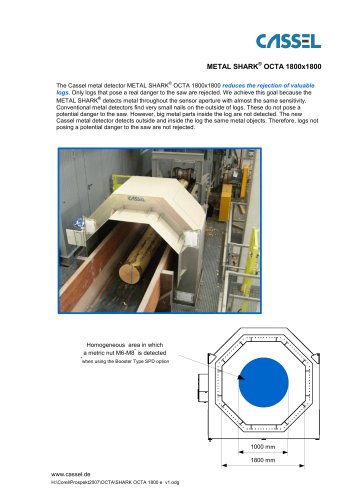
The METAL SHARK® FL is a high-performance metal detector designed for use in industrial environments such as fleece, textile, and foil production. It is capable of detecting both magnetic and non-magnetic metals with high sensitivity and accuracy.
Design and Construction
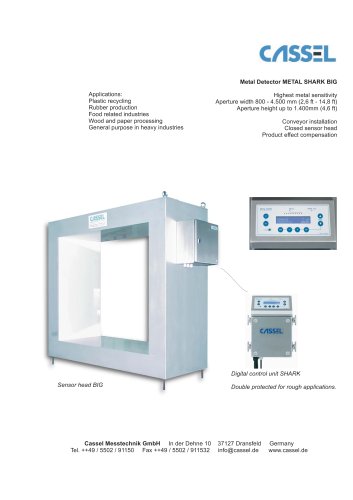
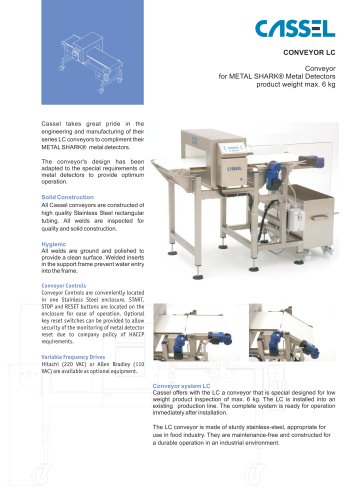
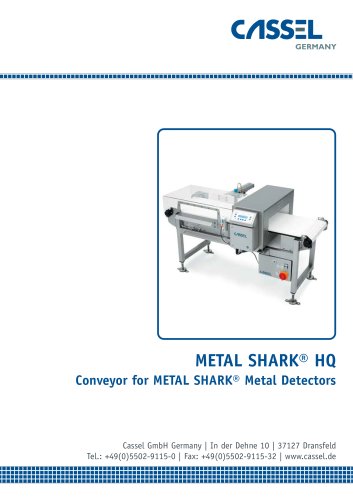
The device features a robust industrial design with sensor and control unit housings made from stainless steel, suitable for food industry applications. It is maintenance-free and built for reliable operation in challenging conditions.
Technology and Features
The METAL SHARK® utilizes advanced four-channel DDS (Direct Digital Synthesizer) and DSP (Digital Signal Processor) technology, providing excellent product-effect compensation and stability. Key features include:
Power and Diagnostics
The device operates on a wide power supply range (85-265 V AC) and includes automatic diagnostics to display functional defects.
User Interface and Operation
The METAL SHARK® is designed for user-friendliness with an intuitive interface. The software guides users through necessary adjustments, and the display shows only essential information. Performance validation is automated, prompting regular checks as per HACCP standards.
Specifications
Installation and Configuration
The METAL SHARK® can be installed below or above the conveyed material, with a metal-free zone required before and after the detector. It supports a wide range of conveyor speeds and includes a teach mode for automatic product effect compensation.
The METAL SHARK® FL is a high-performance metal detector designed for use in industrial environments such as fleece, textile, and foil production. It is capable of detecting both magnetic and non-magnetic metals with high sensitivity and accuracy.
Design and Construction
The device features a robust industrial design with sensor and control unit housings made from stainless steel, suitable for food industry applications. It is maintenance-free and built for reliable operation in challenging conditions.
Technology and Features
The METAL SHARK® utilizes advanced four-channel DDS (Direct Digital Synthesizer) and DSP (Digital Signal Processor) technology, providing excellent product-effect compensation and stability. Key features include:
- Digital balance control to mitigate temperature and humidity effects.
- Auto calibration for easy setup.
- Digital frequency and phase control to prevent drifts.
- Digital noise filters to eliminate unwanted signals.
- Multi-channel technology for detecting all metal types.
Power and Diagnostics
The device operates on a wide power supply range (85-265 V AC) and includes automatic diagnostics to display functional defects.
User Interface and Operation
The METAL SHARK® is designed for user-friendliness with an intuitive interface. The software guides users through necessary adjustments, and the display shows only essential information. Performance validation is automated, prompting regular checks as per HACCP standards.
Specifications
- Sensing width: 200 - 4000 mm
- Ferrous ball detection: Varies with height above sensor
- Installation: Typically horizontal, adaptable to various angles
- Metal-free zone requirements: Fixed metal = 250 mm, Moving metal = 500 mm
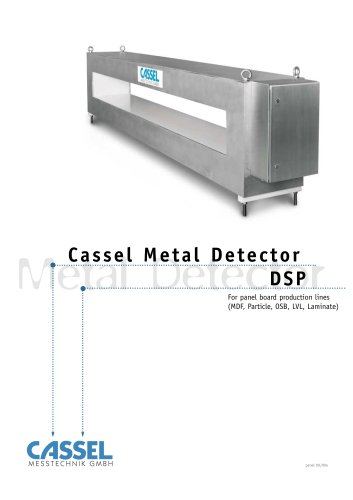
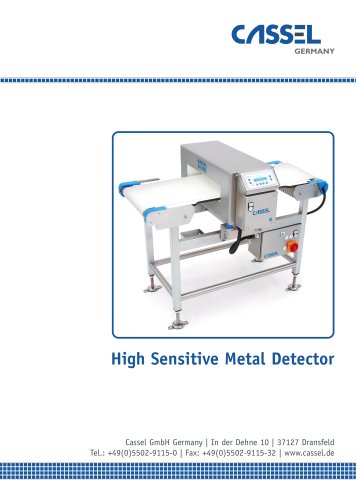
- Applications: Suitable for plastic/foil, panel board, and felt/textile/fleece production
- Power input: 100 Watts
- Temperature range: Ambient -10 to +50°C, Product -20 to +80°C
- Protection: Control unit IP65, Sensor IP67
- Conveyor speed: 25 - 3000 mm/sec
Installation and Configuration
The METAL SHARK® can be installed below or above the conveyed material, with a metal-free zone required before and after the detector. It supports a wide range of conveyor speeds and includes a teach mode for automatic product effect compensation.
See more
All Cassel Messtechnik catalogs and technical brochures
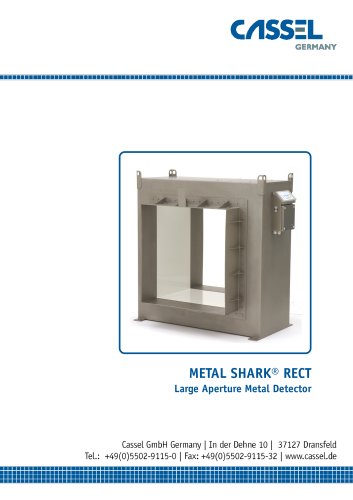 SHARK® RECT
2 Pages
 SHARK® OCTA
2 Pages
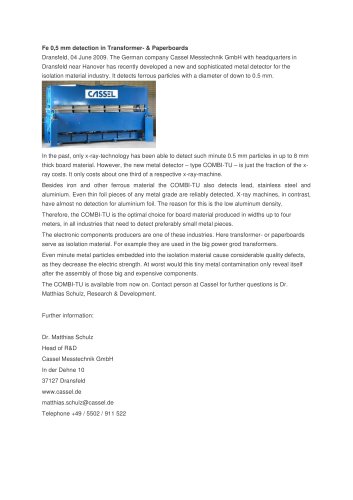 SHARK® COMBI-TU
1 Page
Archived catalogs
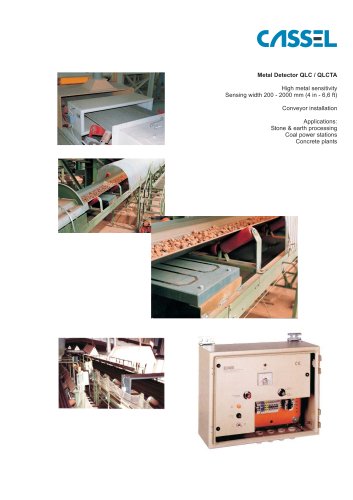 QLC/QLCTA Product Catalogue
2 Pages
 All METAL SHARK Products
24 Pages





*Prices are pre-tax. They exclude delivery charges and customs duties and do not include additional charges for installation or activation options. Prices are indicative only and may vary by country, with changes to the cost of raw materials and exchange rates.
About DirectIndustry
DirectIndustry is a marketplace that offers B2B players a complete experience, from product sourcing to purchase. DirectIndustry is an entity of VirtualExpo Group.
Are you a buyer?
Are you a supplier?