

INVERTAPUSH™

INVERTAPUSH™
Cascade's INVERTAPUSH™ is versatile and can be used in operations that ship unit loads of bags or cartons, including products like fertilizer, grain, cement, mail, sugar, canned goods, boxed goods, glass, and plastic.
Features
- Retrieving Pallets: The INVERTAPUSH™ allows warehousing products on in-house pallets. For shipping, it places the load on a slip-sheet, customer pallet, or directly on the transit vehicle floor, retrieving the pallet to remain in-house.
- Cost Efficiency: Retaining pallets in-house eliminates return costs and reduces total pallet inventory. The system includes clamping forks, a stabilizer arm, a sideshifter, a rotator, and a push plate.
How It Works
- Bottom forks insert into the pallet, clamping the load against upper forks. A side stabilizer secures the load for rotation.
- The INVERTAPUSH™ rotates 180° so the pallet is on top, with the slip-sheet or customer pallet on the bottom.
- Forks lift the pallet off the load, and the operator pushes off while backing away.
Technical Specifications
- Hydraulic Flow: Minimum 19 LPM, Recommended 26 LPM, Maximum 38 LPM, with a maximum pressure of 159 bar.
- Installation Kit: Catalog Order No. 685559.
- Capacity: 1,815 kg at a 24" (600 mm) load center.
- Mounting: Class 3, 0° angle, with 4 hydraulic functions.
- Weight and Dimensions: Effective thickness 508 mm, Horizontal Center of Gravity 376 mm, Vertical Center of Gravity 457 mm.
Options
- Load push/pull mechanism.
- Various opening and closing ranges.
- Different types, sizes, and spreads of arms.
- Class 2 and 4 mounting options.
Catalog excerpts

Retain your pallets in-house, and reduce your total pallet inventory. The ability to clamp, rotate, and push your product. APPLICATIONS Cascade’s INVERTAPUSH™ may be used in nearly every operation that ships unit loads of bags or cartons, such as fertilizer, grain, cement, mail, sugar, canned goods, boxed goods, glass and plastic. Bottom forks are inserted in pallet. Load is clamped Retrieving your pallets with an Inverta Push The INVERTAPUSH™ enables you to warehouse your products on in-house, ‘captive’ pallets. For shipping, the INVERTAPUSH™ places the load on a slip-sheet, customer pallet or directly on the transit vehicle oor, then retrieves your pallet.Your pallets need never leave the warehouse. Retaining your expensive pallets in-house eliminates the need to dead-head pallets after unloading at the destination. The receiver has no return costs to pay and you can reduce your total pallet inventory. The INVERTAPUSH™ consists of two opposing sets of forks for clamping, an automatically sequenced stabilizer arm on the side with forks, an integral sideshifter, a rotator to invert or rotate the load and a push plate for push-off load deposit. against upper forks. Side stabilizer engages load to secure it for rotation. As truck moves to load-out point, INVERTAPUSH™ turns 180° so pallet is on top of load. Slipsheet or customer pallet (if used) is now on bottom. Forks lift pallet off load. Operator pushes off and backs away simultaneously.
Open the catalog to page 1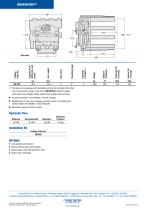
Capacity @ 24" (600 mm) Load Center Mounting Angle Hydraulic Functions Effective Thickness This base unit is equipped with solenoids and may be controlled with either one or two auxiliary valves on the truck. IMPORTANT: Solenoid voltage must match truck voltage. Please specify truck voltage when ordering. A push/pull model is also available. Consult Cascade. Modications of type, size, mounting, spread of arms and opening and closing ranges are available. Consult Cascade. Worksheet required at time of order. Hydraulic Flow Minimum 19 LPM Installation Kit Catalog Order No. 685559 Load push/pull...
Open the catalog to page 2All Cascade catalogs and technical brochures
 N-SERIES FORK POSITIONERS
3 Pages
 J-SERIES FORK POSITIONERS
2 Pages
 WEIGH FORKS - PRO SERIES
4 Pages
 J-Series Sliding Arm Clamps
4 Pages
 FORK POSITIONERS
4 Pages
 F-Series Sideshifter
4 Pages
 Tyre Handler
4 Pages
 Marble handler
2 Pages
 Layer Picker
3 Pages
 Forward Bin Dumper
2 Pages
 Load Stabilizer
2 Pages
 Turnaload™
2 Pages
 Turnafork™
2 Pages
 G-Series Single-Double
4 Pages
 Rotators
4 Pages
 G-Series Carton Clamps
4 Pages
 12G-15G White Goods Clamp
4 Pages
 E-Series Push/Pull
3 Pages
 AFC (Adaptive Force Control)
2 Pages
 Damage Reduction
6 Pages
 Paper Roll Clamps
6 Pages
 J-Series Integral Carriages
3 Pages
 L-Series Fork Positioner
2 Pages
 REVOLUTION
6 Pages
 G Series Bale Clamps
6 Pages
 Forks Brochure
4 Pages


Archived catalogs
 Electronic Force Control TM
2 Pages
 White Goods Clamp
6 Pages
 Harbour Clamps
2 Pages
 Cascade Corporation Products
6 Pages

- Materials handling manipulator
- Palletizer
- Manipulator with gripping tool
- Handling manipulator
- Lifting clamp
- Vertical lifting clamp
- Layer palletizer
- Articulated manipulator arm
- Materials handling clamp
- Building material lifting clamp
- Horizontal lifting clamp
- Unloading manipulator
- Hanging manipulator arm
- Drum manipulator
- Pallet handling pallet fork
- Forklift pallet fork
- Steel pallet fork
- Forklift truck handling clamp
- Agricultural pallet fork
- Block lifting clamp