
- Catalogs
- Carlisle Industrial Brake and Friction
- 2012 Aftermarket Catalog

2012 Aftermarket Catalog

2012 Aftermarket Catalog
Carlisle Brake & Friction (CBF) is a leading provider of high-performance brake, clutch, and transmission solutions for OEM and aftermarket customers across various sectors including mining, construction, military, agriculture, motorsports, industrial, and aerospace. With brands like VelveTouch and FieldPro, CBF offers superior brake performance and technical support globally, operating from ten manufacturing facilities worldwide.
CBF supplies original equipment and aftermarket brake and friction systems across multiple industries. Key products include wet brake friction discs, disc brake pads, dry caliper service brakes, and hydraulic actuation systems. The company serves sectors such as aerospace, mining, construction, agriculture, military, on-highway trucks, powersports, motorsports, and renewable energy.
CBF offers a range of friction materials under the VelveTouch brand, including paper, graphitic, steel, and sinter metallic discs. These products are designed for applications in power shift transmissions, steering clutches, and wet brakes, providing advantages in performance, durability, and engagement quality.
VelveTouch products include paper friction discs, graphitic discs, steel opposing plates, and sinter metallic discs. These products are engineered for high performance in severe applications, offering benefits such as high power absorption and smooth engagement.
This section provides an index and application guide for on-highway and off-road transmission, wet brake, wet clutch, and industrial friction segments. It includes detailed specifications for various parts, such as dimensions and material types.
The catalog includes an index, brake pad compounds, application guide, FMSI cross-reference, and brake pad diagrams for on-highway disc brake pads, highlighting their superior performance in both hot and cold applications.
This section introduces Carlisle products such as brake calipers, linings, pistons, and seal kits, emphasizing their quality and performance advantages.
An introduction to Carlisle Hydraulics and an application guide are provided, showcasing the company's expertise in hydraulic systems for various applications.
CBF's global presence and innovative solutions make it a leader in the brake and friction industry, serving over 100 OEMs in 50 countries.
The document is a technical parts guide focusing on clutch components for on-highway and off-highway vehicles. It includes detailed specifications for various parts, such as clutch buttons, facings, rivets, oil mist discs, and clutch brakes.
This section lists various parts with their specifications, including part numbers, materials, dimensions, and other relevant details. The parts are primarily made of steel and bronze, with some paper components.
Detailed information on clutch buttons is provided, including series, part numbers, materials (ceramic, carbotic, fibertuff), thickness in inches and millimeters, color codes, and reference series. The document highlights different series such as 1H, EVT, RVSR, and VSR, with specific attributes for each.
Some parts are subject to minimum quantity or lead time requirements, and certain items are marked for discontinuation as stock depletes. New parts are also indicated.
The document includes tables with dimensions and specifications for each part, emphasizing critical parameters like thickness, material type, and color coding for easy identification.
The document provides detailed specifications for various clutch buttons and facings, primarily made from ceramic and feramic materials. It includes part numbers, material types, dimensions, and additional notes regarding availability and discontinuation.
Various patterns such as 10000, 11004, and 1185A are listed. Both ceramic and feramic materials are used. Outer diameter (OD) is provided in inches and millimeters, with sizes ranging from 7.469 inches (189.7 mm) to 12.875 inches (327.0 mm). The number of rivet holes varies, with some parts having none.
Items marked with an asterisk (*) are subject to minimum quantity and lead time requirements. Items marked with 'O' are to be discontinued as stock is depleted. Items marked with 'N' are new parts.
This section lists part numbers with details on rivet holes, outer diameter in inches and millimeters, and notes on minimum quantity or lead time requirements. Specifications include part numbers, descriptions, thickness in inches and millimeters, and notes on discontinuation.
This section details rivet head diameter, body diameter, length, and carrier plate thickness. Information includes part numbers, teeth/drill patterns, size in inches, and notes on discontinuation.
Customers are advised to contact customer service for availability and lead time for all KEG orders.
The document provides a comprehensive index and application guide for semi-ceramic brake pads used in various vehicle models and manufacturers. It includes OEM part numbers, vehicle compatibility, and specific brake pad compounds designed for different applications.
Lists part numbers for various manufacturers such as Jarvis Clark, Kawasaki, Koehring Bomag, Rockwell (Goodyear), Terex, Trojan, Unit Rig, Volvo, and Wagner Mining. Each part number is associated with a specific brake pad model.
Provides an index of brake pads for on-highway vehicles, including brands like Bluebird, Buick, Cadillac, Chevrolet, Chrysler, and more. This section helps identify the correct brake pad for specific vehicle models and years.
Describes the VelveTouch Carbon Semi-Metallic disc brake pads, highlighting their design for severe-duty automotive and truck fleet applications. The document details two specific compounds: F1 for class 1-3 vehicles and F3 for class 2-6 commercial trucks.
Highlights the benefits of VelveTouch pads, including extended pad and rotor life, noise reduction, and improved safety and fade resistance. The pads are designed to operate at higher temperatures without significant friction loss.
Provides detailed compatibility information for various vehicle makes and models, specifying the appropriate VelveTouch brake pad numbers and corresponding FMSI numbers.
On-vehicle field tests indicate that VelveTouch pads can improve pad and rotor life by up to 67%, reducing downtime and costs. A graph compares brake effectiveness under different loads, showing superior performance of VelveTouch pads compared to OE replacement pads.
The document provides detailed specifications for various vehicle models, including Chevrolet Tahoe, Uplander, Venture, and Chrysler models such as the 300 and Aspen. The specifications include model subtypes, production years, engine sizes, and drivetrain configurations (e.g., FWD, AWD).
Includes models like W3500, W4, W4500, W5500 with diesel and gas engines, and Chrysler Concorde with LX and LXI models.
The document includes various technical codes such as VT # and FMSI numbers, which are likely related to vehicle parts or specifications.
The document appears to be intended for use in identifying vehicle specifications for maintenance, repair, or parts replacement purposes, particularly focusing on on-highway applications.
The document provides a detailed listing of various vehicle models, their submodels, engine specifications, and applicable years. It includes information on Ram, Sprinter, Eagle, and Ford vehicles, focusing on their engine types and specific notes related to each model.
Emphasizes engine sizes and configurations, which are crucial for understanding vehicle performance and compatibility with parts. The applicable years for each vehicle model are specified, aiding in identifying the correct parts and configurations for maintenance and repairs.
This document provides detailed specifications for various Ford Super Duty Pickup (P/U) models, including F-350, F-450, F-550, F-600, F-650, F-700, and F-750. It covers model years, engine sizes, and specific configurations related to brake components.
Each model is associated with specific brake component codes (e.g., WPD1069x, D1069) which are crucial for maintenance and replacement purposes.
The document specifies the types of brake compounds used, such as Carbon Semi-Metallic F1 and F3, indicating their application in front and rear brakes.
This document provides a detailed listing of brake pad specifications for various GMC vehicle models, focusing on on-highway applications. It includes information on the make, model, submodel, years, engine specifications, and corresponding brake pad part numbers.
For each vehicle model and configuration, the document provides the front and rear brake pad part numbers, identified by VT # and FMSI codes. These codes are crucial for identifying the correct brake pads for replacement or maintenance.
The document specifies the type of brake pad material used, such as carbon semi-metallic, which is indicated by codes like F1 and F3.
This document provides a detailed specification of brake calipers used in various vehicle series and models over different years. It categorizes the information based on vehicle series, model years, and specific caliper types.
The document is intended for use in on-highway applications, providing detailed information for maintenance and replacement of brake components in specified vehicle models.
This document provides a cross-reference between FMSI numbers and Velvetouch numbers for brake pads. Each FMSI number corresponds to a specific Velvetouch part number, facilitating the identification and replacement of brake components.
The legend explains the various measurements and codes used in the brake pad diagrams. It includes details such as pad thickness, length, width, and compound codes, which are essential for selecting the correct brake pad for specific vehicles.
The document contains detailed diagrams of brake pads for various vehicle models, including Ford, Lincoln, Mercury, Chevrolet, and Dodge. Each diagram provides measurements in inches and millimeters, indicating the inner and outer dimensions of the pads.
The document concludes with a note on brake noise, emphasizing that noise can be influenced by the entire brake system and installation process. It suggests keeping certain key items in mind during installation to minimize noise issues.
- Rotor Type: Use an OE or high-quality replacement rotor.
- Rotor Finish: Ensure the surface is clean, smooth, and flat. If turned, apply a non-directional finish using a bead brush or 120 grit sandpaper.
- Pad Fitment: Pads should fit snugly with no rattle or movement. Inspect and replace hardware and abutment clips if necessary.
- Lubrication: Proper lubrication of contact points with high-temperature synthetic lubricant containing moly can reduce noise caused by vibration.
- Break-in: Proper break-in of new brake pads will deposit a transfer layer onto the rotor surface, aiding in smooth contact and reducing vibrations.
- Introduction to Carlisle Products
- Details on Carlisle Brake Calipers and their components, including part assembly numbers, linings, pistons, and seal kits.
- Various models such as A2, AA2, A4, B2, C2, DLM7, DLM13, F4-20, F4-25, FF6, and G1 are listed with their respective lining, piston, and seal kit part numbers.
The document provides a detailed list of brake components and their corresponding part numbers, specifically focusing on Carlisle brake calipers and linings. It includes assembly numbers and associated kits for various brake components.
This section lists various pistons, linings, seal kits, and other related components with their specific part numbers. Each component is associated with a specific assembly number, indicating its application in different brake systems.
The document categorizes components under different assembly numbers such as SCL8, SCL19, SCL53, SCL56, SCL59, and SCL70. Each assembly number is linked to specific parts like pistons, linings, and kits, providing a clear reference for maintenance or replacement.
This section maps Carlisle part numbers to their corresponding brake assemblies. It includes a comprehensive list of part numbers and their associated brake assembly codes, facilitating easy identification and cross-referencing.
The document highlights essential components such as pistons, linings, seal kits, and various hardware kits necessary for brake system maintenance and overhaul. The correlation between assembly numbers and part numbers is crucial for ensuring compatibility and proper functioning of brake systems. The extensive list of part numbers and their corresponding assemblies provides a valuable resource for technicians and engineers involved in brake system maintenance and repair.
The document provides detailed information on various Carlisle brake assemblies and corresponding part numbers, including specifications for pistons, seal kits, and hydraulic actuation systems. It also includes a list of obsolete parts and their replacements.
The document outlines the benefits of Carlisle's hydraulic systems, emphasizing features like a wide range of boost ratios, PTFE seal technology for durability, and ease of installation with minimal hydraulic connections. It highlights the use of common oil supply to prevent fluid contamination.
The document suggests using Carlisle's hydraulic systems for improved braking response and driver comfort. It also recommends specific part replacements for obsolete components to maintain system efficiency.
The tables provide a comprehensive list of part numbers and their corresponding brake assemblies, including obsolete parts and their replacements. This data is crucial for identifying the correct components for maintenance and replacement.
The document emphasizes the importance of using the correct part numbers for specific brake assemblies to ensure optimal performance. It also highlights the benefits of Carlisle's patented design and high-wear resistance technology.
Catalog excerpts

OE GRADE BRAKE & FRICTION SOLUTIONS
Open the catalog to page 1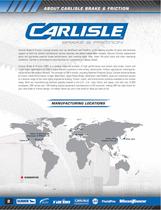
ABOUT CARLISLE BRAKE & FRICTION Carlisle Brake & Friction, through brands such as VelveTouch and FieldPro, is the leading provider of parts and technical support to both the vehicle manufacturer service channels and global independent markets. Genuine Carlisle replacement parts will guarantee superior brake performance, less machine down time, lower life-cycle costs and safer operating conditions. Carlisle is committed to ensuring that our customers are always ahead. Carlisle Brake & Friction (CBF) is a leading solutions provider of high performance and severe duty brake, clutch and transmission...
Open the catalog to page 2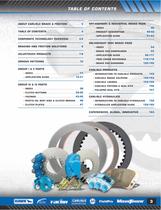
CARLISLE HYDRAULICS - INTRODUCTION TO CARLISLE HYDRAULICS ... 158
Open the catalog to page 3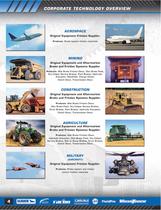
AEROSPACE Original Equipment Friction Supplier. Products: Brake system friction materials MINING Original Equipment and Aftermarket Brake and Friction Systems Supplier. Products: Wet Brake Friction Discs, Disc Brake Pads, Dry Caliper Service Brakes, Park Brakes, Hydraulic Actuation, Manifolds, Charge Valves, Clutch Discs, Transmission Discs CONSTRUCTION Original Equipment and Aftermarket Brake and Friction Systems Supplier. Products: Wet Brake Friction Discs, Disc Brake Pads, Dry Caliper Service Brakes, Drum Brakes, Park Brakes, Hydraulic Actuation, Clutch Discs, Transmission Discs AGRICULTURE...
Open the catalog to page 4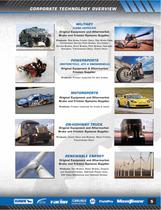
MILITARY (LAND VEHICLES) Original Equipment and Aftermarket Brake and Friction Systems Supplier. Products: Wet Brake Friction Discs, Disc Brake Pads, Combination Service/Park Brakes, Dry Caliper Service Brakes, Drum Brakes, Park Brakes, Hydraulic Actuation, Transmission Discs, Clutch Discs POWERSPORTS (MOTORCYCLE, ATV & SNOWMOBILE) Original Equipment & Aftermarket Friction Supplier. Products: Friction materials for disc brakes MOTORSPORTS Original Equipment and Aftermarket Brake and Friction Systems Supplier. Products: Friction materials for brake & clutch ON-HIGHWAY TRUCK Original Equipment...
Open the catalog to page 5
BRAKING AND FRICTION SOLUTIONS
Open the catalog to page 6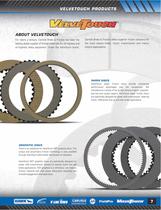
ABOUT VELVETOUCH For nearly a century, Carlisle Brake & Friction has been the leading global supplier of friction materials for off-highway and on-highway heavy equipment. Under the VelveTouch brand, Carlisle Brake & Friction offers superior friction solutions for the most severe brake, clutch, transmission and motion control applications. PAPER DISCS VelveTouch paper friction discs provide substantial performance advantages over the competition. We manufacture a variety of low to high density organic, graphitic, low-met and carbon papers. VelveTouch paper friction discs are specifically designed...
Open the catalog to page 7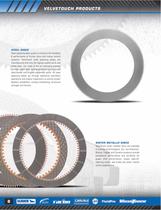
STEEL DISCS Steel opposing plate quality is critical to the durability & performance of friction discs and motion control systems. VelveTouch steel opposing plates are manufactured with only the highest quality hot & cold rolled steel. Our state of the art stamping presses and high speed laser cutting equipment produce both aftermarket and original equipment parts. All steel opposing plates go through additional secondary operations and quality inspections to ensure proper flatness, parallelism, surface conditioning, structural strength and fitment. SINTER METALLIC DISCS VelveTouch sinter metallic...
Open the catalog to page 8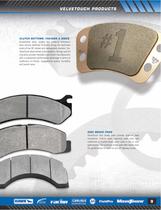
CLUTCH BUTTONS, FACINGS & DISCS Exceptional value, quality and material innovation have earned Wellman Products Group the dominate share of the OE market and replacement markets. Our VelveTouch aftermarket clutch buttons, facings and full ring discs provide rebuilders and clutch manufacturers with a substantial performance advantage in terms of coefficient of friction, engagement quality, durability and overall value. DISC BRAKE PADS VelveTouch disc brake pads provide superior fade resistance, friction wear, opposing plate wear and coefficient of friction levels when used in hot or cold applications....
Open the catalog to page 9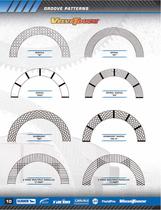
2 PASS MULTIPLE PARALLEL “2 PMP” 3 PASS MULTIPLE PARALLEL “3 PMP”
Open the catalog to page 10
GROUP I & II Application Guide On-Highway & Off-Road Transmission, Wet Brake, Wet Clutch, Industrial Friction Segments
Open the catalog to page 11
GROOVE DETAILS TEETH TANGS Subject quantity time requirement *321 3587 to minimum PP10107and or lead STEEL ------ O Item to be discontinued as stock is depleted X 54 EXT TH 5.48
Open the catalog to page 13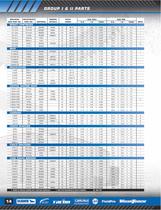
GROOVE DETAILS TEETH TANGS CAPITAL MARINE GEAR 1-00229-1700 CASE ( DAVID BROWN ) 181158A1 Subject to minimum quantity and or lead time requirement O Item to be discontinued as stock is depleted
Open the catalog to page 14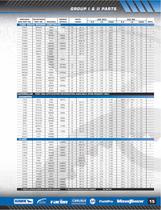
GROOVE DETAILS TEETH TANGS CASE ( DAVID BROWN ) CONTINUED D70672 CATERPILLAR CHAMPION PART AND APPLICATION INFORMATION AVAILABLE UPON REQUEST ONLY SUNBRST 72 INT TH 9.19 X O Item to be discontinued as stock is depleted Subject to minimum quantity and or lead time requirement
Open the catalog to page 15
GROOVE DETAILS TEETH TANGS FIAT ALLIS & HITACHI 70681436 Subject to minimum quantity and or lead time requirement O Item to be discontinued as stock is depleted
Open the catalog to page 17
GROOVE DETAILS TEETH TANGS FIAT ALLIS & HITACHI CONTINUED 099 26135 Subject to minimum quantity and or lead time requirement O Item to be discontinued as stock is depleted
Open the catalog to page 18
GROOVE DETAILS TEETH TANGS FIAT ALLIS & HITACHI CONTINUED 790 44333 Subject to minimum quantity and or lead time requirement O Item to be discontinued as stock is depleted
Open the catalog to page 19
GROOVE DETAILS TEETH TANGS 1 EXT LG 9.00 X O Item to be discontinued as stock is depleted Subject to minimum quantity and or lead time requirement
Open the catalog to page 20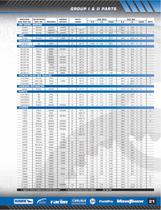
GROOVE DETAILS TEETH TANGS HITACHI ( ALSO SEE EUCLID ) E12577948 Subject to minimum quantity and or lead time requirement O Item to be discontinued as stock is depleted
Open the catalog to page 21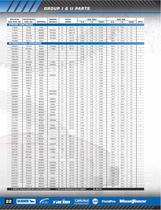
GROOVE DETAILS TEETH TANGS Subject to minimum quantity and or lead time requirement O Item to be discontinued as stock is depleted
Open the catalog to page 22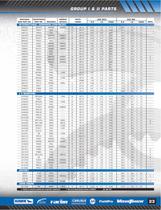
GROOVE DETAILS TEETH TANGS INTERNATIONAL (DRESSER) CONTINUED 658354C2 14 INT TH 12.32 X O Item to be discontinued as stock is depleted Subject to minimum quantity and or lead time requirement
Open the catalog to page 23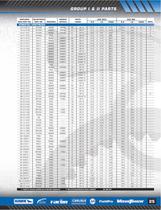
GROOVE DETAILS TEETH TANGS Subject to minimum quantity and or lead time requirement O Item to be discontinued as stock is depleted
Open the catalog to page 25
GROOVE DETAILS TEETH TANGS Subject to minimum quantity and or lead time requirement O Item to be discontinued as stock is depleted
Open the catalog to page 26All Carlisle Industrial Brake and Friction catalogs and technical brochures
 Complete brake systems
8 Pages
 2013 Hawk Performance Catalog
260 Pages

Archived catalogs
 WBF1-89-SC
2 Pages
 WBA4-90
2 Pages
 WBA1-90-SC
2 Pages
 WBA1-75-SC
2 Pages
 NoiseFree linings
2 Pages
 Hydrastar XL
2 Pages
 hydraStar
2 Pages
 Electrastar
2 Pages
 Wet And Dry
1 Page
 TwinBoosters
1 Page
 SlaveCylinders
1 Page
 SingleBoosters
1 Page
 MidiBoosters
1 Page
 MasterCylinders
1 Page

- Cylinder
- Actuator
- Hydraulic cylinder
- Friction brake
- Industrial actuator
- Industrial cylinder
- Rotary actuator
- Electromagnetic brake
- Multi-channel manifold
- Hydraulic brake
- Hydraulic actuator
- Pneumatic brake
- Mechanical actuator
- Cylinder actuator
- Integrated cylinder
- Caliper disc brake
- Wide actuator
- High-performance cylinder
- Tandem cylinder