
- Catalogs
- Carbolite Gero
- Vacuum, Inert and Reactive Gas Furnaces up to 3000 °C


Vacuum, Inert and Reactive Gas Furnaces up to 3000 °C

Vacuum, Inert and Reactive Gas Furnaces up to 3000 °C
Carbolite Gero GmbH & Co. KG specializes in high-temperature furnaces for vacuum, inert, and reactive gas environments up to 3000 °C, used in quality control, research, and development.
Company Overview
Carbolite Gero operates production facilities in Sheffield, UK, and Neuhausen, Germany, and is part of the Verder Scientific Division.
Product Portfolio
The company offers standard and customized furnaces for heat treatment processes, operating in various environments and suitable for inert and reactive gases.
Heat Transfer Mechanisms
Furnaces utilize conduction, convection, and radiation, with radiation significant above 700 °C.
Design and Insulation Principles
Furnaces are designed for optimal temperature homogeneity using closed retorts, gas flow design, radiation shields, and high-grade insulation.
Vacuum Technology
Furnaces are equipped with sealed devices for vacuum environments, crucial for processes above 1800 °C.
Special Furnaces and Options
Specialized furnaces are available for metal injection molding, graphitization, and crystal growth, with customized solutions for specific needs.
Conclusion
Carbolite Gero offers comprehensive heat treatment solutions with a focus on innovation and reliability.
The document explains the relationship between temperature, force, and pressure in furnaces, using the Kelvin scale to illustrate principles.
Vacuum Ranges and Pumps
Defines four vacuum levels and lists common pumps used in high-temperature furnaces, describing their operation and suitability.
Pressure Environments
Heat treatment can occur in vacuum, partial pressure, controlled pressure, and overpressure environments.
Temperature and Atmosphere Considerations
Outlines the importance of determining operating temperature and atmosphere, with guidelines for atmospheres up to 3000 °C.
Furnace Selection Guide
Provides a guide for selecting furnaces based on temperature range and application.
Debinding Furnace Details
The EBO debinding furnace is highlighted for catalytic debinding of MIM and CIM feedstock, featuring precise control and safety interlocks.
Details specifications and procedures for furnaces like EBO and GLO, designed for debinding, annealing, soldering, and pyrolysis.
EBO Furnace
Designed for debinding 'green parts' using BASF Catamold® feedstock, featuring temperature uniformity and precision.
GLO Furnace
Used for annealing and other heat treatments up to 1100°C, with vacuum-tight retort and symmetric heating element arrangement.
VL Soldering Tube Furnace
Designed for high-purity gas atmospheres and vacuum operations up to 1050°C, with automated controls.
Applications and Advantages
Furnaces are used for annealing, tempering, quenching, soldering, and pyrolysis, offering precise atmosphere control and safety management.
Provides specifications and applications for tube furnaces like VL, FHA, FST, and AZ series, suitable for high vacuum environments and controlled atmospheres.
VL Furnace
Designed for soldering and brazing in high vacuum environments, with programmable operating system.
FHA Tube Furnaces
Operate up to 1350 °C with low thermal mass ceramic fibre insulation.
FST Split Tube Furnaces
Reach temperatures up to 1300 °C, designed for easy positioning of work tubes.
AZ Eight-Zone Tube Furnace
Features eight independent heating zones for precise temperature profiling.
Applications
Used for hardening, annealing, tempering, soldering, brazing, and more, particularly useful for aging experiments and material approval.
Furnaces operate within 1300 °C to 3000 °C, equipped with MoSi2 heating elements for efficiency and durability.
Specifications
Includes tube, split tube, chamber, and laboratory furnaces with specific features like vacuum and inert gas capabilities.
Key Features
MoSi2 heating elements, low thermal mass insulation, vacuum and reactive gas options, advanced controllers.
Applications
Suitable for calibration, hardening, annealing, tempering, sintering, and research on volcanic rock viscosity.
Safety and Control
Features over-temperature protection and automated gas flow control systems.
Designed for high-temperature applications under hydrogen atmospheres, adhering to SIL2 safety standards.
Tube Furnaces
Allow up to 100% hydrogen purity, equipped with safety systems and automated operation.
Chamber Furnaces
Available in graphite, metallic, or ceramic fibre insulation, suitable for processes like pyrolysis and sintering.
Safety and Control Features
Equipped with safety provisions for hydrogen operation, automated control systems, and water cooling systems.
Applications and Use Cases
Used for heat treatment of magnetic materials, technical ceramics, and high vacuum brazing.
Focuses on hood furnaces (HBO and HB series) and bottom loading furnaces (HTBL series) for high-temperature processes.
Hood Furnaces (HBO Series)
Operate up to 2200°C, ideal for vacuum soldering and brazing.
Hood Furnaces (HB Series)
Feature a movable hood, suitable for debinding and sintering.
Bottom Loading Furnaces (HTBL Series)
Available in graphite or metallic versions, suitable for high purity atmospheres.
Technical Data
Includes specifications for each furnace model, cooling times, and temperature profiles.
Features a single heating zone made from graphite, suitable for large-scale production.
Technical Specifications
Constructed with metallic materials, suitable for high vacuum processes.
Vacuum System and Software
Equipped with various vacuum pumps, managed by TP 1900 or WinCC software.
Options and Applications
Includes customized vacuum systems and suitable for processes like liquid silicon infiltration.
Technical Data Summary
Provides detailed technical data for various HTBL models.
Laboratory Furnaces (LHT Series)
Compact high-temperature furnaces for research and development, ideal for laboratories.
Focuses on heat treatment processes and crystal growth applications.
Specifications
Includes TP 1900 and WinCC systems, Eurotherm Controllers, and temperature capabilities.
Procedures
Manual and automatic operation procedures, with data logging capabilities.
Norms and Recommendations
Safety measures and gas handling recommendations.
Application Examples
Includes carbon nanotubes and Bridgman crystal growth.
Technical Data
Details models, dimensions, and operational capabilities.
Options and Accessories
Includes additional equipment and software connectivity.
Focuses on applications in metal and ceramic injection molding, debinding, sintering, and graphitization.
Heating System Design
Utilizes molybdenum elements and radiation shields for temperature uniformity.
Cooling System
Optional fast cooling system with a heat exchanger.
Technical Specifications
Includes PDS 120 MO/14 model specifications.
Application Examples
Discusses MIM and CIM processes.
Debinding and Sintering Solutions
Includes GLO and EBO furnace models.
Graphitization Furnaces
Designed for high-temperature applications up to 3000°C.
Focuses on SERIE 3000 graphitization furnaces and Bridgman-type crystal growth furnaces.
Specifications
Includes temperature control, vacuum systems, and software.
Procedures
Graphitization and Bridgman crystal growth processes.
Applications
Used for heat treatment and crystal growth.
Technical Data
Includes furnace models and crystal growth methods.
Additional Information
Includes accessories and customized solutions.
Focuses on customization options, operational capabilities, and control systems.
Specifications
Includes production and laboratory furnaces, and split tube furnaces.
Control Systems
Includes Eurotherm Controllers and over-temperature control.
Options and Accessories
Includes retorts, gas supply, fast cooling, and vacuum pump stands.
Safety and Maintenance
Includes safety packages and debinding assembly.
Describes methods for managing gaseous by-products and maintaining stable furnace pressure.
Furnace Configuration and Temperature Management
Graphite furnaces can operate up to 2200 °C, with potential for higher temperatures.
Process Visualization and Control
WinCC process visualization system offers advantages over touch panel interfaces.
Power Compensation
Power compensator or filter can maintain a power factor close to 1.0.
Cooling Systems
Cooling units with up to 160 kW capacity can be installed externally.
Tube Furnace Accessories
Includes high purity tube materials, water-cooled flanges, and gas supply equipment.
Material and Temperature Specifications
Lists materials used for tube furnaces and their maximum recommended temperatures.
Product Range and Customization
Offers a wide range of standard and customized furnace solutions.
Catalog excerpts

Vacuum, Inert and Reactive Gas Furnaces up to 3000 °C
Open the catalog to page 1
As part of the VERDER Group, the business division VERDER SCIENTIFIC sets standards in the development, manufacture and sales of laboratory and analytical equipment. The instruments are used in the areas of quality control, research and development for sample preparation and analysis of solids.
Open the catalog to page 2
Leading Heat Technology Portfolio The foundation for a good project: Understanding With the formation of Carbolite Gero GmbH & Co. KG, customer requirements. The Carbolite Gero technical staff customers realizing heat-treatment processes from 30 °C consists of highly-qualified engineers, physicists and chemists to 3000 now have access to a single highly qualified °C with a strong theoretical background. They are true experts source for equipment. Carbolite Gero instruments work in the wide range of heat treatment applications up to with vacuum, partial pressure, air, controlled pressure, and...
Open the catalog to page 3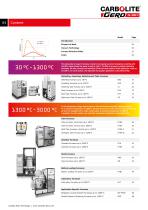
Content Debinding, Annealing, Soldering and Tube Furnaces Debinding Furnace up to 150 °C Annealing Furnaces up to 1100 °C Soldering Tube Furnace up to 1050 °C Tube Furnaces up to 1350 °C Split Tube Furnaces up to 1300 °C Eight-zone Tube Furnace up to 1300 °C Model Page In this temperature range, tube furnaces or hot wall furnaces use MoSi2 heating elements for a maximum temperature of 1800 °C. All other furnaces are referred to as cold wall furnaces as they are equipped with a water cooled vessel. A maximum temperature of 3000 °C is possible. For each system, one important and popular application...
Open the catalog to page 4
Special Furnaces and Options In this chapter, some special furnaces are described. The metal injection molding furnaces include solutions for the whole process chain of debinding and sintering. SERIE 3000 furnaces are based on the standard LHTG and HTK GR models, including options for pyrolysis and 3000 °C operation. At least some solutions for crystal growth as well as some customized heat treatment systems and their unique features for applications are briefly mentioned. Metal Injection Moulding (MIM) Furnaces Solutions for Debinding and Sintering Graphitization Furnaces SERIE 3000 Chamber...
Open the catalog to page 5
Heat is generated by the averaged random movement of molecules, atoms and electrons. For example: temperature in a gas is caused by the Brownian movement of the molecules and atoms the gas consists of. The same is true for a liquid. The thermal movement of the electrons in a solid is the reason why a temperature measurement with thermocouples is possible. The standard thermocouples are from type K, N, S, R, B and C. They consist of wires from different materials, which are welded together at the tip. The highest temperatures up to 3000 are controlled by °C means of measuring the heat radiation...
Open the catalog to page 6
Introduction Physics of Heat Some design and insulation principles In reality, all three heat transfer mechanisms are present at the same time. As a result, time consuming calculations and simulations are needed to design a furnace with outstanding temperature homogeneity. Carbolite Gero has accumulated decades of engineering experience creating exceptional heat treatment systems. Some important design principles are: Temperature distribution within a three zone furnace with insulation plugs fitted 2.5 outer tube diameter Uniform zone of temperature distribution Temperature distribution within...
Open the catalog to page 7
Nowadays, many heat treatment processes are carried out in vacuum environment. For vacuum metallurgy, annealing, crystal growing, soldering and brazing and many more applications, vacuum technology must be combined with heat treatment. For this purpose, the samples have to be surrounded by a sealed device, such as a sealed working tube, a sealed retort or a sealed water cooled vessel. The most important advantage of the evacuation is the reduction of the Oxygen level to avoid the sample from oxidation. Besides, for heat treatment processes with a temperature above 1800 °C, the Oxygen level has...
Open the catalog to page 8
CARBOLITEr/Tg^nr iv 'MVacuum Technology 09Vacuum pumps Turbomolecular pump Roots pump Rotary vane pump The turbomolecular pump consists of stators between several high speed rotors. The rotational speed is more than 10 000 turns per minute. At these speeds, the rotor is now in the range of the particle velocity enabling gas to be pushed through the pump. When combined with a pre-vacuum pump, the achievable vacuum level is in the high vacuum range or better. Turbomolecular pumps are the most convenient and frequently used pumps for high and ultra-high vacuum operation. Very high atmospheric purity...
Open the catalog to page 9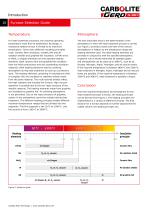
Temperature For heat treatment processes, the required operating temperature must first be established. By design, a resistance heated furnace is limited to its maximum temperature. Three main different insulating principles exist: Ceramic fibre insulation, metallic (Mo and W) radiation shields and graphite felt insulation. CrFeAl wires or MoSi2 U-shaped elements are two possible heating elements. Both ceramic fibre and graphite felt insulation have low heat conductance and are outstanding insulation materials. Both heating elements need an oxidizing atmosphere during heat treatment to build...
Open the catalog to page 10
CARBGLITEr/Tg^nr iv 'MFurnace Selection Guide 11 Application matrix Application - not suited Debinding, Annealing, Soldering & Heating Tube Furnaces Model principle Page www.carbolite-gero.com | Leading Heat Technology
Open the catalog to page 11
Soldering Tube Furnace up to 1050 °C Split Tube Furnaces up to 1300 °C °C Eight-zone Tube Furnace up to 1300
Open the catalog to page 13
Debinding, Annealing, Soldering and Tube Furnaces 14 Furnace for catalytic debinding Metal injection moulding (MIM) and Ceramic injection moulding (CIM) is an expanding modern manufacturing technology. The MIM and CIM manufacturing processes are comprised of 4 steps: compounding raw material into feedstock, moulding feedstock to the desired shape creating a green part, debinding, and sintering. Debinding is the most demanding operation in this process. The debinding of Catamold® feedstock is performed catalytically with nitric acid. This process demands precise control of both the temperature...
Open the catalog to page 14All Carbolite Gero catalogs and technical brochures
 CAF G5
2 Pages
 Overview - Ovens & Furnaaces
16 Pages
 Materialography
20 Pages
 PF
PF5 Pages
 PN
PN4 Pages
 AX
AX2 Pages
 Furnaces for Precious Metals
4 Pages




Archived catalogs
 RHZS - Rotating Tube Furnace
2 Pages
 LHT
LHT6 Pages
 Verder Scientific Product News
16 Pages
 Verder Scientific
20 Pages
 Batch Heat Treatment Furnaces
8 Pages
 Furnaces & Ovens for Aerospace
12 Pages


- CARBOLITE GERO oven
- CARBOLITE GERO chamber oven
- Gas analyzer
- CARBOLITE GERO electric oven
- CARBOLITE GERO heat treatment oven
- Liquids analyzer
- Automatic analyser
- Benchtop analyser
- CARBOLITE GERO digital temperature control
- CARBOLITE GERO drying oven
- CARBOLITE GERO laboratory oven
- Temperature controller
- CARBOLITE GERO combustion oven
- Digital temperature controller
- Stainless steel kiln
- CARBOLITE GERO gas oven
- Calibration analyzer
- CARBOLITE GERO industrial oven
- CARBOLITE GERO curing oven
- CARBOLITE GERO controlled atmosphere oven