
- Catalogs
- Carbolite Gero
- Coal, Coke & Iron Ore Testing Furnaces


Coal, Coke & Iron Ore Testing Furnaces

Coal, Coke & Iron Ore Testing Furnaces
The document provides an overview of Carbolite Gero's Variable Width Moving Wall Coking Test Oven and related testing furnaces used for analyzing coal, coke, and iron ore. These instruments are recognized for their high-quality heat technology and are utilized globally across various industries such as aerospace and materials science.
Carbolite Gero, part of the Verder Group, specializes in manufacturing laboratory and industrial ovens and furnaces, with facilities in the UK and Germany. The company is ISO 9001 accredited and adheres to international standards, producing equipment capable of reaching temperatures up to 3000 °C.
The document details various furnace models, including their maximum operating temperatures and specific uses. For instance, the Variable Width Moving Wall Coking Test Oven operates at 1300 °C and is used in coal research and steel plants.
Carbolite Gero offers equipment for proximate analysis, determining moisture, ash, volatile matter, and fixed carbon in coal samples, crucial for assessing coal quality.
The equipment complies with international standards such as ISO, ASTM, EN, BS, and DIN, ensuring reliable and accurate testing results.
Optional features include desiccators, crucibles, and additional trays, enhancing the equipment's functionality for specific testing needs.
Carbolite Gero's testing furnaces and ovens are designed to meet the evolving needs of industries involved in coal, coke, and iron ore analysis, ensuring reliability and compliance with international standards.
Designed to test volatile matter in coal and coke, these furnaces adhere to standards like BS ISO 562:2010 and ASTM D3175-11, featuring a maximum temperature of 1000°C.
These determine ash content in coal and coke, following standards such as BS ISO 1171:2010, with a maximum temperature of 1100°C.
This furnace tests coal's swelling index, indicating caking characteristics, with a maximum temperature of 900°C.
Used for determining carbon, hydrogen, and sulfur content, these furnaces offer maximum temperatures of 1200°C and 1400°C.
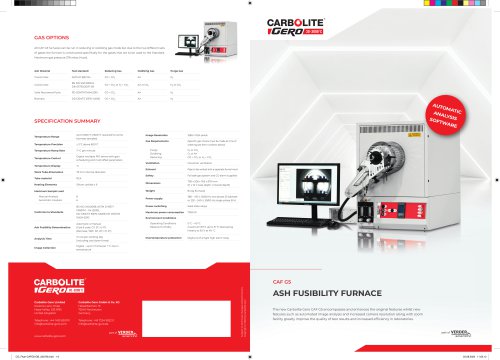
Describes observing ash melting behavior under standard conditions, adhering to standards like DIN 51730:2007-09.
Includes detailed technical data for each furnace model, such as maximum temperatures and power requirements.
Furnaces utilize Eurotherm controllers for precise temperature regulation, with data logging for process parameters.
Equipped with ionisation flame detectors and automatic shutdown procedures to ensure operational safety.
The equipment adheres to various international standards, ensuring reliability and consistency in testing procedures.
Options for software customization, fast heat-up and cool-down capabilities, and provisions for thermocouple probes are available.
Catalog excerpts

Coal, Coke & Iron Ore Testing Furnaces LEADING HEAT TECHNOLOGY Variable Width Moving Wall Coking Test Oven
Open the catalog to page 1
As part of the VERDER Group, the business division VERDER SCIENTIFIC sets standards in the development, manufacture and sales of laboratory and analytical equipment. The instruments are used in the areas of quality control, research and development for sample preparation and analysis of solids.
Open the catalog to page 2
Leading Heat Technology The Carbolite Gero brand is synonymous with high quality, In addition to the wide range of standard products as leading heat technology in the design and manufacture of shown in this catalogue, Carbolite Gero is an expert in laboratory and industrial ovens and furnaces ranging from the development of customized equipment for complex 30 to 3000 and sold globally to over 100 countries. °C °C heat treatment processes. Solving customers’ individual application requirements has given Carbolite Gero an On 1st January 2016 Carbolite (UK) and Carbolite Gero important place in...
Open the catalog to page 3
CONTENTS | COAL, COKE & IRON ORE TESTING FURNACES Icons used in this catalogue CDLT / CDHT Volatile Matter Furnaces Coal Ashing Furnaces Icons are displayed against products that feature these details Furnaces & Ovens for Proximate Analysis Minimum Free Space Oven Coal Drying Ovens Qualitatively assesses. Test method is empirical. Quantitatively measures. Test method is used to provide a measurement or value. Furnaces & Ovens for determination of coke reactivity, iron ore reducibility, ash fusibility, swelling number index, expansion and contraction of coal and coking properties Swelling Number...
Open the catalog to page 4
COAL, COKE & IRON ORE TESTING FURNACES | INTRODUCTION Carbolite Gero’s expertise in coal, coke and iron ore testing The characterisation of coal is important for its quality assessment. The most common types of coal (lignite, bituminous and anthracite) can be distinguished by their different chemical and physical properties. Depending on the product quality, coal is suitable for a variety of uses including coking, steel production and power generation. The formation of coal from a variety of plant materials via biochemical and geochemical processes is called coalification. The nature of the constituents...
Open the catalog to page 5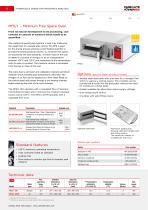
FURNACES & OVENS FOR PROXIMATE ANALYSIS up to 210 C ° 0 MFS/1 – Minimum Free Space Oven From its natural development to its processing, coal contains an amount of moisture which needs to be quantified. One method of quantifying moisture in coal is by measuring the weight loss of a sample after drying. The MFS is used for this drying process and has a small heated chamber to provide the lowest practical volume, ie, minimum free space, as required by the test standards. A known mass of the coal is heated in a stream of nitrogen or air at a temperature between 105 and 110 and maintained at this...
Open the catalog to page 6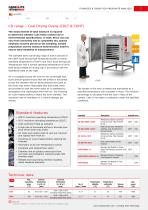
FURNACES & OVENS FOR PROXIMATE ANALYSIS up to 200 C ° 0 CD range – Coal Drying Ovens (CDLT & CDHT) The measurement of total moisture is required to determine whether coal meets commercial or environmental specifications, or both. Since coal can vary from extremely wet to completely dry, special emphasis must be placed on the sampling, sample preparation and the moisture determination itself to ensure total reliability of measurement. The Carbolite Gero coal drying range of ovens consists of the CDHT (Coal Drying High Temperature) with a normal operating temperature of 105 and CDLT (Coal Drying...
Open the catalog to page 7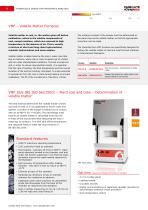
FURNACES & OVENS FOR PROXIMATE ANALYSIS up to 1000 C ° 0 VMF – Volatile Matter Furnaces Volatile matter in coal, ie, the matter given off before oxidisation, refers to the volatile components of coal, except moisture, which are removed at high temperature in the absence of air. This is usually a mixture of short and long chain hydrocarbons, aromatic hydrocarbons and some sulphur. Volatile matter is determined as the loss in mass, less that due to moisture, when coal or coke is heated out of contact with air under standardised conditions. The test is empirical and, in order to ensure reproducible...
Open the catalog to page 8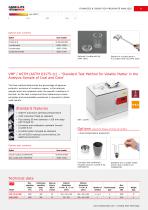
FURNACES & OVENS FOR PROXIMATE ANALYSIS up to 1000 C ° 0 Options part numbers Option Item number Crucible stand handle 00125-3-1007 Optional Crucible with lid (VMF 10/6) Optional 4 crucible stand + 4 crucibles with lids (VMF 10/6) VMF / ASTM (ASTM D3175-11) – ‘Standard Test Method for Volatile Matter in the Analysis Sample of Coal and Coke’ This test method determines the percentage of gaseous products, exclusive of moisture vapour, in the analysis sample which are released under the specific conditions of the test. As the test is empirical strict adherence to basic principles and permissable...
Open the catalog to page 9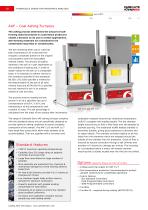
FURNACES & OVENS FOR PROXIMATE ANALYSIS up to 1100 C ° 0 AAF – Coal Ashing Furnaces The ashing process determines the amount of ashforming material present in a petroleum product to enable a decision on its use in certain applications. Ash-forming materials are considered to be undesirable impurities or contaminants. The ash remaining after coal or coke has been incinerated in air is derived from inorganic complexes present in the original coal substance and from associated mineral matter. The amount of sulphur retained in the ash is in part dependent on the conditions of ashing and, in order...
Open the catalog to page 10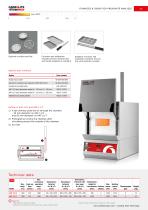
FURNACES & OVENS FOR PROXIMATE ANALYSIS up to 1100 C ° 0 Optional crucibles and lids Corrosion and oxidisation resistant Inconel sample trays and handle supplied as standard Standard corrosion and oxidisation resistant Inconel tray with optional crucibles Options part numbers Option Item number Fused silica crucible Aluminium crucible lid (as required in ASTM D3174-12) AAF 11/3 tray, dimensions inside W = 133 mm, D = 210 mm AAF 11/7 tray, dimensions inside W = 163 mm, D = 330 mm Additional tray loading handle Airflow in AAF 11/3 and AAF 11/7: 1) A tall chimney pulls the air through the chamber...
Open the catalog to page 11All Carbolite Gero catalogs and technical brochures
 CAF G5
2 Pages
 Overview - Ovens & Furnaaces
16 Pages
 Materialography
20 Pages
 PF
PF5 Pages
 PN
PN4 Pages
 AX
AX2 Pages
 Furnaces for Precious Metals
4 Pages




Archived catalogs
 RHZS - Rotating Tube Furnace
2 Pages
 LHT
LHT6 Pages
 Verder Scientific Product News
16 Pages
 Verder Scientific
20 Pages
 Batch Heat Treatment Furnaces
8 Pages
 Furnaces & Ovens for Aerospace
12 Pages


- CARBOLITE GERO chamber oven
- Gas analyzer
- CARBOLITE GERO electric oven
- CARBOLITE GERO heat treatment oven
- Liquids analyzer
- Automatic analyser
- Benchtop analyser
- CARBOLITE GERO digital temperature control
- CARBOLITE GERO laboratory oven
- Temperature controller
- CARBOLITE GERO combustion oven
- Digital temperature controller
- Stainless steel kiln
- CARBOLITE GERO gas oven
- Calibration analyzer
- CARBOLITE GERO curing oven
- CARBOLITE GERO controlled atmosphere oven