
- Catalogs
- Cangzhou Feisu Composite MaterialsCO.,Ltd
- FEISU Carbon fiber prepreg Technical parameters

FEISU Carbon fiber prepreg Technical parameters
FEISU Carbon fiber prepreg Technical parameters
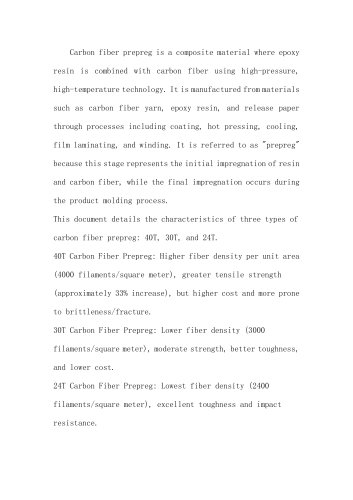
Carbon fiber prepreg is a composite material combining epoxy resin with carbon fiber through high-pressure, high-temperature technology. It involves materials like carbon fiber yarn, epoxy resin, and release paper, processed through coating, hot pressing, cooling, film laminating, and winding. The term 'prepreg' refers to the initial impregnation stage of resin and carbon fiber, with final impregnation occurring during product molding.
- 40T Carbon Fiber Prepreg: Features a higher fiber density (4000 filaments/square meter) and increased tensile strength by approximately 33%. It is more costly and prone to brittleness.
- 30T Carbon Fiber Prepreg: Has a lower fiber density (3000 filaments/square meter), moderate strength, better toughness, and is more cost-effective.
- 24T Carbon Fiber Prepreg: Offers the lowest fiber density (2400 filaments/square meter) with excellent toughness and impact resistance.
- 40T: High hardness and elasticity but can be overly rigid and prone to fracture under uneven stress.
- 30T: Moderate hardness, softer feel, and better toughness.
- Durability and Cost: 40T has a complex production process and high cost, requiring careful maintenance. 30T is less expensive with strong impact resistance.
The document includes a table with parameters for unidirectional carbon fiber prepreg, detailing specification model, modulus, fiber weight, thickness, resin content, total weight, width, and roll length. Parameters may vary slightly by manufacturer and specific processes.
- Core Parameters: Includes weave type (Plain, Twill, Satin, Unidirectional) affecting flexibility and strength.
- Performance Parameters: Tensile strength ≥3400 MPa for 200g fabric, elastic modulus ≥2.3×10⁵ MPa, density approximately 1/4 that of steel.
- Application Fields: Used in industrial manufacturing (aircraft, automotive, wind turbines), building reinforcement (bridges, tunnels), and sports equipment (fishing rods, golf clubs).
Details on fabric models, fiber types, weave structures, and specifications are provided, with customization options available for fiber density and mass per unit.
Catalog excerpts
Carbon fiber prepreg is a composite material where epoxy resin is combined with carbon fiber using high-pressure, high-temperature technology. It is manufactured from materials such as carbon fiber yarn, epoxy resin, and release paper through processes including coating, hot pressing, cooling, film laminating, and winding. It is referred to as "prepreg" because this stage represents the initial impregnation of resin and carbon fiber, while the final impregnation occurs during the product molding process. This document details the characteristics of three types of carbon fiber prepreg: 40T, 30T, and 24T. 40T Carbon Fiber Prepreg: Higher fiber density per unit area (4000 filaments/square meter), greater tensile strength (approximately 33% increase), but higher cost and more prone to brittleness/fracture. 30T Carbon Fiber Prepreg: Lower fiber density (3000 filaments/square meter), moderate strength, better toughness, and lower cost. 24T Carbon Fiber Prepreg: Lowest fiber density (2400 filaments/square meter), excellent toughness and impact resistance.
Open the catalog to page 1
Additionally, the document includes a table listing specific parameters for unidirectional carbon fiber prepreg, including specification model, modulus, fiber weight, thickness, resin content, total weight, width, and roll length. Layout & Colors: The text is formatted in black SimSun font on a white background, ensuring clear readability. The table uses black lines for separation, with data also in black font. The overall document layout is clean and concise, with information presented in distinct sections for easy reading and comprehension. Detailed Text from Image: Carbon fiber prepreg is...
Open the catalog to page 2
of withstanding greater tensile force, strength increased by approximately 33%, with lower resin content. 30T Carbon Fiber Prepreg: Lower density of carbon fiber filaments (3000 filaments/square meter), relatively lower strength, but higher resin content, making it suitable for scenarios requiring durability. Hardness and Elasticity Performance 40T Carbon Fiber Prepreg: Higher hardness, better elasticity, but high-tonnage carbon fiber can be overly rigid and prone to fracture under uneven stress. 30T Carbon Fiber Prepreg: Moderate hardness, relatively poorer elasticity, softer feel, but better...
Open the catalog to page 3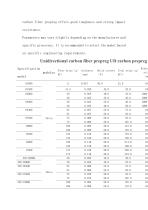
carbon fiber prepreg offers good toughness and strong impact resistance. Parameters may vary slightly depending on the manufacturer and specific processes. It is recommended to select the model based on specific engineering requirements. thickness Resin content Total weigt (g, (mm) (%) m) )
Open the catalog to page 4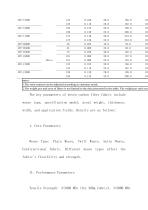
notes: 1.The resin content can be adjusted according to customer needs. 2.The weight per unit area of fibers is not limited to the data presented in the table. The weight per unit area The key parameters of woven carbon fiber fabric include weave type, specification model, areal weight, thickness, width, and application fields. Details are as follows: Weave Type: Plain Weave, Twill Weave, Satin Weave, Unidirectional Fabric. Different weave types affect the fabric's flexibility and strength. Tensile Strength: ≥3400 MPa (for 200g fabric), ≥3000
Open the catalog to page 5
Elastic Modulus: ^2.3X10⁵ MPa (meets national standard requirements). Density: Approximately 1/4 that of steel, offering significant lightweight advantages. Industrial Manufacturing: Aircraft components, automotive parts, wind turbine blades. Building Reinforcement: Seismic strengthening for bridges, tunnels, and floor slabs (requires epoxy resin adhesive). Sports Equipment: Fishing rods, golf clubs, etc. (Higher-tonnage carbon fabric offers lightness and stiffness, while lower-tonnage fabric provides greater toughness). Carbon fiber woven fabric series -1K, 3K, 6K, 12K Product model description:...
Open the catalog to page 6- Industrial technical fabric
- Reinforcement technical fabric
- Thermal insulation technical fabric
- Carbon technical fabric
- Composite technical fabric
- Epoxy resin prepreg
- Unidirectional technical fabric
- Carbon fiber technical fabric
- Fiberglass prepreg
- Electrical insulation technical fabric
- Professional technical fabric