
- Catalogs
- Campbell Scientific Ltd.
- EC150, IRGASON, or EC155


EC150, IRGASON, or EC155
EC150, IRGASON, or EC155
The document provides a technical analysis of Campbell Scientific Eddy Covariance (EC) systems, highlighting their role in measuring exchanges of heat, carbon dioxide, water vapor, and other gases between the Earth's surface and the atmosphere. This data is vital for understanding carbon storage and emissions across various land uses.
Infrared Gas Analyzers
There are two types of IRGAs discussed: open-path and closed-path. Open-path IRGAs, such as the EC150 and IRGASON, measure gases directly in the atmosphere, while closed-path IRGAs like the EC155 require a sample pump to measure gases within an enclosed cell.
Key Specifications
Closed-path systems consume more power (12W) compared to open-path systems (6W) and are generally more expensive. The IRGASON is more cost-effective due to its integrated components, while the closed-path CPEC200 system is 24% more expensive than open-path systems.
Installation and Maintenance
Installation is similar across systems, with the IRGASON simplifying the process by integrating components. Maintenance involves regular cleaning and chemical replacement, with closed-path systems requiring more frequent attention in dusty environments.
Calibration
Open-path systems need a calibration shroud, whereas closed-path systems offer automated zero/span calibration, improving accuracy.
Synchronization and Colocation
All systems achieve synchronization, but only the IRGASON ensures colocation, reducing measurement lag and error.
Lag Time and Flux Attenuation
The CPEC200 system experiences lag time due to wind and air sample travel, ranging from 4 to 132 ms. The IRGASON, with colocated sensors, avoids flux loss, unlike the EC150 and EC155, which require corrections.
Flow Distortion
Flow distortion affects wind velocity measurements. The EC150 and IRGASON minimize this by optimizing sensor placement, while the CPEC200 positions the IRGA away from the sonic path to reduce distortion.
Frequency Response
Open-path systems generally have better frequency response. The EC150 and IRGASON offer good response at various wind speeds, while the CPEC200 provides a bandwidth of 5.8 Hz, outperforming traditional closed-path systems.
WPL Corrections
Open-path IRGAs require WPL corrections due to temperature and latent heat flux effects, whereas closed-path IRGAs do not, as temperature fluctuations are dampened.
Rain Performance
Precipitation can block the infrared beam in open-path IRGAs. The EC150 and IRGASON mitigate this with angled windows and heaters, while closed-path IRGAs like the EC155 are less affected.
Summary
All EC systems are low power, with the CPEC200 having similar requirements to open-path systems. The IRGASON and EC150 are cost-effective, while the CPEC200 offers additional capabilities. Installation and maintenance are straightforward, with the IRGASON providing synchronous measurements and the CPEC200 excelling in frequency response, making it suitable for demanding sites.
Catalog excerpts

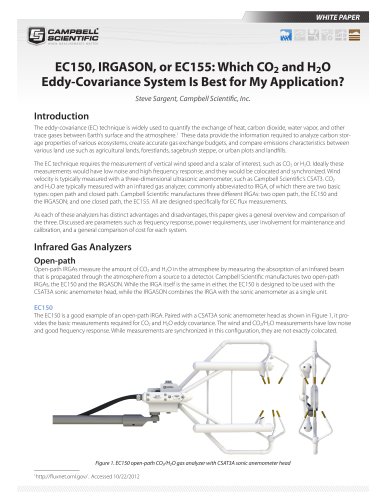
WHITE PAPER EC150, IRGASON, or EC155: Which CO2 and H2O Eddy-Covariance System Is Best for My Application? Steve Sargent, Campbell Scientific, Inc. Introduction The eddy-covariance (EC) technique is widely used to quantify the exchange of heat, carbon dioxide, water vapor, and other trace gases between Earth’s surface and the atmosphere.1 These data provide the information required to analyze carbon storage properties of various ecosystems, create accurate gas exchange budgets, and compare emissions characteristics between various land use such as agricultural lands, forestlands, sagebrush steppe, or urban plots and landfills. The EC technique requires the measurement of vertical wind speed and a scalar of interest, such as CO2 or H2O. Ideally these measurements would have low noise and high frequency response, and they would be colocated and synchronized. Wind velocity is typically measured with a three-dimensional ultrasonic anemometer, such as Campbell Scientific’s CSAT3. CO2 and H2O are typically measured with an infrared gas analyzer, commonly abbreviated to IRGA, of which there are two basic types: open path and closed path. Campbell Scientific manufactures three different IRGAs: two open path, the EC150 and the IRGASON; and one closed path, the EC155. All are designed specifically for EC flux measurements. As each of these analyzers has distinct advantages and disadvantages, this paper gives a general overview and comparison of the three. Discussed are parameters such as frequency response, power requirements, user involvement for maintenance and calibration, and a general comparison of cost for each system. Infrared Gas Analyzers Open-path Open-path IRGAs measure the amount of CO2 and H2O in the atmosphere by measuring the absorption of an infrared beam that is propagated through the atmosphere from a source to a detector. Campbell Scientific manufactures two open-path IRGAs, the EC150 and the IRGASON. While the IRGA itself is the same in either, the EC150 is designed to be used with the CSAT3A sonic anemometer head, while the IRGASON combines the IRGA with the sonic anemometer as a single unit. The EC150 is a good example of an open-path IRGA. Paired with a CSAT3A sonic anemometer head as shown in Figure 1, it provides the basic measurements required for CO2 and H2O eddy covariance. The wind and CO2/H2O measurements have low noise and good frequency response. While measurements are synchronized in this configuration, they are not exactly colocated. Figure 1. EC150 open-path CO2/H2O gas analyzer with CSAT3A sonic anemometer head http://fluxnet.ornl.gov/. Accessed 10/22/2012
Open the catalog to page 1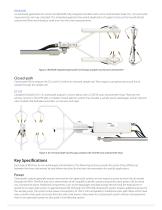
An advanced-generation EC sensor, the IRGASON, fully integrates the IRGA with a sonic anemometer head. CO2, H2O, and wind measurements are truly colocated. This integrated approach also avoids duplication of support structure that would disturb natural wind flow and introduce small error into the wind measurements. Figure 2. IRGASON integrated open-path CO2/H2O gas analyzer and 3D sonic anemometer Closed-path IRGAs measure the CO2 and H2O within an enclosed sample cell. They require a sample pump to pull the air sample through the sample cell. Campbell Scientific’s EC155 closed-path analyzer...
Open the catalog to page 2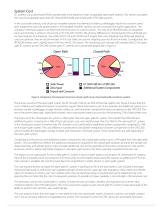
System Cost EC systems using closed-path IRGAs are generally more expensive than comparable open-path systems. This section compares the cost of comparable open-path (EC150 and IRGASON) and closed-path (CPEC200) systems. In this cost trade analysis, a set of typical complete systems was defined, including a datalogger, tripod and crossarm, zero/ span equipment, and solar power systems. All Campbell Scientific systems can be customized for a given application. The company’s technical support can determine the final cost of a custom system. The cost of an IRGASON with its integrated sonic anemometer...
Open the catalog to page 3
The CPEC200 can be ordered without the valve module, in which case zero/span of the EC155 must be performed manually, similar to the open-path IRGAs. For this comparison scenario (manual zero/span), the cost of zero/span is less for the closedpath. This is because the open-path zero/span requires the customer to buy a zero/span shroud and lab stand. The closed-path does not require these additional components as the sample cell is always included. The cost of the tripod and crossarm are the same in either system. The lower percentage of cost attributable to mounting structures for the closed-path...
Open the catalog to page 4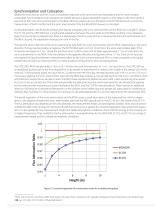
Ideally the wind velocity and the CO2/H2O would be measured at the same time (synchronized) and at the same location (colocated). Synchronization and colocation are related because a spatial separation leads to a time delay as the wind carries a parcel of air from the sonic anemometer to the IRGA. All three systems are synchronized as the EC100 electronics control the measurement of both the IRGA and the sonic anemometer. Only the IRGASON, however, is colocated. As described earlier, the IRGASON achieves this ideal by integrating the sonic anemometer and the IRGA into a single EC sensor. The...
Open the catalog to page 5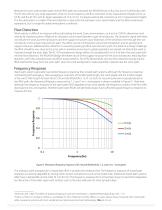
Because the sonic anemometer path and the IRGA path are colocated, the IRGASON has no flux loss (curve is identically one). The EC150, with its very small separation of 6.0 cm (2.4 in) requires a 2% flux correction at low measurement height (2.0 m, or 6.6 ft), and the EC155, with its larger separation of 15.6 cm (6.1 in) requires almost 6% correction at 2.0 m measurement height. The flux attenuation is smaller if the wind direction is along the line between sonic anemometer and the IRGA (streamwise separation), but it is larger for stable atmospheric conditions. Flow Distortion Wind velocity...
Open the catalog to page 6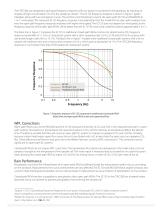
The CPEC200 was designed to give good frequency response with low power. It was tested in the laboratory by injecting an impulse of high-concentration CO2 into the sample air stream.5 The EC155 frequency response is shown in Figure 7 (green triangles), along with two comparison curves. The red line is the theoretical curve for the open-path (EC150 and IRGASON) at 1 m·s-1 wind speed. The measured EC155 frequency response is actually better than the model for the open-path analyzer. However, the open-path frequency response improves with higher wind speed. The EC155 does not depend on wind speed,...
Open the catalog to page 7All Campbell Scientific Ltd. catalogs and technical brochures
 Datalogger Overview
8 Pages
 Solar Radiation Sensors
2 Pages
 Precipitation Sensors
2 Pages
 Digital Cameras
1 Page
 TempVue 10
2 Pages
 FW05, FW1, and FW3
2 Pages
 ASPTC-L
2 Pages
 BLACKGLOBE-L
1 Page
 43347 and 43502
2 Pages
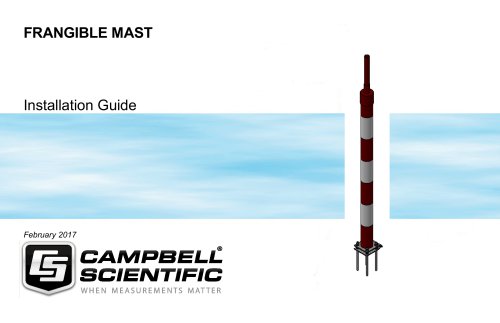 FRANGIBLE MAST
4 Pages
 Eases Programming
2 Pages



- Power supply unit
- DC power supply
- Digital imager
- AC/DC power supply
- Temperature probe
- Visible imager
- Rectangular housing
- Concentration analyzer
- Monitoring analyzer
- Data logger
- Resistance temperature sensor
- Infrared imager
- Plastic housing
- Monitoring camera system
- Wall-mount box
- Level probe
- Liquid level sensor
- Single-output power supply
- Analog I/O