
- Catalogs
- CAMOZZI AUTOMATION
- Pneumatic automation from basic principles to practical techniques EN


Pneumatic automation from basic principles to practical techniques EN

Pneumatic automation from basic principles to practical techniques EN
Camozzi Automation S.p.A. is a leader in pneumatic automation, providing high-quality solutions for various industrial sectors. The document highlights the importance of education in pneumatics, with the Camozzi Competence Centre offering continuous training and resources.
Structured educational programs are essential to keep up with technological advancements. The Camozzi Competence Centre ensures employees, suppliers, and clients are equipped with both theoretical and practical knowledge.
Pneumatic automation is versatile and high-performance, crucial for industrial processes. Understanding product operation and application principles fosters innovation and growth.
Camozzi Automation is a global leader offering customized solutions through research and development, operating six manufacturing plants with a focus on lean production and technological innovation.
- Chapter 1: Physics - Covers basic principles like atmospheric pressure and Boyle’s law.
- Chapter 2: Air Production and Preparation - Discusses compressors and air treatment.
- Chapter 3: Cylinders - Explains cylinder operation and performance modification.
- Chapter 4: Valves - Details valve types and applications.
- Chapter 5: Circuit Technique - Guidelines for designing pneumatic circuits.
- Chapter 6: Electro-Pneumatic Circuits - Integrating electrical and pneumatic systems.
Includes explanations of gas behavior under pressure, atmospheric pressure impact, and pneumatic and electro-pneumatic systems principles, with practical examples and calculations.
Camozzi Automation emphasizes continuous learning and innovation in pneumatic automation to meet industrial sector demands, serving as a comprehensive guide to pneumatic principles.
Discusses pressure equilibrium and Boyle's Law, stating that at constant temperature, gas volume is inversely proportional to pressure.
Explains how gases change volume with temperature changes, using Gay-Lussac's laws.
Illustrates calculations of volume and pressure changes using Boyle's and Gay-Lussac's laws.
Summarizes the interdependence of pressure, volume, and temperature with practical problems.
Discusses Gay-Lussac's laws application in pneumatic systems, providing formulas and calculations.
Explains pressure and flow rate concepts in pneumatics, using examples and Torricelli’s law.
Explores Pascal’s principle, demonstrating pressure consistency across system sections.
Discusses Venturi’s principle, highlighting fluid velocity and pressure changes in constricted tubes.
Covers basic mechanical concepts like force, work, velocity, and equilibrium of forces.
Explains sliding and rolling friction, influenced by material, surface finish, and contact force.
Provides calculations for static, kinetic, and rolling friction forces, and work done.
Describes magnetism and electromagnetism, including magnetic fields and solenoids.
Discusses compressors, air treatment, and pressure regulation, emphasizing air quality and efficiency.
Details air compression and cooling processes, including water removal and cooling methods.
Explains primary and secondary network configurations for air distribution.
Describes methods for determining correct pipe diameter based on flow rate and pressure drop.
Emphasizes the importance of removing impurities from compressed air.
Explains pressure regulator operation and relieving function.
Describes isolation valves and their role in air treatment units.
Explains soft start valves' function in controlling piston movement speed.
Discusses energy-saving pressure regulators without compensation chambers.
Used to maintain constant pressure by discharging excess air.
Describes the need for additional lubrication in pneumatic systems.
Explains pneumatic cylinders' force generation and sealing importance.
Analyzes pistons and calculates thrust forces, demonstrating relationships between diameter, pressure, and force.
Details pneumatic cylinder components and their functions.
Explains pressure dynamics in double-acting cylinders.
Discusses force development in single and double-acting cylinders.
Outlines different pneumatic cylinder types and construction materials.
Explains cylinder sizing based on load and performance factors.
Discusses braking systems in pneumatic cylinders and cushioning phase effectiveness.
Analyzes graphs illustrating load and piston speed relationships.
Describes adjustable cushioning systems in cylinders.
Explains the starting phase of pneumatic cylinders.
Describes brackets for fixing cylinder bodies and minimizing radial loads.
Discusses proper alignment of piston rods to avoid wear.
Explains compression load and standards for rod length and diameter.
Provides examples of different installation types and their impact on stroke length.
Includes diagrams for determining cylinder and rod dimensions.
Discusses installation types and maximum stroke lengths for cylinders.
Explains lever use in modifying cylinder performance.
Describes crank transformation of cylinder movement into angular movement.
Explains gear use in converting linear to circular motion.
Describes wedge use as a blocking device in pneumatic systems.
Discusses rotary cylinders and their applications.
Includes torque calculation and applications for various mechanisms.
Describes magnetic cylinders with proximity switches.
Discusses opposed, tandem, multi-position, and rod-less cylinders.
Calculates free air consumption and cost based on operational parameters.
Used for speed control in pneumatic systems.
Provides a technical analysis of pneumatic systems, focusing on cylinder and valve operation.
Describes hydrocheck use for precise speed regulation.
Used for increasing supply pressure in space-constrained scenarios.
Discusses valve types and their roles in pneumatic systems.
Explains poppet valve design and operation phases.
Describes spool valve configurations and functions.
Includes calculations for outgoing pressure determination.
Illustrates cylinder and valve operations with diagrams.
Provides technical information on valve types and manual control mechanisms.
Explains valve positions and operations in pneumatic systems.
Describes manual operation methods for poppet valves.
Discusses mechanical switches for valve operations.
Designed for compactness and small tube diameters.
Describes 3/2-way and 5/2-way spool valves.
Explains manual and mechanical control devices for valves.
Provides a technical analysis of solenoid valves in pneumatic systems.
Describes valve types and symbols for identification.
Categorizes valves into direct and indirect control types.
Details solenoid valve components and operation.
Explains operation of NC and NO solenoid valves.
Discusses typical applications of solenoid valves.
Stresses understanding pressure, orifice size, and solenoid force relationships.
Provides a technical analysis of solenoid valves in pneumatic systems.
Describes solenoid valves designed for reduced dimensions and low power consumption.
Describes internal and external servo pilot valves.
Offers a third position through a repositioning spring.
Used to stop pneumatic cylinders during their stroke.
Includes diagrams illustrating valve configurations.
Used in applications requiring precise control of pneumatic systems.
Describes operation of a double acting cylinder with an intermediate stop.
Describes integration of two spools into one valve body.
Used for processing signals in pneumatic circuits.
A 3/2-way NO monostable valve for low-pressure pilot signals.
A 3/2-way NC monostable valve for pneumatic logic circuits.
Used in pneumatic circuits to control signal passage.
Supplies a signal based on the last received pneumatic command.
A monostable 3/2-way NC valve that amplifies low-pressure pilot signals.
Discusses operation of pneumatic valves and sensors.
Emphasizes sizing valves based on flow rate.
Details calculations for valve and tube sizing.
Describes unidirectional and quick exhaust valves.
Adjust air flow to regulate piston speed.
Discusses operation of flow regulation valves.
Demonstrates effect of flow regulators on cylinder performance.
Examines use of valves with vacuum.
Ensure system operation within required pressure ranges.
Covers air preparation, cylinder types, and directional control valves.
Provides a guide on designing circuits for electric and pneumatic systems.
Explains circuit composition and symbol representation.
Describes valve and cylinder representations and operations.
Controls single cylinders using 3/2-way valves.
Requires air flow in two directions, controlled by 5/2-way valves.
Involves using a pilot valve for remote operation.
Describes circuits with defined actuator sequences.
Uses additional valves for automatic cycle repetition.
Explains pneumatic circuit operations and valve functions.
- Valve Operations: Explains pneumatically operated bistable 5/2-way valve operation.
- Elementary Circuits: Introduces 5-way/3-position valves with different centers.
- Literal and Graphical Representation: Describes cylinder movement representation.
- Flow Diagrams: Provides examples of flow diagrams for operations.
- Limit Switch Signals: Discusses role of limit switches in controlling movements.
- Continuous Cycle Operations: Details signals for continuous cycle operations.
- Understanding valve positions and limit switch activations is crucial.
- Different valve configurations have specific applications.
- Accurate representation of cylinder movements is essential.
- Flow diagrams are valuable for visualizing operations.
- Continuous cycle operations require careful signal management.
Analyzes pneumatic automation circuits, focusing on logic principles and functions.
Outlines pneumatic cylinder operation and limit switch roles.
Explains basic logic functions applicable to pneumatic systems.
Illustrates logic function applications in pneumatic systems.
Details pneumatic valve use for logic functions.
Emphasizes understanding logic functions for efficient automation.
Analyzes pneumatic circuit techniques, focusing on valves and memory functions.
Outlines use of 3/2-way and 5/2-way valves for signal management.
Describes memory valve use for signal handling.
Recommends valve types and emergency command design.
Includes figures illustrating valve and circuit configurations.
Highlights importance of valve selection and emergency mechanisms.
Outlines pneumatic circuit operation sequence involving multiple cylinders.
Describes sequence development for cylinder operations.
Analyzes circuit using 5/2-way and 3/2-way valves.
Details safety conditions for operation.
Outlines sequence phases and safety conditions.
Describes cycle involving multiple cylinders.
Identifies and manages different signal types.
Analyzes pneumatic circuit operation, emphasizing sequence and safety.
Discusses pneumatic cylinder operation using limit switches and signals.
- Signal c1: Generates negative stroke of cylinder A.
- Signal a0: Generates negative stroke of cylinder C.
- Signal c0: Generates negative stroke of cylinder B.
- Signal b0: Generates positive stroke of cylinder A.
Analyzes sequences and identifies blocking signals.
- Mechanical Control Removal: Removes mechanical control of limit switch.
- Air Supply Control: Controls air supply to limit switch.
- Signal Control: Controls signal generated by limit switch.
Includes flowcharts illustrating sequence phases.
Discusses solutions like unidirectional roller levers.
Provides strategies to ensure smooth pneumatic circuit operation.
Explains pneumatic circuit techniques using memory valves in cascade.
Describes system with cylinders performing tasks in sequence.
Details sequence phases and memory valve activation.
Emphasizes correct configuration of memory valves and limit switches.
Includes figures illustrating operation phases.
Stresses avoiding unintended limit switch activations.
Explains pneumatic circuit system operation using memory valves and sequencers.
Uses memory valves and limit switches for cylinder sequence control.
Describes step-by-step circuit operation.
Emphasizes safety and emergency function analysis.
Includes figures illustrating circuit layout and operations.
Relies on bistable and monostable valves for sequence control.
Provides a guide to pneumatic circuit system implementation.
Describes pneumatic and electrical system components and diagrams.
Explains relay operation and circuit control.
Describes identity, negation, and memory functions in circuits.
Explains electro-pneumatic circuit operation using solenoids.
Discusses monostable and bistable solenoid valve operation.
Describes single and continuous cylinder cycles using solenoid valves.
Analyzes electro-pneumatic circuits and logic functions.
- YES Function: Energizes solenoid with button activation.
- NOT Function: De-energizes solenoid with button activation.
- AND Function: Energizes solenoid with both button activations.
- OR Function: Energizes solenoid with either button activation.
- NAND Function: Energizes solenoid unless both buttons are activated.
- NOR Function: Energizes solenoid unless either button is activated.
Describes circuits with dual commands for maintenance.
Discusses emergency control methods for safety.
Includes figures illustrating circuit configurations.
Analyzes electro-pneumatic circuits for cylinder control.
Outlines solenoid valve use for cylinder movement control.
Describes operational procedures for cylinder cycles.
Emphasizes safety conditions for stroke execution.
Includes figures and equations for sequence control.
Highlights memory circuit use for signal control.
Outlines electro-pneumatic circuit operation for cylinder strokes.
Uses monostable solenoid valves and limit switches for control.
- Phase 1 (Stroke A+): Initiated by I.C. button for positive stroke.
- Phase 2 (Stroke B+): Triggered by contacts for positive stroke.
- Phase 3 (Stroke B-): Activated by limit switch for negative stroke.
- Phase 4 (Stroke C+): Initiated by limit switch for positive stroke.
- Phase 5 (Stroke C-): Triggered by limit switch for negative stroke.
- Phase 6 (Stroke A-): Activated by limit switch for negative stroke.
- Relays: Control sequence of operations.
- Solenoids: Control valve positions for strokes.
- Limit Switches: Detect cylinder positions.
Ensure correct wiring and maintenance for sequence integrity.
Catalog excerpts

CAMOZZI AUTOMATION PNEUMATIC AUTOMATION CAMOZZI COMPETENCE CENTRE Contacts Camozzi Automation S.p.A. Società Unipersonale Via Eritrea, 20/I 25126 Brescia Italy Tel. +39 030 37921 [email protected] A Camozzi Group Company PNEUMATIC AUTOMATION FROM BASIC PRINCIPLES TO PRACTICAL TECHNIQUES
Open the catalog to page 1
Published by Camozzi Automation S.p.A. Società Unipersonale Via Eritrea, 20/I 25126 Brescia Itay Tel. +39 030 37921 [email protected] 2019 Edition All rights reserved. Every intellectual property right on the contents of this manual is reserved for the purposes of the legislation. All the contents of these pages (title, texts, images and drawings included) may not, either totally or in part, be reproduced, published or distributed in any way without the prior written consent.
Open the catalog to page 2
CAMOZZI COMPETENCE CENTRE PNEUMATIC AUTOMATION FROM BASIC PRINCIPLES TO PRACTICAL TECHNIQUES
Open the catalog to page 3
THE IMPORTANCE OF EDUCATION IN PNEUMATICS Camozzi Competence Centre Expertise and passion Providing innovative high quality solutions to clients, Einstein stated “It is the supreme art of the teacher to offering efficiency, quality and reliability with awaken joy in creative expression and knowledge”. components adapted to the requirements of each It is now even more essential to institute an ongoing sector, thereby resulting in maximum added value training program which includes theoretical in terms of both performance and customer benefit, principles to complement knowledge acquired this has...
Open the catalog to page 4
THE UTILIZATION OF PNEUMATIC AUTOMATION IN THE INDUSTRIAL SECTOR Knowledge, imagination, creativity Progress begins here Knowledge is our greatest asset, and when the principles upon which the operation of knowledge, imagination and creativity coalesce, the products and respective applications are based. ideas are born, which stimulate progress and growth. In particular, process automation displays unique The rapidity of technological evolution features within each sector with pneumatics which characterizes this industry, demands representing one of the most common technologies, that component...
Open the catalog to page 7
CAMOZZI TECHNOLOGY AND TAILOR-MADE INDUSTRIAL SOLUTIONS Camozzi Automation is one of the leading Camozzi Automation is an international international groups operating in the field of network based in Italy with a presence on all pneumatic components for industrial automation. continents, comprising sales offices and workshops in 21 countries, with exclusive distributors With 6 manufacturing plants, structured according covering over 75 countries. to the principles of “Lean Production”, and supported by MARC (Mechatronic Application Research Center), Continuous technological research, development...
Open the catalog to page 8
CAMOZZI AUTOMATION > PNEUMATIC AUTOMATION Index Chapter 1 PHYSICS The air Atmospheric pressure Absolute and relative pressure Boyle’s law The effect of temperature on gases Gay-Lussac’s law Relationship between pressure, volume and temperature Pressure and flow rate Pascal’s principle Venturi’s principle Mechanical concepts Magnetism and electromagnetism Chapter 2 AIR PRODUCTION AND PREPARATION 38 Compressors 40 From the compressor to the air receiver 41 From the receiver tank to the point of use 43 Pipe size calculations 44 Treatment of compressed air: - the filter - coalescing filters 47 Pressure...
Open the catalog to page 10
CAMOZZI AUTOMATION > PNEUMATIC AUTOMATION Manual operation of poppet valves Mechanical operation of poppet valves Mini poppet valves 3/2-way spool valves 5/2-way spool valves Manual and mechanical operating devices for spool valves Pneumatic operating devices for the valves Directly operated solenoid valves Servo solenoid valves with internal pilot Servo solenoid valves with external pilot Three-position valves Blocking valves: - unidirectional - bidirectional Double 2/2-way and 3/2-way valves Signal processing valves Nominal flow rate Sizing of directional control distribution valves and connecting...
Open the catalog to page 11
CAMOZZI AUTOMATION > PHYSICS
Open the catalog to page 12
CAMOZZI AUTOMATION > PHYSICS The air Atmospheric pressure Absolute and relative pressure Boyle’s law The effect of temperature on gases Gay-Lussac’s law Relationship between pressure, volume and temperature Pressure and flow rate Pascal’s principle Venturi’s principle Mechanical concepts Magnetism and electromagnetis
Open the catalog to page 13
CAMOZZI AUTOMATION > PHYSICS Every entity having mass and space dimensions is defined matter and is made up of minute particles called “molecules”. Matter exists in the following forms: • solid, the molecules are rigidly bound, consequently the solids take on their own shape and volume; • liquid, the molecules are not rigidly bound together, they possess volume and assume the shape of the container which holds them; • gaseous, the molecules move freely - to the point that the distance between them varies continuously, as does their relative positions. Gases therefore have neither shape nor definitive...
Open the catalog to page 14
CAMOZZI AUTOMATION > PHYSICS Atmospheric pressure Air possesses weight as a result of the Earth’s gravity. The sensation of weight exerted on anything it comes into contact with is called atmospheric pressure. One of the characteristics of atmospheric pressure is that it varies according to the altitude. The maximum value is at sea level (zero altitude) and decreases as the altitude increases. This is due to the weight of the air on the lower layers of the atmosphere being greater than the weight on the upper layers. At sea level the atmospheric pressure is an average of 760 mm Hg and decreases...
Open the catalog to page 15
CAMOZZI AUTOMATION > PHYSICS The height which the column of water must achieve to equal the atmospheric pressure is 10,3 m. In the International System the unit of measurement of pressure is the Pascal (Pa) and is equal to the pressure of a Force of 1 N over 1 m2. 1 Pa = 1 N ⁄ m2 A much used multiple of Pa is the bar (even though it doesn’t belong to the International System): 1 bar ≈ 100.000 Pa ≈ 0,1 MPa The table below illustrates the most common units of measure: bar mercury column column of water same weight 10,33 Newton Absolute and relative pressure In this chapter we observe the phenomena...
Open the catalog to page 16All CAMOZZI AUTOMATION catalogs and technical brochures
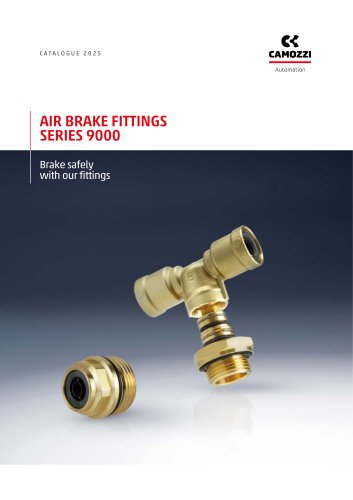 Air brake fittings Series 9000
36 Pages
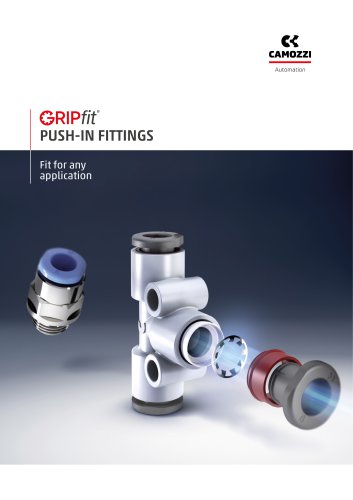 GRIPfit - Push-in Fittings
16 Pages
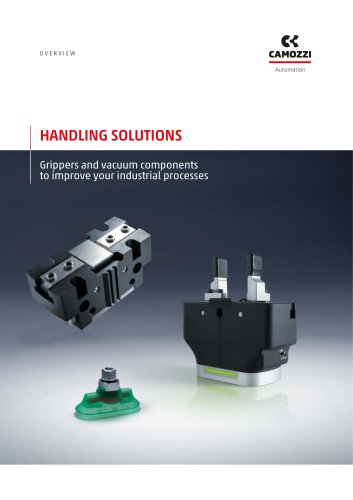 Handling solutions
12 Pages
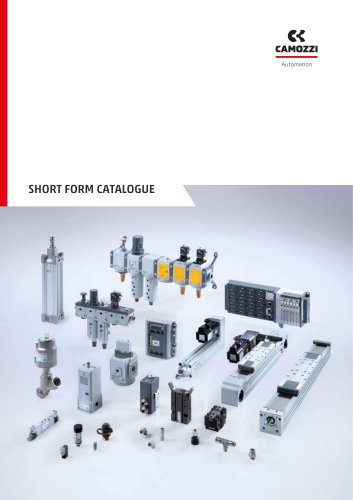 Short Form Catalogue
392 Pages
 Transportation Overview
24 Pages
 Electric Actuation Overview
8 Pages
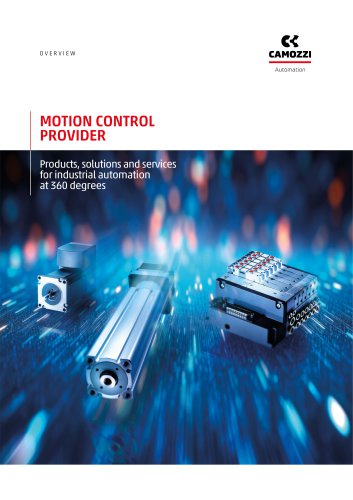 Camozzi Automation Overview
20 Pages


Archived catalogs
 Training Simulators EN
20 Pages
 Pneumatic connection
126 Pages
 Series 63 ISO 15552 cylinder EN
16 Pages
 Fieldbus and Multipole Systems
260 Pages
 Air treatment
234 Pages
 Proportional Technology
82 Pages
 Handling
132 Pages
 Valves and Solenoid Valves
418 Pages
 Vacuum Components
76 Pages
 Pneumatic actuation
333 Pages
 Electric actuation
116 Pages
 Series 29 Mini ball valves
4 Pages
 Handling solutions EN
8 Pages
 SERIES 63
12 Pages


