
- Catalogs
- Camille Bauer Metrawatt AG
- Main Catalogue Industrial Measuring Solutions 2016/2017


Main Catalogue Industrial Measuring Solutions 2016/2017

Main Catalogue Industrial Measuring Solutions 2016/2017
- Measurement Input: Voltage range from 0 V to 690 V, with nominal frequencies of 50/60 Hz or 400 Hz. Current range from 1 A to 6 A, with various configurations for single-phase and three-phase systems.
- Measurement Output: Configurable outputs including 1 mA to 20 mA or 1 V to 10 V, with options for unipolar, bipolar, or live-zero signals.
- Accuracy: Class 0.2 to 0.5 at temperatures between 15°C and 30°C.
- Power Supply: Options include 24 – 60 V AC/DC or 85 – 230 V AC/DC, with some devices powered directly from the measurement input.
- Dimensions: Standard dimensions for devices are 69.1 x 70 x 112.5 mm, with variations for different configurations.
- Monitoring of power consumption and system stability, with applications in energy distribution and process engineering.
- Safety features include galvanic isolation and shock-proof terminals, compliant with IP20 standards.
- Standard compliance with Germanischer Lloyd (GL) for maritime applications.
- Power system monitoring for energy distribution, rotating machines, and conveyor facilities.
- Frequency and phase angle monitoring for synchronization and control in electric systems.
- Insulation monitoring for medical IT systems, ensuring safety and compliance with IEC/EN 61557-8 standards.
- Various models available for specific measurement needs, including SINEAX and SIRAX series for voltage, current, frequency, and power measurements.
- LINAX IR7100 for insulation monitoring in medical environments.
The document discusses multifunctional instruments for power system monitoring, specifically designed for top-hat rail installations. These instruments are used in energy distribution, automation, and process engineering to monitor and process electrical variables efficiently. They offer advantages such as reduced installation time, flexibility, and lower costs compared to conventional transducers.
Specifications
The devices comply with DIN VDE 0100-710 and IEC 60364-7-710:2002-11 standards, monitoring insulation in IT systems and identifying faults. They also monitor phase currents and transformer temperature. Key features include an insulation monitor, alarm relays, and a display/control unit. The RS485 (Modbus RTU) interface facilitates parameterization and data retrieval.
Operating Principle
The instruments measure the fundamental frequency, sample input variables, calculate required measurements, and provide values for process use. They support extensive analyses limited by the microcontroller's capacity.
Application
These instruments are suitable for various system configurations and can be programmed without hardware variants. They support universal use with current and voltage transformers or direct connections. The devices offer service functions for commissioning and can simulate outputs for testing.
Technical Data
Measurement inputs range from 57.7 to 400 V (Ph-N) and 100 to 693 V (Ph-Ph), with a frequency range of 45-65 Hz. The devices offer high accuracy with voltage and current uncertainty at ±0.12% and power at ±0.2%. They support a power supply of 100-230 V AC/DC or 24-230 V DC.
Device Variants
The SINEAX DM5S and DM5F are universal measurement devices for heavy-current systems, adaptable via CB-Manager software. They support analog DC current outputs or Modbus mapping and can handle up to 32 energy meters with tariff assignments.
Customer Benefits
The instruments provide consistent measurement, adaptability, and comprehensive system analysis. They feature a graphic display for data visualization and support long-term recording and event logging.
Interfaces and Communication
Options include USB, Modbus/RTU, Ethernet, and IEC 61850 protocols for real-time data analysis. The devices support high-bandwidth Ethernet communication for efficient data transmission.
Conclusion
These multifunctional instruments offer a robust solution for power system monitoring, providing flexibility, accuracy, and comprehensive data analysis capabilities.
The document provides a comprehensive overview of multifunctional instruments for power system monitoring, focusing on the SINEAX AM-SERIES and APLUS devices. These instruments are designed for measuring, monitoring, and analyzing power systems, offering high-quality Swiss engineering and customer benefits.
Specifications
The devices support various functionalities, including:
- 12 limit values and 8 monitoring functions with 3 inputs each.
- 1 collective alarm combining all monitoring functions.
- 3 operating hour counters with definable conditions.
Data Recording
The devices feature a high-performance data logger for recording periodic data, events, and disturbances. The AM2000/AM3000 models use an SD card for memory, while the AM1000 uses internal memory.
Power System Monitoring
The APLUS platform is versatile, available with TFT or LED displays or as a top-hat rail version. It supports remote control, open communication via Modbus/RTU, Modbus/TCP, and Profibus DP, and offers long-term data storage and power quality analysis.
Energy Management
APLUS devices facilitate energy management through active and reactive meters, load profiles, trend analysis, and external meter connections. They are suitable for power distribution, industrial environments, and building automation.
Technical Data
Key technical specifications include:
- Nominal voltage up to 693 V and current up to 5 A.
- Accuracy: Voltage and current 0.1%, power factor ±0.1°.
- Dimensions: 96 x 96 x 105 mm (with display).
Customer Benefits
The devices offer clear data visualization, easy operation, and parameterization. They integrate active and reactive energy meters and provide cost-effective alternatives to traditional energy meters.
Conclusion
The document highlights the versatility and advanced features of the SINEAX AM-SERIES and APLUS devices, making them ideal for demanding power system monitoring and energy management tasks.
Specifications: The instruments feature large LED displays, digital outputs for alarms, integrated power meters, and extendable functionality through plug-in modules. They support various system configurations, including single-phase and three-phase currents, and offer high accuracy in voltage, current, power, and frequency measurements. Power supply options range from 100-230 V AC/DC to 24-60 V AC/DC.
Applications: These instruments are suitable for monitoring electrical distribution systems, especially in environments with non-linear loads like computers and electronically controlled motors. They help prevent issues such as fuse blow-outs, overloads, and device malfunctions by analyzing harmonics and system unbalance.
Power Quality Monitoring
The document emphasizes the importance of continuous power quality monitoring to proactively address potential issues. Devices like LINAX PQ3000 and MAVOSYS 10 provide detailed power quality analysis, conforming to international standards such as IEC 61000-4-30 and EN 50160. They offer features like data exchange formats, energy consumption analysis, and network state monitoring.
Customer Benefits
Users benefit from enhanced system availability, proactive issue detection, and compliance with regulatory standards. The instruments support various communication protocols and can be configured via software or web interfaces.
Accessories and Extensions
Extension modules and accessories, such as top-hat rail adapters and interface adapter cables, enhance the functionality of the instruments. The document also mentions software tools for configuration and data analysis, such as A200plus and SMARTCOLLECT PM20.
Conclusion
The document highlights the critical role of precise instruments in process control engineering, emphasizing their use in temperature measurement, signal conversion, and process management to ensure safety and efficiency in industrial applications.
- Customer Benefits: Offers 3-way galvanic isolation and removable screw-fit terminals.
- Technical Data: Input and output can be current or voltage, with a test voltage of 1.5 kV and accuracy of 0.2%. Power supply ranges from 19-40 V DC or 19-28 V AC.
- Customer Benefits: Features HART pass-through and is suitable for hazardous areas with line breakage and short-circuit monitoring.
- Technical Data: Input circuit of 4-20 mA, with various output options. Power supply ranges from 24-60 V AC/DC or 85-230 V AC/DC.
- Customer Benefits: Similar to B811 with additional line monitoring via LED and a setting time of less than 0.3 ms.
- Technical Data: Similar input and output specifications as B811, with different dimensions.
- Customer Benefits: Offers configurable I/O combinations, intrinsically safe inputs, and manual calibration.
- Technical Data: Supports a wide range of input and output signals, with power supply options of 24-60 V AC/DC or 85-230 V AC/DC.
- Customer Benefits: Provides high-voltage isolation for shunt and voltage measurement with a high test voltage of 10 kV.
- Technical Data: Switch-selectable input and output ranges, with a power supply of 24-253 AC/DC.
- Customer Benefits: Programmable without power supply connection, suitable for temperature measurement in hazardous areas.
- Technical Data: Supports various thermocouples and resistance thermometers, with programmable output options.
- Customer Benefits: Multifunctional signal converter with high accuracy, integrated mathematical functions, and safety-aligned measurements.
- Technical Data: Supports a wide range of inputs and outputs, with a power supply of 24-230 V DC or 100-230 V AC.
- Customer Benefits: Similar to V604s with additional remote I/O functionality and MODBUS communication.
- Technical Data: Similar input and output specifications as V604s, with programmable relay options.
This document provides detailed technical specifications and customer benefits for various process control engineering and power system monitoring devices, including multifunctional transmitters, videographic recorders, and data management systems. It also outlines the accessories and software required for configuration and data analysis.
Specifications and Features
- Multifunctional Transmitters (SINEAX VC604s and VQ604s): These devices measure DC voltage, DC current, temperature, and resistance. They feature MODBUS system capability, sensor redundancy, programmable relays, and a wide-range power supply. Inputs and outputs are adjustable, and the devices support various thermocouple types.
- Videographic Recorders (LINAX DR2000 and DR3000): These recorders offer high-quality TFT displays, fast scanning rates, and IP65/NEMA4 protection. They support multiple channels, have extensive memory options, and provide data security compliant with FDA standards.
- Data Management Systems (SMARTCOLLECT): Designed for energy and industry applications, this software measures, stores, and visualizes consumption data. It offers transparency, cost reduction, and optimization through comprehensive reporting and analysis functions.
Technical Data
- Inputs and Outputs: Devices support Pt100, Ni100, and various thermocouples. Outputs are adjustable for current and voltage, with relay outputs for AC and DC.
- Power Supply: Devices operate on a wide range of AC/DC power supplies.
- Dimensions: Standard dimensions are provided for installation compatibility.
Accessories and Software
- Converters: USB to RS485 and RS232 converters are available for device connectivity.
- Programming Cables: Various cables are offered for programming and communication with devices.
- Configuration Software: Software for device parameterization and data visualization is available, supporting multiple languages and operating systems.
Customer Benefits
- Devices offer fast measurement, system capability, and easy sensor connections without external jumpers.
- Software provides user-friendly interfaces, modular design, and versatile use for energy data management.
- Comprehensive support and multilingual options enhance user experience and accessibility.
- Measuring Range: Programmable between 0° to 360° for KINAX HW730 and specific ranges for other models like KINAX WT707 and WT717.
- Power Supply: Power over Ethernet (PoE) for KINAX HW730, and DC/AC voltage for others.
- Accuracy and Reproducibility: High accuracy with error limits as low as ±0.15° and reproducibility of <0.1° for KINAX HW730.
- Environmental Conditions: Operates in temperatures ranging from -40°C to +85°C, with high humidity tolerance and robust housing protection (IP 67 and IP 69k).
- Starting Torque: Maximum 0.5 Nm for KINAX HW730, with other models having different specifications.
- Material: Housing made of anodized aluminum and shafts of rust-proof hardened steel.
- Mounting Position: Flexible mounting options available.
- Robust design suitable for field applications with high mechanical and electrical safety.
- Capacitive scanning system ensures no wear and low maintenance.
- Vibration and shock-resistant, suitable for hazardous areas with explosion protection.
- Programmable features include measuring range, sense of rotation, and output characteristics.
- Electrical connections via spring-type terminal block or plug connector M12.
- Supports Modbus/TCP protocol with PoE for fast implementation and high bandwidth transmission.
The document provides detailed specifications for position sensors and transmitters for angular position, specifically focusing on the KINAX 2W2 and KINAX N702 series. Key specifications include:
- Drive shaft diameters of 2 mm, 6 mm, or 1/4" with admissible static loading of radial max 16 N and axial max 25 N for 2 mm shafts, and radial max 83 N and axial max 130 N for 6 mm or 1/4" shafts.
- Materials used include chromated aluminium for housing and rust-proof hardened steel for shafts.
- Environmental conditions specify a temperature range of -25 to +75 °C and relative humidity ≤ 90% non-condensing, with improved versions offering wider ranges.
- Explosion protection is provided with intrinsic safety Ex ia IIC T6.
The KINAX 2W2 features a programmable measuring range between 0 to 350°, with a measuring output of 4 to 20 mA using a 2-wire connection. It supports a power supply of 12 to 33 V DC and offers high accuracy with an error limit of ≤ ±0.5% and reproducibility of < 0.2%. The response time is < 5 ms.
The KINAX 2W2 is a compact transmitter designed for integration into other equipment. It uses a capacitive scanning system for immediate absolute position detection, requires low maintenance, and can be mounted in any position. It supports programming via PC for various parameters including measuring range and output characteristics.
The document also covers inclination transmitters like the KINAX N702 series, which use a magnetoresistive angular position transmitter principle. These transmitters are robust, contact-free, and freely rotatable without stops. They convert tilt angles into direct current signals proportional to the angle, with applications in solar energy plants, shipping, and heavy-duty vehicles.
Both position and inclination transmitters adhere to various environmental and protection standards, including IP 66 housing protection and compliance with IEC standards for vibration and shock resistance.
The document details the specifications of inclination transmitters, specifically the KINAX N702-INOX and KINAX N702-INOX HART models. These transmitters convert tilt angles into direct current signals, crucial for safety and control systems in machinery. The measuring principle is magnetic with a hall sensor and oil-damped pendulum system, offering a programmable measuring range between 0 to 360 degrees. The power supply ranges from 8 to 33 VDC with a power consumption of less than 22 mA. The basic accuracy is less than ±0.2° at 25°C, with a resolution of 12 bits and a transient response time of less than 1 second for 25° tilts.
Mechanical and Environmental Data:
The transmitters are made from stainless-steel INOX AiSi 316Ti, weighing approximately 1.1 kg. They are designed to operate in temperatures ranging from -30 to +70°C and can withstand relative humidity up to 100%. The housing protection is rated IP68 and IP69K, making them resistant to aggressive media like seawater and detergents. They are also robust against high mechanical loads and vibrations.
Electrical Connections:
The document provides a detailed pin configuration for the M12 connector, specifying the cable colors and corresponding signals. The inclination sensor connects via a flexible, shielded signal line, preassembled at the factory.
Main Features:
The transmitters are robust, hermetically sealed, and suitable for field applications. They offer free parameterization via control lines and are HART compatible. The design ensures high measuring accuracy and steadfastness to mechanical loads.
Accessories:
The document lists various accessories for mounting and connecting the transmitters, including programming cables, plug connectors, adapter sleeves, and mounting kits. These accessories facilitate easy installation and secure connections.
Drive System Variables:
The document also discusses important drive system variables, emphasizing the need for motors to be designed according to their mode of operation to prevent overload. It outlines different modes of operation, such as continuous and temporary operations, and provides formulas for calculating torque, work, performance, and acceleration times.
Operating Ratio:
The operating ratio of a machine is determined by the impact factor, average operating time per day, and the number of switching operations per hour. The document provides a table to determine the operating ratio based on these factors.
Conclusion:
The document provides comprehensive technical data and guidelines for the use and installation of inclination transmitters, ensuring accurate and reliable performance in various industrial applications.
This document provides technical specifications and guidelines for shaft couplings and energy management systems. It covers the basics of shaft misalignments, selection criteria for couplings, and energy management solutions including energy meters and software.
Shaft Couplings
- Misalignments: Three types of misalignments are identified: radial, angular, and axial. These can cause stress on bearings, leading to increased wear and shorter machine runtimes.
- Coupling Selection: Key considerations include shaft diameters, installation space, connection type, maximum speed, torque, misalignment tolerance, climatic conditions, and electric insulation requirements.
- Torsion Spring Stiffness: The stiffness should be high enough to prevent natural resonance but low enough to minimize retractive forces on bearings.
- Assembly Instructions: Steps include checking for misalignment, aligning couplings, fastening screws carefully, and protecting the coupling during assembly.
Energy Management
- Overview: Rising energy costs necessitate efficient energy management. The document highlights the potential for significant savings through responsible resource management and minor investments.
- Energy Meters: These are used for acquiring and billing electrical energy across various sectors. They come with initial MID calibration for immediate use in billing.
- Summation Stations: These collect and evaluate meter data through different interfaces.
- Load Management: Systems like the U1500 help avoid power peaks through load optimization.
- Energy Management Software: SMARTCOLLECT software offers data management, analysis, monitoring, and reporting capabilities.
- Current Transformers: These transform high alternating currents into safe, measurable currents.
Technical Specifications
- Energy Meters: Available in various configurations for different systems (2-wire, 3-wire, 4-wire) with options for direct or transformer connections.
- Approval and Calibration: Meters comply with the MID directive and are shipped with initial factory calibration, reducing lead times and costs.
- Customer Benefits: Features include flexibility, compact design, rapid installation, cost-effectiveness, and integration capabilities.
Conclusion
The document emphasizes the importance of selecting the right shaft couplings and implementing effective energy management systems to enhance machine performance and reduce energy costs.
The document provides detailed specifications and functionalities of various energy meters designed for different electrical systems. These meters are used for energy management in industrial, commercial, and residential applications.
Specifications
The energy meters are available for 2-wire, 3-wire, and 4-wire systems, with options for direct and transformer connections. They comply with the MID directive, ensuring they are suitable for billing purposes across Europe. The meters support system frequencies of 50 Hz and 60 Hz and offer various voltage ratings (100-500 V).
Features
- Initial factory calibration for cost savings and immediate use.
- Multifunctional design with options for reactive energy measurement.
- Pulse output options for energy measurement, with programmable rates.
- Bus connection interfaces including LON, M-Bus, and L-Bus.
- Integrated error detection for installation issues.
- Optional auxiliary power input for meter reading when the circuit is off.
Applications
The meters are suitable for energy acquisition and billing in trade, household, industry, and building management. They provide real-time power display and can be connected directly or via transformers.
Customer Benefits
- Precise energy measurement with class B accuracy.
- Cost-effective due to initial calibration and conformity with MID.
- Compact design requiring minimal space.
- Optional interfaces for flexible communication and data logging.
Technical Data
- Nominal voltage: 100-500 V.
- Nominal frequency: 50 Hz or 60 Hz.
- Direct connection: 5(65) A; Transformer connection: 1(6) A and 5(6) A.
- Display: LCD with 7-digit main and 8-digit ancillary displays.
- Accuracy: Active energy class B, Reactive energy class 2.
Stock Variants
Various models are available for direct and transformer connections, with options for different system configurations and communication interfaces.
Accessories
Includes installation sets and various types of current transformers.
Communication Modules
Modules for Modbus, M-Bus, and TCP/IP LAN are available, allowing integration with data logging and management systems.
Summation Stations
These stations facilitate the transmission of consumption data via various bus systems and are integrated into management systems for data evaluation and processing.
The document provides detailed information on various energy management products and solutions offered by Camille Bauer. These include the SMARTCONTROL, SMARTLOGGER, load management systems, and different types of current transformers. Each product is designed to optimize energy usage, manage consumption data, and reduce energy costs.
SMARTCONTROL
The SMARTCONTROL system is a versatile energy management tool that integrates with the Energy Control System (ECS). It collects energy and consumption data, manages load, and sends error messages. It supports various inputs and outputs, including digital, analog, and temperature inputs, and can be configured via the SMARTCONTROL manager. The system can be networked using Modbus TCP and supports memory expansion.
SMARTLOGGER
The SMARTLOGGER is a multifunctional data logger that complements the ECS for applications with fewer measuring points. It logs energy and consumption data, manages error messages, and supports various interfaces, including M-Bus and Modbus. It is equipped with digital and analog inputs and outputs, and offers a UPS function with an optional external battery.
Load Management
The U1500 system is designed to reduce power peaks and optimize load management. It features inputs for operating feedback and special control programs for kitchen optimization. The system helps reduce energy costs by managing the start-up of power-consuming devices.
Current Transformers
The document describes different types of current transformers, including split-core, bushing-type, and wound-primary transformers. These devices convert high amperage AC current into safe, measurable current. They are designed for easy installation and are suitable for retrofit purposes without interrupting the power supply.
Technical Specifications
The document provides detailed technical specifications for each product, including input and output configurations, interfaces, memory options, and power supply requirements. It also lists available stock variants and accessories for each product.
The document outlines specifications for various transformers (WSK 30, WSK 40, WSK 70.6 N) with details on dimensions, primary and secondary current ranges, and VA ratings. It includes article numbers for different configurations and accessories like snap fasteners and sealing caps.
Energy Management Software:
The document describes two software solutions: EMC 5.X and SMARTCOLLECT. EMC 5.X is designed for automatic logging, visualization, analysis, and billing of energy consumption data, offering benefits like cost minimization and environmental compatibility. SMARTCOLLECT is a modular data management software that stores data in an open SQL database and supports easy data communication and analysis.
Technical Data:
Minimum system requirements for EMC 5.X include a Pentium PC with 1 GHz, 250 MB RAM, and compatibility with XP and Windows 7. The software supports multiple languages and offers various expansion modules for enhanced functionality.
Customer Benefits:
Both software solutions provide transparency, cost savings, and environmental benefits. EMC 5.X offers real-time data overview and flexible billing, while SMARTCOLLECT supports easy data communication and modular expansion.
Services:
Camille Bauer Metrawatt AG offers services including on-site support, documentation, and testing. The company emphasizes safety, quality, and environmental standards, with certifications like ISO 9001 and ISO 14001.
Environmental Testing:
The document details environmental testing procedures to ensure product reliability under various conditions, including temperature, humidity, and mechanical stress. Standards like EN/IEC 60 688 guide these tests to verify device performance and durability.
Shock testing involves subjecting a device to specific shocks through acceleration and deceleration at irregular intervals to assess its behavior when dropped from a certain height.
Some instruments require tests not covered by standard procedures, such as earthquake vibration tests, which need low-frequency, high-amplitude vibrations. These tests are conducted externally, with costs typically borne by the customer. Camille Bauer offers test instruments for customer use upon request.
Camille Bauer can perform all required product tests in-house, including cold, dry heat, humid heat, vibration, and shock tests as per EN/IEC standards.
EMC ensures that electrical products operate safely without emitting or being affected by electromagnetic interference. Compliance with the EMC Directive 89/336/EC is mandatory for products in Europe, marked by the CE-mark. Outside Europe, similar standards apply.
The proliferation of electronic devices increases interference risks, especially with high-frequency applications like mobile phones. This can lead to operational failures in sensitive environments like hospitals and aircraft.
Interference often arises in industrial settings with high power usage or wireless communication facilities, affecting sensitive equipment.
Specific standards define product requirements and testing procedures. Complete examination according to these standards is necessary for EMC safety, though partial testing is sometimes conducted due to cost or equipment limitations.
Galvanic isolation electrically separates circuits to prevent charge flow, ensuring safety and signal integrity. Camille Bauer uses both electromagnetic and optical methods for isolation in their signal converters.
Signal converters perform signal conversion, galvanic isolation, and amplification. They are available in passive (2-wire) and active (4-wire) configurations, with active converters providing additional functionalities like signal amplification.
Camille Bauer designs equipment for hazardous areas with intrinsic safety, preventing ignition in explosive environments. Equipment is classified by zones based on the presence of gas or dust, with specific requirements for each zone.
Pertaining equipment is installed outside hazardous zones to safely couple or decouple electrical signals into or out of these zones. It must be designed and certified according to construction regulations concerning external voltage influences and circuit values. Camille Bauer's pertaining equipment includes passive isolators, power supply units, alarm units, programmable isolation amplifiers, universal transmitters, and temperature transmitters.
An intrinsically safe circuit consists of at least one intrinsically safe and one pertaining equipment. The safety values of both must be harmonized, and the user is responsible for ensuring safe interconnection.
The safety of intrinsically safe circuits depends on the components used and their susceptibility to failure. Devices are classified into three protection levels according to EN 60079-11:
- ia: No ignition with two errors in normal operation (Zones 0, 1, 2)
- ib: No ignition with one error in normal operation (Zones 1, 2)
- ic: No ignition in normal operation (Zone 2)
Electrical equipment is labeled according to ATEX and IECEx standards, indicating type of protection, temperature class, equipment protection level, gas and dust group, and equipment category. Special installation conditions and certificate numbers are also provided.
Systems are classified by IP codes for protection against contact, foreign matter, and water. The first digit indicates protection against contact and foreign matter, while the second digit indicates water protection.
Accuracy, error limits, repeatability, and resolution are defined for position sensors. Binary and Gray codes are used for encoding, and protection classes are specified for contact and foreign matter.
SSI provides absolute position information via a serial interface, suitable for industrial environments. CANopen is a communication protocol used in automation, with basic services like request, indication, response, and confirmation. Communication objects include SDO, PDO, NMT, and others.
- Power System Monitoring: Includes a range of instruments from simple measuring transducers to multifunctional system modules that monitor energy consumption and electric grid quality.
- Position Sensors: Offers solutions for angular position and inclination measurement, suitable for rough environments.
- Energy Management: Provides complete solutions from energy meters to data management software for sustainable cost savings and resource management.
Catalog excerpts

Camille Bauer Metrawatt AG DISTRIBUTION PARTNERS IN OVER 40 COUNTRIES Electromediciones Kainos S.A. Poligon Industrial Est, Energía, 56 E-08940 Cornellá de Llobregat · Barcelona TEL +34 934 742 333 · FAX +34 934 743 470 www.kainos.es · [email protected] ˇ GMC-mêricí technika s.r.o. Fügnerova 1a CZ-67801 Blansko TEL +420 516 482 611/-617 · FAX +420 516 410 907 www.gmc.cz · [email protected] GMC-Instruments Italia S.r.l. Via Romagna, 4 I-20853 Biassono (MB) TEL +39 039 2480 51 · FAX +39 039 2480 588 www.gmc-instruments.it · [email protected] GMC-Instruments (Tianjin) Co., Ltd Rm.710 · Jin Ji Ye BLD. No.2 · Sheng Gu Zhong Rd. P.C.: 100022 · Chao Yang District TEL +86 10 84798255 · FAX +86 10 84799133 www.gmci-china.cn · [email protected] Camille Bauer Metrawatt AG Aargauerstrasse 7 ▪ 5610 Wohlen ▪ Switzerland TEL +41 56 618 21 11 ▪ FAX +41 56 618 21 21 www.camillebauer.com ▪ [email protected] Industrial measuring solutions 2016/2017 GMC-Instruments France SAS 3 rue René Cassin F-91349 Massy Cedex TEL +33 1 6920 8949 · FAX +33 1 6920 5492 www.gmc-instruments.fr · [email protected] Subject to change without notice ▪ CB-1037-00-01-EN-08.16 GMC-I Messtechnik GmbH Südwestpark 15 D-90449 Nürnberg TEL +49 911 8602-111 · FAX +49 911 8602-777 www.gossenmetrawatt.com · [email protected] YOUR DISTRIBUTION PARTNER INDUSTRIAL MEASURING
Open the catalog to page 1
WELCOME TO CAMILLE BAUER METRAWATT AG. Further fields of the GMC-Instruments Group: TEST AND MEASUREMENT Operating as a leading provider of high-quality instrumentation, we have pursued the goal of making electric engineering processes safer, more transparent and thus more efficient for more than 70 years. Being a leading provider of measuring and testing technology, we offer our customers a wide and modern portfolio of instruments. High-quality multimeters, device testers, installation test devices as well as an extensive service program – this is what Gossen Metrawatt stands for. Camille Bauer...
Open the catalog to page 2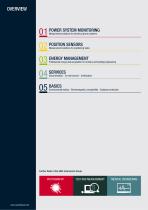
01 POWER SYSTEM MONITORING Measurement solutions for electrical power systems Measurement solutions for positioning tasks Professional energy data acquisition for industry and building engineering Documentation - On-site service - Certification Environmental testing - Electromagnetic compatibility - Explosion protection Further fields of the GMC-Instruments Group: MEDICAL ENGINEERIN
Open the catalog to page 3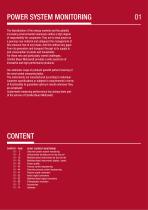
POWER SYSTEM MONITORING The liberalisation of the energy markets and the globally increasing environmental awareness define a high degree of responsibility for companies: They are to treat power as a precious raw material and safeguard the management of this resource free of any losses. And this without any gaps: From its generation and transport through to its supply to and consumption at plants and households. For these new and particularly varied challenges, Camille Bauer Metrawatt provides a wide spectrum of innovative and high-performance products. Our extensive range of products perwith...
Open the catalog to page 4
Q-| POWER SYSTEM MONITORING WITHOUT DISPLAY WITH DISPLAY HIGH-VOLTAGE ISOLATION INSULATION INSTRUMENTS DISPLAY/ POWER MANAGEMENT | QUALITY PROCESS CONTROL Signal converters Videographic recorders SOFTWARE, ACCESSORIES PROGRAMMING AND CONFIGURATION DATA MANAGEMENT ADDITIONAL CABLES SOFTWARE SOFTWARE Please take further technical specification from the data sheets.
Open the catalog to page 5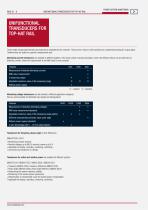
UNIFUNCTIONAL TRANSDUCERS FOR TOP HAT RAIL POWER SYSTEM MONITORING I—/~~| TOP-HAT RAIL These mostly analog based devices are produced as requested by the customer. They convert a heavy-current quantity into a proportional analog DC output signal. Therefore they are suited to a specific measurement task. Alternating current transducers are available in different qualities. If the input current is almost sinusoidal a more cost-effective device can be used than for distorted currents, where the measurement of the RMS value is more complex. Measurement of distorted alternating currents ■ Adjustable...
Open the catalog to page 6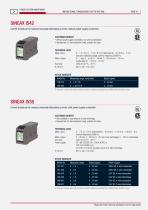
POWER SYSTEM MONITORING UNIFUNCTIONAL TRANSDUCERS FOR TOP HAT RAIL SINEAX I542 Current transducer to measure sinusoidal alternating currents, without power supply connection. CUSTOMER BENEFIT • • Without power supply connection, low wiring expenditure Standard als GL (Germanischer Lloyd), suitable for ships TECHNICAL DATA Meas. input: 0…1 A / 5 A, 0…1.2 A / 6 A or customised (0…0.5 A to 0…7.5 A, only one measuring range), nominal frequency 50/60 Hz 0…1 mA, 0…5 mA, 0…10 mA, 0…20 mA or 0…10 V or customised (0…1 V to 0…<10 V) Class 0.5 at 15…30 °C 69.1 x 35 x 112.5 mm Meas. output: Accuracy: H x...
Open the catalog to page 7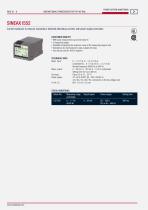
UNIFUNCTIONAL TRANSDUCERS FOR TOP HAT RAIL POWER SYSTEM MONITORING SINEAX I552 Current transducer to measure sinusoidal or distorted alternating currents, with power supply connection. CUSTOMER BENEFIT RMS value measurement up to crest factor 6 2 measuring ranges • Possibility of adjusting the maximum value of the measuring range on site • Standard as GL (Germanischer Lloyd), suitable for ships • Can also be used for 400 Hz systems • • TECHNICAL DATA Meas. input: 0…1 A / 5 A, 0…1.2 A / 6 A or customised (0…0.1 / 0.5 A to 0…<1.2 / 6 A) Nominal frequency 50/60 Hz or 400 Hz 0…20 mA, 4…20 mA, 0…10...
Open the catalog to page 8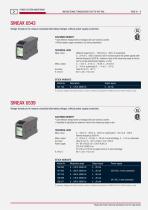
POWER SYSTEM MONITORING UNIFUNCTIONAL TRANSDUCERS FOR TOP HAT RAIL SINEAX U543 Voltage transducer to measure sinusoidal alternating voltages, without power supply connection. CUSTOMER BENEFIT • • Cost-effective measurement of voltages with low harmonic content Without power supply connection, low wiring expenditure TECHNICAL DATA Meas. input: Different ranges from 0…100/√3 to 0…500 V or customized 0…20 V to 0…600 V, maximum 300 V nominal value of the system against earth Nominal frequency 50/60 Hz, maximum value of the measuring range is fixed or can be set via potentiometer (approx. ±10%) 0…1...
Open the catalog to page 9All Camille Bauer Metrawatt AG catalogs and technical brochures
 Power System Monitoring
8 Pages
 Position sensor
8 Pages
 Camille Bauer
12 Pages
 A2000
A200010 Pages
 SIRAX Monitor-Series
8 Pages
 SINEAX DME 424/442
21 Pages
 APLUS-LED
89 Pages
 SINEAX F534
4 Pages
 SIRAX BT5100
32 Pages
 Compact Signal Converters
4 Pages
 SINEAX V604s-Family
12 Pages
 SINEAX DM5S/F
4 Pages
 SINEAX CAM
12 Pages
 SINEAX V604s
12 Pages
 SMARTCOLLECT
8 Pages
 LINAX PQ-series
12 Pages
 CENTRAX CU-Series
8 Pages
 Videographic recorder
8 Pages
 Our core product range
20 Pages
 KINAX WT720
4 Pages
 KINAX N702
6 Pages
 KINAX HW730
4 Pages
 SINEAX TV829
2 Pages
 SINEAX DM5
4 Pages
 Catalogue Industrial Instrumentation
140 Pages
 SINEAX VS30
4 Pages
 KINAX 3W2
4 Pages


Archived catalogs
 CORE PRODUCT RANGE
16 Pages
 Process Control Engineering
80 Pages
 Angular Position Engineering
64 Pages
 Heavy Current Engineering
76 Pages