
- Catalogs
- Camille Bauer Metrawatt AG
- Heavy Current Engineering


Heavy Current Engineering

Heavy Current Engineering
- SINEAX U543/U539: Designed for measuring sinusoidal alternating voltages without a power supply connection. They offer cost-effective measurement with low wiring expenditure and are suitable for voltages with low harmonic content.
- SINEAX U553/U554: Suitable for measuring sinusoidal or distorted alternating voltages with a power supply connection. They provide RMS value measurement up to a crest factor of 6 and are suitable for ship applications.
- SINEAX TV829: Used for shunt and voltage measurement on high potential, offering safe galvanic isolation and high common-mode rejection ratio.
- SINEAX P530/Q531: Converts active or reactive power into a proportional DC signal, useful for monitoring power consumption and energy distribution systems.
- SINEAX F534: Converts system frequency into a proportional DC signal, aiding in the determination of frequency stability.
- SINEAX F535: Measures frequency difference for synchronisation purposes.
- SINEAX G536: Measures phase angle or power factor, useful for reactive power compensation.
- SINEAX G537: Measures phase angle difference for synchronisation control.
- EMMOD205: Designed for power instruments A210, A220, A230, and A230s, this module uses the LONTALK protocol for acquiring instantaneous values and meter readings. It connects directly to the U160x summator of Gossen-Metrawatt.
- EMMOD206: This module provides information on energy consumption via the M-Bus protocol and includes a digital input for tariff switching or external synchronization of billing intervals. It supports various measured values such as active and reactive energy, mean power values, and instantaneous values like voltage and current.
- SINEAX A2000: A multifunctional power transducer for three-phase heavy current systems. It measures harmonics, harmonic distortion, and neutral wire current, and offers continuous measured value recording for load profiles and statistical purposes. It includes options for fault recording and is available in a mobile version.
- Gossen Metrawatt Energy Meters: These meters comply with the MID directive and are suitable for billing purposes. They offer precise active energy measurement, calibration capability, and display of instantaneous power. They are available for both direct and transformer connections and support optional interfaces like LON and M-Bus.
- LONWORKS Interface: Utilizes the LONTALK protocol with a transmission speed of 78 kBit/s and pluggable screw terminals for connections.
- M-Bus Protocol: Complies with EN 13 757, supporting transmission rates from 300 baud to 38.2 kbaud.
- Energy Meters: Offer various configurations for different system frequencies and transformer ratios, with options for calibrated and uncalibrated displays.
The document outlines energy meters compliant with DIN EN 62053-23 for reactive energy measurement (class 2) and DIN EN 50470-3 for active energy measurement (class B). These meters are approved under the EU Directive 2004/22/EG for measuring instruments (MID) and are designed for installation on DIN rails according to EN 50 022.
Energy meters are available for both direct and transformer connections. Direct connection meters support up to 80 A, while transformer connection meters support 1 A and 5 A. Various models offer features like programmable pulse rates, LON, and M-Bus compatibility.
Accessories include battery packs for meter reading without continuous power, installation sets for door assembly, and various current transformers.
The energy meters provide compact, double-tariff measurement capabilities for 4 quadrants, supporting both import and export. They offer programmable current transformer ratios, phase sequence indicators, error detection, and flexible communication options via infrared, M-Bus, Modbus, and Ethernet interfaces.
These meters are suitable for industrial, household, commercial, and building management applications. They facilitate energy acquisition and billing, transmitting data to logging, billing, and optimization systems.
The ECS is a professional solution for industrial energy data acquisition, offering synchronization with utility measuring intervals, flexible meter grouping, autonomous evaluation, and high-speed data transmission. It supports web-oriented data read-out, analysis, and billing.
Summators like the U1600 series provide autonomous acquisition, calculation, and storage of energy data. They support multiple input channels, synchronization with utility intervals, and local data processing via ECL programming. They are designed for easy networking and integration with existing systems.
- Power supply: 16 – 36 VDC, max. 3 W
- Dimensions: 100 x 75 x 105 mm
- Assembly: DIN rails according to EN 50 022
- Max. 32 participants
- Article No. M830R: MAVOLOG 10S
- MAVOLOG PS/C: Power pack 230 V / 24 VDC and interface converter RS485/RS232 Z863D
- MAVOLOG PS/C universal: Wide-range power pack 60 – 320 VDC, 50 – 230 VAC / 24 VDC and interface converter RS485/RS232 Z863G
- MAVOLOG BP: DC emergency back-up for MAVOLOG 10 in case of system failure Z863E
- METRAwin 10 / MAVOLOG: Parameterising and visualising software Z852D
- PC.doc-ACCESS / MAVOLOG: Database software for MS-Office products ACCESS, EXCEL, WORD Z852F
- Gossen Metrawatt MAVOSYS 10: Monitoring system for analysis of system quality, power, and energy.
- Features: Combination with up to four virtual analysers, input modules for voltage, current, and digital signals, local operating via optional touchscreen, certification according to IEC 61 000-4-30, Class A, time synchronisation via NTP or GPS, Ethernet and RS interfaces, communication protocols TCP/IP, HTTP, XML, Modbus TCP/RTU.
- Application: Identifies poor system quality indicators like overheated motors, excessive currents, flickering lights, and inexplicable energy cost rises.
- Innovation: Surpasses classic maximum limit of 8 channels for voltage and current inputs, allowing for space and cost savings.
- Various types with specific configurations for voltage and current monitoring.
- Configuration software for heavy current transducers and power meters, including features like programming, visualising, simulation, and password protection.
- CB-Manager and CB-Analyzer for data acquisition and analysis, supporting multiple devices and offering features like real-time clock setting, data archiving, and report generation.
- Software for energy management, including ECSwin for U160x summators, offering configuration, data acquisition, and load optimisation.
- EMC software for systematic energy management, providing transparency, cost minimization, and environmental benefits.
Z308G, Z308H, Z308I, Z308J, and Z508K are various EMC licenses offering different capabilities such as user limits, location coverage, and measuring points. The EMC maintenance contract is available for one year at 12% of the purchase price, paid annually in advance. EMC 5.x is a system for energy data management by Gossen Metrawatt, which includes software for energy management and analysis.
Encore Series Software:
This software is designed for controlling and communicating with the MAVOSYS 10, allowing for visualization and analysis of events and measured values. It supports up to 50 or more MAVOSYS 10 instruments and includes features like a password-protected multiuser web interface. The software is suitable for data acquisition and storage, with additional enterprise software available for extended analyses.
AnswerModules®:
These are intelligent algorithms integrated into the Encore series software for automatic data interpretation. Modules include Sag Direction, CapSwitchTM, kVAR Verification, UPS Verification, Energy User, Radial Line Fault, Reliability Benchmark, and Online-Diagram.
Electromagnetic Compatibility (EMC):
EMC ensures that electrical products operate safely by limiting electromagnetic interference. The EMC Directive 89/336/EC mandates testing for compliance, with the CE-mark indicating conformity. The document discusses the increasing complexity of electronic products and the potential for interference from various sources, including mobile phones and radio frequencies.
Standards and Testing:
Specific standards like IEC/EN 61 000-6-2 and IEC/EN 61 000-6-4 define requirements for industrial environments. Tests cover immunity to static discharge, high-frequency fields, fast transient interference, impulse voltages, conducted disturbances, magnetic fields, and voltage dips. Camille Bauer conducts comprehensive EMC testing, even beyond standard requirements.
Environmental Testing:
Products are tested for resistance to environmental impacts such as temperature, climate, water, dust, vibration, and shock. Standards like EN/IEC 60 688 guide these tests to ensure reliability. Special measurements may be required for non-standard applications, with external testing facilities used when necessary.
Catalog excerpts
Subject to change without notice SM-1021-000-04-EN-09.13 Part of the METRAWATT INTERNATIONAL Group Other product ranges of Camille Bauer ANGULAR POSITION ENGINEERING PROCESS CONTROL ENGINEERING HEAVY CURRENT ENGINEERING
Open the catalog to page 1
Camille Bauer Local branch offices Camille Bauer AG of Switzerland is affiliated with Metrawatt International GmbH domiciled in Nuremberg (Germany). Our group is represented all over the world by many affiliates and sales partners. The name of GMC-Instruments is composed of the corporate names of Gossen, Metrawatt and Camille Bauer. Germany GMC-I Messtechnik GmbH Südwestpark 15 D-90449 Nürnberg GMC-Instruments Schweiz AG Glattalstrasse 63 CH-8052 Zürich Dranetz 1000 New Durham Road Edison, New Jersey 08818-4019, USA [email protected] www.gossenmetrawatt.com [email protected] www.gmc-instruments.ch...
Open the catalog to page 2
Unifunctional transducers Current transducers Current transducers Power transducers High-voltage isolation amplifiers for DC variables Multifunctional transducers Frequency and phase angle Displaying power meters, extendable by modules Overview Multi-transducer DM5x Universal measuring units CAM, APLUS Displaying power meters Overview Displaying power meter APLUS „All in one“ Energy management Energy meters Energy Control System (ECS) Summators Additional components for summators Load optimisation Power quality Software, accessories, basics Software for heavy current transducers and power meters...
Open the catalog to page 3
Camille Bauer Unifunctional Transducers
Open the catalog to page 5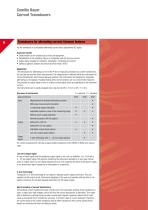
Camille Bauer Current Transducers Transducers for alternating current: Common features For the conversion of a sinusoidal alternating current into a proportional DC signal. Customer benefit • Determination of the variable load of lines and equipment • Identification of the utilisation ratio by a comparison with the nominal current • Output signal useable for indication, registration, monitoring and control • Safety by galvanic isolation and shock-proof terminals (IP20) Application The transducers for alternating current of the P-line are typically connected via current transformers, but can also...
Open the catalog to page 6
Camille Bauer Current Transducers Transducer for alternating current To measure sinusoidal alternating currents, without power supply connection. Customer benefit • Without power supply connection, low wiring expenditure • Standard as GL (Germanischer Lloyd), suitable for ships Technical data Meas. input: 0…1 A / 5 A, 0…1.2 A / 6 A or customised (0…0.5 A to 0…7.5 A, only one measuring range), nominal frequency 50/60 Hz Meas. output: 0…1 mA, 0…5 mA, 0…10 mA, 0…20 mA or 0…10 V or customised (0…1 V to 0…<10 V) Accuracy: Class 0.5 at 15…30 °C H x W x D: 69.1 x 35 x 112.5 mm Stock variants Article...
Open the catalog to page 7
Camille Bauer Current Transducers Transducer for alternating current To measure sinusoidal or distorted alternating currents, with power supply connection. Customer benefit • RMS value measurement up to crest factor 6 • 2 measuring ranges • Possibility of adjusting the maximum value of the measuring range on site • Standard as GL (Germanischer Lloyd), suitable for ships • Can also be used for 400 Hz systems Technical data Meas. input: 0…1 A / 5 A, 0…1.2 A / 6 A or customised (0…0.1 / 0.5 A to 0…<1.2 / 6 A) Nominal frequency 50/60 Hz or 400 Hz Meas. output: 0…20 mA, 4…20 mA, 0…10 V or customised...
Open the catalog to page 8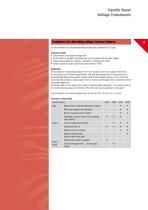
Camille Bauer Voltage Transducers Transducers for alternating voltage: Common features For the conversion of a sinusoidal alternating voltage into a proportional DC signal. Customer benefit • Determination of the present voltage level • Determination of the load of the equipment by a comparison with the rated voltage • Output signal useable for indication, registration, monitoring and control • Safety by galvanic isolation and shock-proof terminals (IP20) Application The transducers for alternating voltage of the P-line may be connected via voltage transformers, but can also be used for direct...
Open the catalog to page 9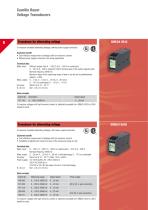
Camille Bauer Voltage Transducers Transducer for alternating voltage To measure sinusoidal alternating voltages, without power supply connection. Customer benefit • Cost-effective measurement of voltages with low harmonic content • Without power supply connection, low wiring expenditure Technical data Meas. input: Different ranges from 0…100/√3 to 0…500 V or customized 0…20 V to 0…600 V, maximum 300 V nominal value of the system against earth Nominal frequency 50/60 Hz Maximum value of the measuring range is fixed or can be set via potentiometer (approx. ±10%) Meas. output: 0…1 mA, 0…5 mA, 0…10...
Open the catalog to page 10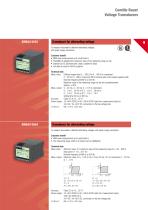
Camille Bauer Voltage Transducers Transducer for alternating voltage To measure sinusoidal or distorted alternating voltages, with power supply connection. Customer benefit • RMS value measurement up to crest factor 6 • Possibility of adjusting the maximum value of the measuring range on site • Standard as GL (Germanischer Lloyd), suitable for ships • Can also be used for 400 Hz systems Technical data Meas. input: Different ranges from 0…100/√3 to 0…500 V or customized 0…20 V to 0…690 V, maximum 400 V nominal value of the system against earth Nominal frequency 50/60 Hz or 400 Hz Maximum value...
Open the catalog to page 11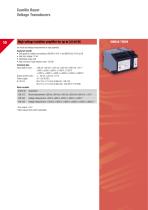
Camille Bauer Voltage Transducers High-voltage isolation amplifier for up to 3.6 kV DC for shunt and voltage measurement on high potential. Customer benefit • Safe galvanic isolation according to DIN EN 61 010-1 and DIN EN 50 124 (Cat. III) • High test voltage: 10 kV • Calibrated range shift • High common-mode rejection ratio: 150 dB Technical data Input (switch-over): : Output (switch-over):: Power supply: H x W x D: Stock variants Article No. 158 312 Only output ±10 V Upon request (not switch-selectable)
Open the catalog to page 12All Camille Bauer Metrawatt AG catalogs and technical brochures
 Power System Monitoring
8 Pages
 Position sensor
8 Pages
 Camille Bauer
12 Pages
 A2000
A200010 Pages
 SIRAX Monitor-Series
8 Pages
 SINEAX DME 424/442
21 Pages
 APLUS-LED
89 Pages
 SINEAX F534
4 Pages
 SIRAX BT5100
32 Pages
 Compact Signal Converters
4 Pages
 SINEAX V604s-Family
12 Pages
 SINEAX DM5S/F
4 Pages
 SINEAX CAM
12 Pages
 SINEAX V604s
12 Pages
 SMARTCOLLECT
8 Pages
 LINAX PQ-series
12 Pages
 CENTRAX CU-Series
8 Pages
 Videographic recorder
8 Pages
 Our core product range
20 Pages
 KINAX WT720
4 Pages
 KINAX N702
6 Pages
 KINAX HW730
4 Pages
 SINEAX TV829
2 Pages
 SINEAX DM5
4 Pages
 Catalogue Industrial Instrumentation
140 Pages
 SINEAX VS30
4 Pages
 KINAX 3W2
4 Pages


Archived catalogs
 CORE PRODUCT RANGE
16 Pages
 Process Control Engineering
80 Pages
 Angular Position Engineering
64 Pages