
- Catalogs
- CAMEL GROUP CO., LTD
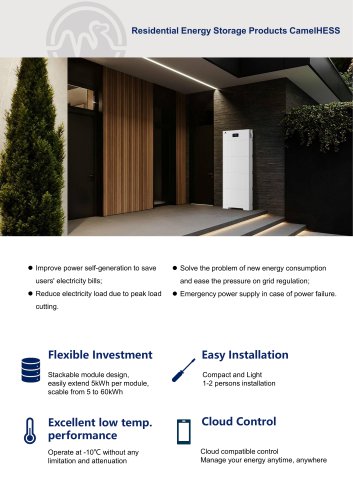
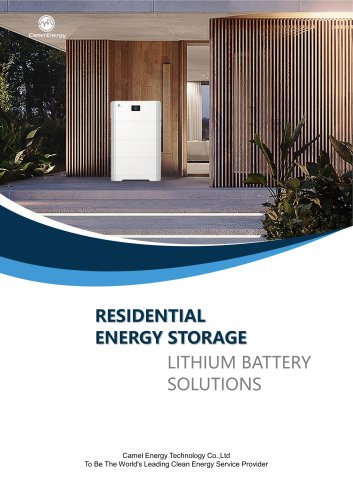
- Camel residential energy storage system LFP 2600


- Company
- Products
- Catalogs
- News & Trends
- Exhibitions
Camel residential energy storage system LFP 2600

Camel residential energy storage system LFP 2600
This manual provides guidance for the installation and operation of the Chome-LFP 2600HV Lithium Battery Storage, focusing solely on the battery and excluding hybrid inverters or other equipment.
The Chome-LFP 2600HV complies with the RE Directive 2014/53/EU.
- Important Safety Instructions: Adhere to all instructions for safe installation and operation, complying with IEC 60364 standards.
- Warnings: Identify potential hazards such as electric shock and fire, and necessary precautions.
- Battery Handling Guide: Use the battery as directed, avoid damage, and contact customer service for issues.
- Emergency Situations: Procedures for handling leaking, fire, wet, or damaged batteries.
- Installers: Installation should be conducted by skilled workers familiar with electrical systems and safety practices.
- APP Download: Instructions for downloading the app for battery monitoring.
- Scrap Battery: Follow local regulations for recycling or disposal.
- Technical Data: Specifications include a total energy of 2.56kWh, nominal voltage of 102.40Vd.c, and a lifespan of over 15 years with more than 6,000 cycles at 90% DOD.
- Features: Includes a Battery Management System (BMS), expandability, and easy firmware updates.
Instructions for handling and inspecting batteries during shipment to ensure safety and compliance.
- Location: Must be earthquake-resistant, away from the sea, and free from flammable materials.
- Requirements: Ensure a stable environment with minimal dust and no corrosive gases.
Details on package items, pre-installation checks, and installation methods including wall mounting and ground installation.
Instructions for configuring device WIFI, registering an account, and setting CAN/485 bus pins.
Steps for commissioning and shutting down the battery.
Guidance on updating the BMS firmware to the latest version.
The installation must occur in a restricted access location or cabinet to provide a barrier for the battery terminal. A maximum of 8 batteries is allowed. The DVC class specification is DVC-C for battery terminals and DVC-A2 for communication terminals. The insulation design is based on 450V DC of OVC II and 230V AC of OVC III, with no connections allowed above these voltages.
The battery installation should follow a specific flow chart detailed in Chapter 5. Installers need to prepare power, data, and earth cables, a ground wire, and a bipolar external isolator for series connections. A breaker with a minimum current of 150A is recommended between the battery and inverter.
Required tools include screwdrivers, a torque wrench, a cable crimper, a voltmeter, and more. Safety gear such as insulated gloves, safety goggles, and shoes must comply with IEC 60364 or relevant standards.
Network cables should follow inverter definitions and be tested with a LAN cable tester. For storage, batteries should not be stacked more than 8 high, stored at -20°C to 25°C, and kept dry. If stored over 3 months, disconnect the DC circuit to prevent discharge.
Package includes a battery, cardboard, user manual, and optional cables. Before installation, check for defects and ensure voltage is above 96V. Installation can be wall-mounted or ground-based, with specific steps for each. For series connections, address settings for master and slave batteries are required.
Data cables connect to M/S communication terminals. Voltage differences between batteries should be less than 2.0V.
The battery has a built-in Wi-Fi module for app use. If Wi-Fi setup fails, switch to broadcast mode. Account registration is optional. Communication settings for CAN/485 bus pins are specified.
For commissioning, ensure the battery voltage is above 96V and follow specific steps for single or series battery setups. Shut down the battery when no charge/discharge current is present. Firmware updates can be done remotely via the Wi-Fi monitor app.
Catalog excerpts

USER MANUAL Chome-LFP 2600HV Lithium Battery Storage To Be The World's Leading Clean Energy Service Provider
Open the catalog to page 1
About Chome-LFP 2600HV battery Chome-LFP 2600HV battery can only be installed in Series. See part 5.3.3 for for the DIP and address selection. About this manual This manual is intended for the Chome-LFP 2600HV Energy Storage battery, but the hybrid inverter and any other equipment is not included. Declaration We declare that this Chome-LFP 2600HV is compliance with the essential requirements and other relevant of RE Directive 2014/53/EU.
Open the catalog to page 2
1. Safety Introduction 1.1 Important Safety Instructions This manual contains important instructions for: Chome-LFP 2600HV product. This manual must be followed when installing and using this product. The product is designed and tested in accordance withinternational safety requirements IEC 60364, but as with all electrical and electronic equipment, certain precautions must be observed when installing and/or operating the product. To reduce the risk of personal injury and ensure the safe installation and operation of the product, you must carefully read and follow all instructions, cautions and...
Open the catalog to page 5
Do not insert any additional objects into the battery pack. Do not use cleaning solvents to clean the battery. 1.4 Response to emergency situations The battery is designed with multiple safety strategies to prevent hazards resulting from failures. However, we cannot guarantee their absolute safety for uncertain situations. I. Battery leaking If the battery pack leaks electrolyte, avoid contact with the leaking liquid or gas. Electrolyte is corrosive and contact may cause skin irritation and chemical burns. If one is exposed to the leaked substance, perform following actions: Inhalation: Evacuate...
Open the catalog to page 6
1.5 Installers Energy Storage battery is suggested installing by skilled worker or electrician. A skilled worker is who has been trained as a qualified electrician or has all following skills and experience: - Knowledge of the functional principles and operation of on-grid Energy Storage systems. - Knowledge of the dangers and risks associated with installing and using electrical devices and acceptable mitigation methods. - Knowledge of the installation of electrical devices - Knowledge of and adherence to this manual and all safety precautions and best practices. 1.6 APP download Scan this QR...
Open the catalog to page 7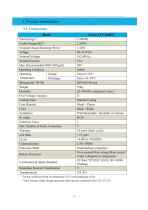
2. Product Introduction 2.1 Technical data Model Chome-LFP 2600HV 2.56kWh 2.2kWh 1.5kW 96~112Vd.c 102.40Vd.c 15A 90% Indoor From 0~50℃ From -10~50℃ 500*442*88 mm 27kg 20~60%(No condensed water) II Natural Cooling Metal + Plastic Black / White Wall Mountable / Stackable or Cabinet IP 20 I 4 Total Energy* Usable Energy(DC)* Nominal Charge/Discharge Power Voltage Nominal Voltage Nominal Current Max. Recommended DOD (Off-grid) Operating Condition Operating Charge Temperature Discharge Dimension(L*W*H) Weight Humidity Over Voltage Category Cooling Type Case Material Color Installation IP rating Protective...
Open the catalog to page 8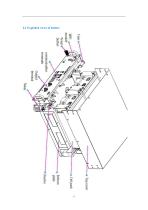
2.2 Exploded views of battery
Open the catalog to page 9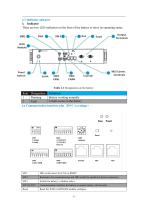
2.3 Indicator and port I. Indicator There are two LED indicators on the front of the battery to show its operating status. Table 2-1 Designations on the battery Item Designation Definition 1 Running Battery working normally A fault occurs in the battery 2 Fault 2.4 Communication interface plat(DVC-A2 voltage) Resistance for communication and DIP switch for parallel or Series connection Switch for battery’s Address select Communication interface for battery or master battery with Inverter Reset the WIFI or GPS/GPS module configure
Open the catalog to page 10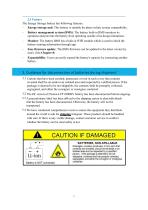
2.5 Feature The Energy Storage battery has following features: - Energy storage unit: This battery is suitable for photo voltaic system compatibility. - Battery management system (BMS): The battery built-in BMS monitors its operation and prevents the battery from operating outside of its design limitations. Monitor: The battery BMS has a built-in WIFI module which is used to check the battery running information through app. Easy firmware update: The BMS firmware can be updated to the latest version by users. (See Chapter 8) Expandability: Users can easily expand the battery's capacity by connecting...
Open the catalog to page 11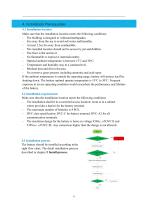
4. Installation Prerequisites 4.1 Installation location Make sure that the installation location meets the following conditions: - The building is designed to withstand earthquakes. - Far away from the sea to avoid salt water and humidity. - At least 2.5m far away from combustible. - The installed location should not be access by pet and children. - The floor is flat and level. - No flammable or explosive materials nearby. - Optimal ambient temperature is between 15℃ and 30°C. - Temperature and humidity stay at a constant level. - Minimal dust and dirt in the area. - No corrosive gases present,...
Open the catalog to page 12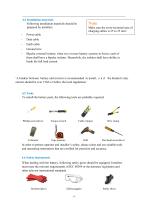
4.4 Installation materials Following installation materials should be prepared by installers. Make sure the cross-sectional area of charging cables is 25 to 35 mm2. Power cable Data cable Earth cable Ground wire Bipolar external isolator, when two or more battery systems in Series, each of them shall have a bipolar isolator. Meanwhile, the isolator shall have ability to break the full load current. ‘A breaker between battery and inverter is recommended to install, a n d the breaker's min. current should be over 150A or follow the local regulations.’ 4.5 Tools To install the battery pack, the...
Open the catalog to page 13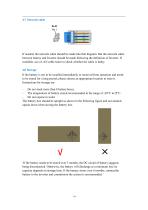
If needed, the network cable should be made like that diagram. But the network cable between battery and Inverter should be made following the definition of Inverter. If available, use a LAN cable tester to check whether the cable is faulty. 4.8 Storage If the battery is not to be installed immediately or removed from operation and needs to be stored for a long period, please choose an appropriate location to store it. Instructions for storage are: - Do not stack more than 8 battery boxes. - The temperature of battery stored recommended in the range of -20°C to25°C. - Do not expose to water The...
Open the catalog to page 14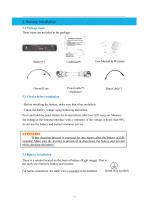
5. Battery Installation 5.1 Package items These items are included in the package. Ground Line User Manual & Warranty 5.2 Checks before installation - Before installing the battery, make sure that it has no defects. - Check the battery voltage using following instruction. Press and hold the panel button for 4s and release after two LED turns on. Measure the voltage at the terminal interface with a voltmeter. If the voltage is lower than 96V, do not use the battery and contact customer service. ATTENTION 'If this checking process is executed for any reason after the battery is fully installed....
Open the catalog to page 15Archived catalogs
 Camel SLI Battery
4 Pages
 Camel AGM Battery
4 Pages
 Camel EFB battery
4 Pages




- 12 V battery
- Lead battery
- High-performance battery
- Electric vehicle battery
- Maintenance-free battery
- Rectangular battery
- ISO battery
- Lithium-ion battery
- Battery for automotive applications
- Deep cycle battery
- Lead-acid battery
- High-reliability battery
- 48 V battery
- Battery for marine applications
- 24 V battery
- High-power battery
- High-capacity battery
- AGM battery
- 6 V battery