
- Catalogs
- Cambridge Technology
- POLYGONAL MIRRORS

POLYGONAL MIRRORS

POLYGONAL MIRRORS
General Properties: Manufactured from 5052 aluminum alloy, these mirrors offer flatness to 1/8 per inch and are produced through a low-cost, automated process.
Applications: Suitable for bar code scanning, laser printing, graphic arts, laser marking, infrared imaging, and inspection.
General Properties: Made from electroless nickel plated 6061-T6 aluminum alloy, these mirrors exhibit low scatter, are durable, scratch-resistant, and meet the MIL C-675 standard. They also offer flatness to 1/8 per inch but are relatively higher in cost due to a labor-intensive process.
Applications: Used in gray scale printing, film writing, image display, web inspection, robotic vision, and laser inspection.
- Clear Aperture: Area on the facet where optical specifications apply.
- Surface Figure: Flatness measure specified in wavelengths of light, standard is 1/4 per inch.
- Surface Roughness: Microstructure measure in Angstroms (Å) RMS, standard is 80 Å for diamond turned and 20 Å for polished surfaces.
- Lay Direction: Direction of surface pattern, specified for diamond turned surfaces.
- Reflectivity: Various coatings available, with reflectivity versus wavelength detailed in Chart A.
Catalog excerpts
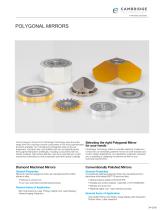
e CAMBRIDGE TECHNOLOGY A Novanta Company POLYGONAL MIRRORS Lincoln polygon mirrors from Cambridge Technology span the entire range from low-cost/high-volume components to the most sophisticated products available. Our manufacturing integrates state-of-the-art equipment, machine tools, and facilities and can successfully tackle the toughest fabrication challenges, including components with low scatter surfaces, high surface flatness, minimum pyramidal error, tight mechanical tolerances as well as specially optimized optical coatings. Selecting the right Polygonal Mirror for your needs Cambridge Technology offers a complete selection of diamond turned and conventionally polished mirrors for both standard and custom design applications. Our application engineers will assist you in selecting or designing the precise solution to your scanning requirements. Diamond Machined Mirrors General Properties Diamond machined polygonal mirrors are manufactured from 5052 aluminum alloy. • Flatness to X/8 per inch. • Low cost, automated manufacturing process. General Areas of Application Bar Code Scanning, Laser Printing, Graphic Arts, Laser Marking, Infrared Imaging, Inspection Conventionally Polished Mirrors General Properties Conventionally polished polygonal mirrors are manufactured from electroless nickel plated 6061-T6 aluminum alloy. • Optical surfaces exhibit LOW SCATTER. • Durable and scratch resistant, meets MILC-675 STANDARD • Flatness to X/8 per inch • Relatively higher cost - labor-intensive process. General Areas of Application Gray Scale Printing, Film Writing, Image Display, Web Inspection, Robotic Vision, Laser Inspection
Open the catalog to page 1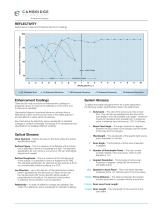
REFLECTIVITY Performance of Gold and Protected Aluminum Coatings REFLECTIVITY IN PERCENT - 0° INCIDENCE scale change shortwave infrared WAVELENGTH ( ) 01 Protected Gold Enhancement Coatings System Glossary There are two major functions of enhancement coatings on polygonal mirrors: to improve the reflectance of the mirror and to improve its durability. To design the proper polygonal mirror for a given application, the following system specifications need to be determined. Unprotected diamond machined aluminum surfaces have a reflectance of 85% to 92% across most of the visible spectrum and are...
Open the catalog to page 2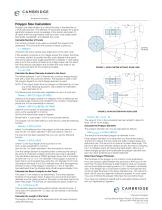
Polygon Size Calculation Polygon size determination is a critical first step in the selection of a motorized scanner. The selection of the proper polygon for a given application requires some knowledge of the system parmeters. In all cases a few key parameters must be known: scan angle, beam feed angle, wavelength, and desired duty cycle. Calculate Number of Facets The number of facets to be used is a tradeoff that needs to be addressed. The formula for the number of facets is given by: n = 720(C) /θ. where θ is the active optical scan angle and C is the duty cycle. If this equation produces...
Open the catalog to page 3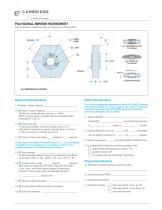
POLYGONAL MIRROR WORKSHEET This worksheet is designed to help you specify your requirements CLEAR APERTURE Mechanical Specifications Optical Specifications 1.1 Number of facets needed: _______________________________ For surface roughness requirements below 50 Å RMS, polished nickel plated polygons must be utilized. For surface roughness requirements greater than 50 Å RMS, diamond machined aluminum polygons may be utilized. 1.2 � Facet to center distance: _____________________________ The facet to center distance may vary +/–.005 in. Within a given polygon, all facets shall be equidistant within...
Open the catalog to page 4All Cambridge Technology catalogs and technical brochures
 Diode Pointer
2 Pages
 ScanMaster Designer
2 Pages
 Lincoln hyperSCAN Series
3 Pages
 PHCAB Outline Drawing
1 Page
 SA24 Outline Drawing
1 Page
 SA24C Outline Drawing
1 Page
 P1AB Outline Drawing
1 Page
 LXP Hybrid
5 Pages
 ProSeries 2
4 Pages
 ProSeries Scan Head
5 Pages
 3-Axis Scan Head
2 Pages
 ScanMaster Controller
4 Pages
 CRS Series
3 Pages
 NEW LII/ScanMaster Brochure
2 Pages
 Pen Motors
3 Pages
 Rotary Actuators
3 Pages
 Scanning Components Brochure
4 Pages
 ScanMaster? Brochure
4 Pages
 3-Axis Brochure
4 Pages
 Scan Heads Brochure
4 Pages
 Scan Head Solutions
4 Pages
 Optical Scanning Components
6 Pages


- Power supply unit
- DC power supply
- AC/DC power supply
- Automation software solution
- Process software
- Windows software
- Computer-aided design software
- Control software
- Design software solution
- Switched-mode power supply
- 3D software solution
- Industrial software
- Servo-amplifier
- Interface software
- DC servo-amplifier
- Regulated power supply
- Pulsed laser
- 3D scanning system
- Solid-state laser
- Laser scanner