
- Catalogs
- Cambridge Technology
- Pen Motors

Pen Motors

Pen Motors
The G-Series Open Loop Optical Scanners are designed for deflecting mirrors in commercial and scientific optical equipment. These galvo motors offer a cost-effective alternative to closed-loop systems, suitable for applications where speed and accuracy are not critical.
Specifications
- Motor Selection: Based on required scan angle and load inertia, which should be between 1/10 and 10 times the motor's armature.
- Bandwidth: Up to 85% of resonant frequency with sinusoidal wave; approximately 5% with sawtooth, triangular, or square wave.
- Cross-Axis Motion: Typically below 10 micro radians.
Technical Specifications
- G100 Series: Models include G102, G108, G112, G115, G124 with resonant frequencies ranging from 700 to 2,400 Hz and optical scan angles from ±2° to ±24°.
- G300 Series: Models include G302, G306, G310, G320, G330 with resonant frequencies from 130 to 520 Hz and optical scan angles from ±2° to ±30°.
- Common Features: Armature inertia, torque, coil resistance, inductance, sensitivity, back-EMF constant, temperature coefficient, linearity, repeatability, hysteresis, life cycles, and weight are specified for each model.
Pen Motors
These are the original optical scanners with limited bandwidths compared to the G-Series. Specifications include rotation, total error, natural frequency, stylus inertia, bandwidth, torque, rotor inertia, current, power, resistance, inductance, weight, and life cycles.
Rotary Actuators
Used as beam choppers and laser beam detectors, not recommended for optical scanning. Specifications include rotation, natural frequency, null torque, linearity, hysteresis, sensitivity, coil resistance, inductance, rotor inertia, and temperature coefficient.
Contact Information
Contact details for Americas, Europe, and Asia are provided for sales and service inquiries.
Catalog excerpts

Open Loop Galvo Motors G-Series The Series G Open Loop Optical Scanners are designed to deflect mirrors of various sizes in commercial and scientific optical equipment. The mirror deflection of these galvo motors is proportional to the drive current, but they do not include a position feedback sensor. Therefore, they are intended primarily as a lower cost alternative to General Scanning's closed loop galvo motors where speed of response or accuracy is not required, or where angular position is derived independently. The cross-axis motion of these motors is typically below 10 micro radians. Motor selection is dictated primarily by the required scan angle, yet load inertia should be between 1/10 and 10 times that of the motor’s armature (moving parts). Series G scanners with mounted mirrors can be driven at any amplitude up to the rated mechanical rotation. Their bandwidth is up to 85% of their resonant frequency with a sinusoidal wave, and up to approximately 5% of the resonance frequency with sawtooth, triangular or square wave. The illustration below shows the resonant frequency, in terms of the mirror-to-armature ratio.
Open the catalog to page 1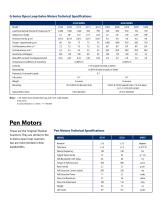
G-Series Open Loop Galvo Motors Technical Specifications
Open the catalog to page 2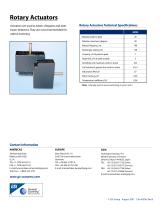
Rotary Actuators Actuators are used as beam choppers and laser beam detectors.They are not recommended for optical scanning Rotary Actuators Technical Specifications GM20 Rotation peak-to-peak Rotation maximum, degrees Null torque, rated g-cm Sensitivity, mA maximum (coils in series) Coil resistance, typical, ohm (coils in series) Inductance Mh/coil Note: Internally wired in series terminating on pins 4 and 5 Contact Information AMERICAS © GSI Group August 2007 736-49506 Rev.B
Open the catalog to page 3All Cambridge Technology catalogs and technical brochures
 Diode Pointer
2 Pages
 ScanMaster Designer
2 Pages
 POLYGONAL MIRRORS
4 Pages
 Lincoln hyperSCAN Series
3 Pages
 PHCAB Outline Drawing
1 Page
 SA24 Outline Drawing
1 Page
 SA24C Outline Drawing
1 Page
 P1AB Outline Drawing
1 Page
 LXP Hybrid
5 Pages
 ProSeries 2
4 Pages
 ProSeries Scan Head
5 Pages
 3-Axis Scan Head
2 Pages
 ScanMaster Controller
4 Pages
 CRS Series
3 Pages
 NEW LII/ScanMaster Brochure
2 Pages
 Rotary Actuators
3 Pages
 Scanning Components Brochure
4 Pages
 ScanMaster? Brochure
4 Pages
 3-Axis Brochure
4 Pages
 Scan Heads Brochure
4 Pages
 Scan Head Solutions
4 Pages
 Optical Scanning Components
6 Pages


- Power supply unit
- DC power supply
- AC/DC power supply
- Automation software solution
- Process software
- Windows software
- Computer-aided design software
- Control software
- Design software solution
- Switched-mode power supply
- 3D software solution
- Industrial software
- Servo-amplifier
- Interface software
- DC servo-amplifier
- Regulated power supply
- Pulsed laser
- 3D scanning system
- Solid-state laser
- Laser scanner