
- Catalogs
- Cambridge Technology
- NEW LII/ScanMaster Brochure

NEW LII/ScanMaster Brochure

NEW LII/ScanMaster Brochure
The document discusses the advancements in laser processing applications powered by Lightning IITM and driven by ScanMasterTM. It highlights the improvements in throughput, accuracy, and ease of use in laser systems.
Key Features
- Constant Speed: The system maintains a constant velocity throughout the vector, allowing for independent velocity settings at endpoints.
- Eliminated Delays: Automated laser synchronization reduces the need for mark and jump delays, enhancing job execution speed.
- Local, Automatic Application: Trajectory modifications are applied only where necessary, optimizing speed and accuracy.
- Shape-Specific Algorithms: These algorithms avoid converting shapes into vector strings, reducing execution time.
- Immediate Start: Encoder-based galvos and state-space servos require no warm-up, increasing productivity.
Performance Comparison
- Traditional vs. ScanPack Control: The document provides a comparison of traditional control methods with ScanPack control, showing significant reductions in total time and errors.
Technical Specifications
- Lightning IITM Scanners: Features include 24-bit GSBus communication, state-space servo architecture, and optimized beryllium mirrors.
- ScanMasterTM Controller: Includes proprietary ScanPack algorithms, 24-bit GSBus communications, and advanced laser control.
- ScanMasterTM Designer: Offers a user-friendly GUI, 3D layering, and a high-level API.
System Connectivity
- Supports direct connection to major laser systems and offers high-speed bidirectional signaling.
- Provides options for long-distance connectivity and modular extensibility.
Conclusion
The document emphasizes the enhanced performance, accuracy, and versatility of the new laser processing systems, making them suitable for a wide range of applications.
Catalog excerpts

New Fully Integrated Subsystems The Future of Laser Processing Applications Highest System Throughput Best Resolution and Accuracy Most Versatile System Connectivity Easiest Job Creation Highest Throughput Constant Speed The velocity at the end points of the vector can be set independently of the velocity in the middle. This allows maintaining a constant velocity through the full length of the vector. Eliminated Delays Automated laser synchronization is done by the control algorithm, eliminating the need for mark delay and jump delay, thus reducing overall job execution time. Local, Automatic Application Trajectory modifications for position accuracy are only applied where needed, allowing the rest of the job to be executed at maximum speed. Shape-Specific Algorithms Shape-optimized algorithms reduce execution time by avoiding conversion of shapes into vector strings. Immediate Start CTI’s encoder-based galvos and state-space servos require no warm up to achieve their ultra-high accuracy, increasing overall system productivity. Best Accuracy Traditional Control Mark / Jump Speed = 8 m/s Mark / Jump Delay = 250 µs Total time = 8.4 seconds ScanPack Control Mark / Jump Speed = 8 m/s Mark / Jump Delay = N/A Total time = 2.0 seconds Traditional Control Mark / Jump Speed = 4 m/s Mark / Jump Delay = 150 µs Polyline Delay = 190 µs Total time = 960 ms ScanPack Control Mark / Jump Speed = 4 m/s Mark / Jump Delay = N/A Polyline Delay = N/A Total time = 580 ms Mark Speed = 275 mm/s Traditional Control: Total time = 1.03 ms ScanPack Control: Total time = 0.90 ms Mark Speed = 500 mm/s Traditional Control: Total time = 0.75 ms ScanPack Control: Total time = 0.50 ms Position Accuracy Trajectory planning algorithms automatically adjust the scanners command to ensure the laser hit the target at the required position. Traditional Control - 10 µm error ScanPack Control - No error
Open the catalog to page 1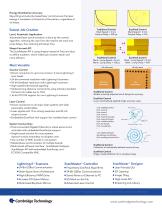
Energy Distribution Accuracy Skywriting and velocity-based laser control ensure the laser energy is consistent at all points of the pattern, regardless of its shape. Traditional Control Mark Speed = 2 m/s Polyline Delay = 200 µs Traditional Control Mark / Jump Speed = 8 m/s Mark / Jump Delay = 150 µs Local, Automatic Application Automated laser synchronization is done by the control algorithm, relieving the user from the need to set mark and jump delays, thus reducing job setup time. Shape-Focused API The ScanMaster API is using shapes instead of lines and dots to define a pattern, which makes...
Open the catalog to page 2All Cambridge Technology catalogs and technical brochures
 Diode Pointer
2 Pages
 ScanMaster Designer
2 Pages
 POLYGONAL MIRRORS
4 Pages
 Lincoln hyperSCAN Series
3 Pages
 PHCAB Outline Drawing
1 Page
 SA24 Outline Drawing
1 Page
 SA24C Outline Drawing
1 Page
 P1AB Outline Drawing
1 Page
 LXP Hybrid
5 Pages
 ProSeries 2
4 Pages
 ProSeries Scan Head
5 Pages
 3-Axis Scan Head
2 Pages
 ScanMaster Controller
4 Pages
 CRS Series
3 Pages
 Pen Motors
3 Pages
 Rotary Actuators
3 Pages
 Scanning Components Brochure
4 Pages
 ScanMaster? Brochure
4 Pages
 3-Axis Brochure
4 Pages
 Scan Heads Brochure
4 Pages
 Scan Head Solutions
4 Pages
 Optical Scanning Components
6 Pages


- Power supply unit
- DC power supply
- AC/DC power supply
- Automation software solution
- Process software
- Windows software
- Computer-aided design software
- Control software
- Design software solution
- Switched-mode power supply
- 3D software solution
- Industrial software
- Servo-amplifier
- Interface software
- DC servo-amplifier
- Regulated power supply
- Pulsed laser
- 3D scanning system
- Solid-state laser
- Laser scanner