
- Catalogs
- Cambridge Technology
- C026: 405 nm Dielectric Coating

C026: 405 nm Dielectric Coating

C026: 405 nm Dielectric Coating
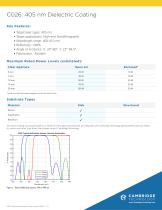
- The document provides estimated power levels for different clear aperture sizes in both open air and enclosed environments. For example, a 5 mm aperture has a power level of 25 W in open air and 13 W when enclosed. The power levels increase with aperture size, reaching 100 W in open air and 50 W enclosed for a 20 mm aperture.
- The document lists substrate materials such as Silicon, Fused Silica, and Beryllium, each with a rating of 3.
- This section highlights the key features of the C026 dielectric coating, which is designed for 405 nm laser types and high-end stereolithography applications. It covers a wavelength range of 400-410 nm, with a reflectivity of ≥98%. The angle of incidence ranges from 30°-60° in the X direction and 22°-58.5° in the Y direction, with random polarization.
- The coating can be applied to various mirror types and sizes compatible with Cambridge Technology galvanometers and scan heads. For custom sizes, contact Cambridge Technology.
- The document includes a figure showing typical reflectivity spectra from 340 to 480 nm for random polarization.
Catalog excerpts
C026: 405 nm Dielectric Coating Key Features: • Target laser types: 405 nm • Target applications: High-end Sterolithography • Wavelength range: 400-410 nm • Reflectivity: ≥98% • Angle of incidence: X: 30°-60°, Y: 22°-58.5° • Polarization: Random Maximum Rated Power Levels (estimated): Clear Aperture *Includes scan heads and customer-designed enclosures that restrict air flow. Substrate Types Material Silicon Fused Silica Beryllium This mirror coating can be purchased on a variety of mirror types and sizes that are integrated with Cambridge Technology galvanometers and scan heads. For mirror sizes other than those listed, please contact Cambridge Technology. -C026 Typical Reflectivity Spectra, Random Polarization Figure 1: Typical reflectivity spectra, 480 nm. Figure 1: Typical reflectivity spectra, 340 to340 to 480 nm. www.CambridgeTechnology.com ©2017 Cambridge Technology. All rights reserve
Open the catalog to page 1All Cambridge Technology catalogs and technical brochures
 Diode Pointer
2 Pages
 ScanMaster Designer
2 Pages
 POLYGONAL MIRRORS
4 Pages
 Lincoln hyperSCAN Series
3 Pages
 PHCAB Outline Drawing
1 Page
 SA24 Outline Drawing
1 Page
 SA24C Outline Drawing
1 Page
 P1AB Outline Drawing
1 Page
 LXP Hybrid
5 Pages
 ProSeries 2
4 Pages
 ProSeries Scan Head
5 Pages
 3-Axis Scan Head
2 Pages
 ScanMaster Controller
4 Pages
 CRS Series
3 Pages
 NEW LII/ScanMaster Brochure
2 Pages
 Pen Motors
3 Pages
 Rotary Actuators
3 Pages
 Scanning Components Brochure
4 Pages
 ScanMaster? Brochure
4 Pages
 3-Axis Brochure
4 Pages
 Scan Heads Brochure
4 Pages
 Scan Head Solutions
4 Pages
 Optical Scanning Components
6 Pages


- Power supply unit
- DC power supply
- AC/DC power supply
- Automation software solution
- Process software
- Windows software
- Computer-aided design software
- Control software
- Design software solution
- Switched-mode power supply
- 3D software solution
- Industrial software
- Servo-amplifier
- Interface software
- DC servo-amplifier
- Regulated power supply
- Pulsed laser
- 3D scanning system
- Solid-state laser
- Laser scanner