
- Catalogs
- CAE S.p.A.
- Radar Water Level Sensor LPR


Radar Water Level Sensor LPR

Radar Water Level Sensor LPR
Catalog excerpts

LPR ‐ LEVEL PROBING RADAR First and only water level sensor based on radar technology en rely designed and manufactured in Italy, LPR is available in the version for measuring the water level in streams, rivers and reservoirs and liquids. LPR is characterised by a reduced measuring cone, low power consump on, compact design and absence of parts immersed in water. It has no mechanical moving parts and is therefore extremely robust. LPR is designed for use in a wide range of situa ons. Independence from changes in temperature and humidity, typical of radar technology, provides accurate measurements in all weather condi ons, with a measurement accuracy of ±2 mm up to 35 metres away. Thanks to its high technology, LPR is able to provide a reliable and precise measurement in less than 10 seconds, making it the fastest in its category. To simplify and reduce the cost of installa on, LPR is provided together with a prac cal configura on so ware for PC or tablet. Thanks to this interface it is possible to iden fy and isolate, with the aid of a graph, any obstacles in the measurement area (pillars, boulders, containment structures, etc.) that are not the actual target to be measured. The same so ware allows the user to adjust all the opera ng parameters, including measurement mes. In addi on to providing a 4‐20 mA standard analogical physical interface, LPR has an RS485 port that implements an SDI‐12 standard protocol, with a mechanism that makes it simple to install and easy to interface with any data
Open the catalog to page 1
CAE S.p.A-Via Colunga 20 40068 San Lazzaro di Savena (BO) - Italy tel.: +39 051 4992711|fax: +39 051 4992709 www.cae.it
Open the catalog to page 2All CAE S.p.A. catalogs and technical brochures
 RÆVO
RÆVO2 Pages
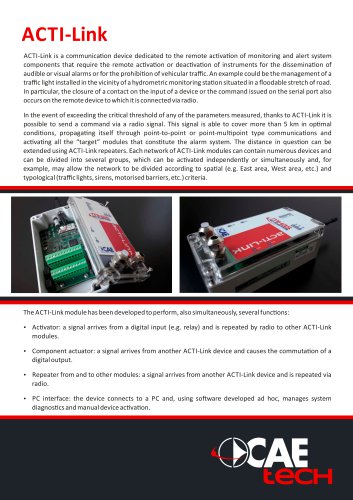
 BROCHURE ACTI-LINK
2 Pages
 PG10 & PG10R Rain Gauge
2 Pages
 Heated Rain Gauge PG2R
4 Pages
 Rain Gauge PG2
4 Pages
 Datalogger Mhaster
4 Pages
 RAIN GAUGE PG10
2 Pages
 Thermo-Hygrometer THS
2 Pages
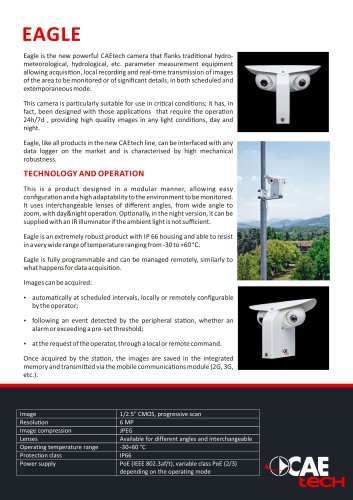 Camera Eagle
1 Page





- Data logger
- Liquid level sensor
- USB datalogger
- Data-logger with screen
- Analog level sensor
- Wireless datalogger
- Battery-powered datalogger
- Digital output level sensor
- Monitoring datalogger
- IP68 level sensor
- Communication module
- Compact logger
- Solid level sensor
- Digital datalogger
- High-precision level sensor
- Bulk materials storage datalogger
- Compact level sensor
- RS-485 level sensor