
- Catalogs
- CAE S.p.A.
- Heated Rain Gauge PG2R


Heated Rain Gauge PG2R

Heated Rain Gauge PG2R
The PG2 and PG2R are advanced rain gauges designed for accurate measurement of precipitation, including solid precipitation at low temperatures. The PG2R model includes heating elements powered by a battery and solar panel, allowing it to function without mains power.
Specifications
- Sensor Type: Tipping bucket
- Collecting Area: 200 cm²
- Measurement Range: 0-500 mm/h
- Resolution: 0.1 mm
- Accuracy: Better than 3% across the entire range
- Temperature Range: PG2: 0-60°C, PG2R: -10-60°C
- Power Consumption: PG2 and PG2R @ 12.5V: <1mA; PG2R with heater: 60W @12.5V
- Connection: RS-485 with SDI-12 protocol
Performance and Features
The PG2 and PG2R rain gauges are certified under the UNI 11452:2012 standard, ensuring a maximum error of less than 3% up to 500 mm/h. They are equipped with on-board electronics that calculate correction factors to provide accurate rain intensity measurements every minute. The PG2R model includes heaters that activate during snowfalls to ensure accurate measurement of solid precipitation.
Maintenance and Installation
The rain gauges feature a "zero breakdown strategy" with minimal maintenance requirements. They include diagnostics to reduce downtime and ensure continuous operation. Installation options include mounting on a 48 mm diameter pole or directly on a concrete plinth.
Standards and Certification
The PG2 and PG2R models are classified in Class A according to the UNI 11452:2012 standard, representing the highest performance category. CAE has developed an automatic calibration machine to ensure compliance with this standard, providing clients with a calibration certificate for each sensor.
Conclusion
The PG2 and PG2R rain gauges offer high precision and reliability for measuring precipitation, with advanced features for low-temperature operation and minimal maintenance requirements. They are certified to meet stringent accuracy standards, making them a top choice for meteorological applications.
Catalog excerpts

PG2 & PG2R Rain Gauge PG2 is the highest-performance rain gauge with 200 cm2 capta on surface on the market today for the measurement of accumulated precipita on and of its intensity per minute. It's accurate, it indicates any malfunc ons before they cause interrup on of measurement and it's usable without a power supply also at low temperatures thanks to the heated rain gauge version: PG2R. RESPONSE PRECISION AND SPEED PG2 measures liquid precipita on and, in the heated version, water equivalent of solid precipita on with a resolu on of 0.1 mm. CAE is the first company to cer fy all its new rain gauges in class A according to the criteria of the UNI 11452: 2012 standard; for this reason, each sensor is provided with a document cer fying an error of <3% up to 500 mm/h. Despite the cer fica ons of most of the other precipita on gauges on the market, which usually apply to selected value of rain intensity, the maximum error of PG2 is guaranteed in the en re measurement range. Unlike that guaranteed by the most popular sensors based on weight technology, PG2 and PG2R measure with this degree of accuracy from the first minute following the phenomenon detected, thus being par cularly suitable for the mely measurement of downpours. LOW TEMPERATURES (PG2R) PG2 does not require any mains power, even in the heated version PG2R, since with the sole aid of ba ery and solar panel it can measure the water equivalent of solid precipita ons down to very low temperatures. The extremely low power consump on of the hea ng elements posi oned in the various areas of the sensor is op mised thanks to the management electronics, which use various diagnos c thermometers in the instrument, as well as the choice of materials used and careful shape desi
Open the catalog to page 1
EASY MAINTENANCE AND "ZERO BREAKDOWN STRATEGY" Thanks to the pping technology, PG2 and PG2R don't need to be emp ed and require very li le and easy maintenance. The sensing element is a reed which is redundant to ensure con nuity of opera on in case of failure. The sensor is also the only one in its category to implement diagnos cs, with the objec ve of reducing down me due to faults. Among these are: Ÿ The correct func oning of the heaters (PG2R); Ÿ The check for clogging of the funnel that directs the water into the pping mechanisms; Ÿ The “electronic spirit level” for correct inclina on of...
Open the catalog to page 2
the correction factor is close to 0, while it increases when intensity reaches 50 mm/h or higher; this correction by the software makes it possible to compensate the inherent error of tipping bucket rain gauges up to high intensities. RAIN INTENSITY MEASUREMENT The intensity of rain, measured by the sensor based on the tipping of the container, indicates the real intensity of rain every minute, expressed in mm/h, with a resolution of 0.1 mm/h. The intensity reading calculated by the instrument is based on the average intensity in a minute, then referred to an hour to calculate the mm/h. In this...
Open the catalog to page 3
THE UNI 11452:2012 STANDARD In July 2012 the UNI 11452:2012 standard was approved as part of the na onal standards, regula ng the metrological requirements for sensors dedicated to measuring intensity of liquid precipita on at ground level. It defines a classifica on criterion for sensors, based on the assessment of measuring accuracy. This standard is the first na onal reference for defining the performance of rain gauge sensors. It is the result of the experience gained by the Italian Air Force Meteorological Service and the University of Genoa during the ac vi es performed within the framework...
Open the catalog to page 4All CAE S.p.A. catalogs and technical brochures
 RÆVO
RÆVO2 Pages
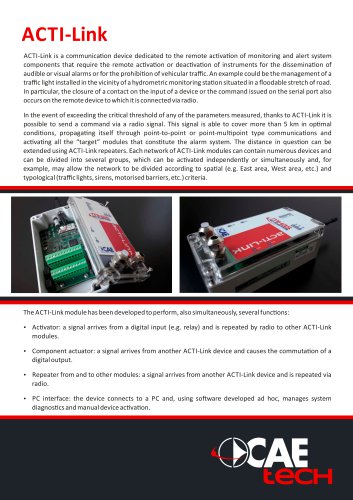
 BROCHURE ACTI-LINK
2 Pages
 PG10 & PG10R Rain Gauge
2 Pages
 Rain Gauge PG2
4 Pages
 Datalogger Mhaster
4 Pages
 RAIN GAUGE PG10
2 Pages
 Thermo-Hygrometer THS
2 Pages
 Radar Water Level Sensor LPR
2 Pages
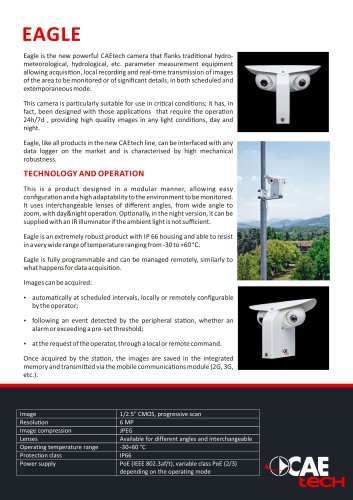 Camera Eagle
1 Page





- Data logger
- Level probe
- Liquid level sensor
- USB datalogger
- Data-logger with screen
- Analog level sensor
- Wireless datalogger
- Battery-powered datalogger
- Digital output level sensor
- Monitoring datalogger
- IP68 level sensor
- Communication module
- Compact logger
- Water level sensor
- Solid level sensor
- Digital datalogger
- High-precision level sensor
- Bulk materials storage datalogger
- Compact level sensor
- RS-485 level sensor