
- Catalogs
- Cablecraft Motion Control
- Turbo & EGR Platforms & Beyond


Turbo & EGR Platforms & Beyond

Turbo & EGR Platforms & Beyond
This document, prepared by Chris Kaufman, Director of Engineering, outlines the specifications and applications of high-temperature rod ends and linkages, particularly for Turbo and EGR platforms.
Specifications
The standard Cablecraft® linkage design is based on the 6mm – ¼” rod end family, featuring interchangeable raceways for different temperature ranges: MGT (232°C), UHT (301°C), and HGT (343°C). These designs offer adjustable or fixed centerlines, controlled breakaway torque, and various assembly options.
Design Features
Alternate stud alignments and custom levers enhance flexibility and ease of assembly. High-temp linkages are designed to manage temperature gradients, prolonging component life and reducing cooling system costs.
Performance Characteristics
Composite raceways dampen vibrations, reduce wear, and allow for low friction movement. The design accommodates misalignment, eliminating binding concerns and reducing costs. High-strength materials support high torque applications.
Applications
These linkages are used in various sectors, including on-highway diesel vehicles, farm equipment, hybrid vehicles, racing, and industrial applications near heat sources. They are also suitable for harsh environments like chemical and power plants.
Advantages
Cablecraft® linkages offer lightweight designs, customizable lengths, and detachable connection points for easy servicing. The composite raceway design resists contaminants and uses standard corrosion-resistant steel without expensive treatments.
Temperature Specifications
The document provides detailed temperature specifications for each linkage type, including maximum over-temperature conditions and recommendations for application-specific validation.
Conclusion
Cablecraft® high-temp rod ends and linkages provide robust solutions for high-temperature and harsh environments, with proprietary design processes ensuring superior performance.
Catalog excerpts

High-Temp Rod Ends/ Linkages Turbo & EGR Platforms & Beyond Prepared by: Chris Kaufman Director of Engineering Connecting a W orld in M otion
Open the catalog to page 1
High-Temp Rod Ends/ Linkages Standard Cablecraft® Linkage Design: • • Based on “6mm – ¼” Rod End family *Interchangeable Raceway (3 temperature ranges – See appendix) Natural Black (MGT), Blue Paint ID (UHT), White Paint ID (HGT) Adjustable or fixed CL’s for tamperproof designs Controlled breakaway torque Variable CL lengths Threaded or rivet studs for assembly Hex drive for threaded stud assembly Connecting a W orld in M otion *Custom Cablecraft® Race
Open the catalog to page 2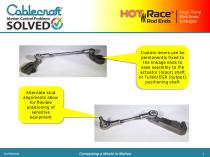
High-Temp Rod Ends/ Linkages Custom levers can be permanently fixed to the linkage ends to ease assembly to the actuator (input) shaft or Turbo/EGR (output) positioning shaft Alternate stud alignments allow for flexible positioning of sensitive equipment Connecting a W orld in M otion
Open the catalog to page 3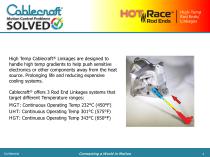
High-Temp Rod Ends/ Linkages High Temp Cablecraft® Linkages are designed to handle high temp gradients to help push sensitive electronics or other components away from the heat source. Prolonging life and reducing expensive cooling systems. Cablecraft® offers 3 Rod End Linkages systems that target different Temperature ranges: MGT: Continuous Operating Temp 232°C (450°F) UHT: Continuous Operating Temp 301°C (575°F) HGT: Continuous Operating Temp 343°C (650°F)
Open the catalog to page 4
High-Temp Rod Ends/ Linkages Performance Characteristics: • Composite Raceways • Effectively dampen vibration of engine environments that cause excessive wear in metallic joints • Allow for low friction movement, while keeping play at minimum • No need for high cost stainless heat treatment or specialty coatings • Rod end design allows for misalignment and reduced cost in component location criticality • Also eliminates concerns of binding from temperature deflection in fixed pin designs that can’t accommodate for misalignment • High strength material allows for high torque actuator usage • Raceway...
Open the catalog to page 5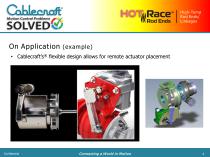
High-Temp Rod Ends/ Linkages On Application (example) • Cablecraft’s® flexible design allows for remote actuator placement Connecting a W orld in M otion
Open the catalog to page 6
High-Temp Rod Ends/ Linkages Where used? Increased Fuel Economy & Performance • On-highway diesel vehicles • Farm/Construction equipment • Hybrid vehicles – EGR valves • Racing (turbo-chargers) • Material handling equipment High-Temp Applications • Food equipment • Industrial near heat source applications • HVAC Harsh Environments • Chemical plants • Power plants Confidential
Open the catalog to page 7
High-Temp Rod Ends/ Linkages Composite raceway’s absorb vibration generation from the application preventing accelerated joint degradation Lightweight design lowers mass acceleration that can impact connected components Linkage centerline can be custom length and alignment per application without large tooling impact Detachable connection point makes electronic actuator or turbo serviceable without removing entire unit (At lever arm or ball stud of rod end) Composite raceway design allows for use of standard high corrosion resistant steel without the use of expensive coatings or Heat Treatment...
Open the catalog to page 8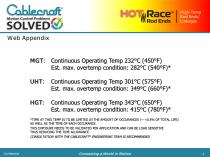
High-Temp Rod Ends/ Linkages Web Appendix MGT: Continuous Operating Temp 232°C (450°F) Est. max. overtemp condition: 282°C (540°F)* UHT: Continuous Operating Temp 301°C (575°F) Est. max. overtemp condition: 349°C (660°F)* Continuous Operating Temp 343°C (650°F) Est. max. overtemp condition: 415°C (780°F)* *TIME AT THIS TEMP IS TO BE LIMITED IN THE AMOUNT OF OCCURANCES (~ <0.5% OF TOTAL LIFE) AS WELL AS THE TIME OF EACH OCCURANCE. THIS EXPOSURE NEEDS TO BE VALIDATED PER APPLICATION AND CAN BE LOAD SENSITIVE THUS REDUCING THE TIME ALLOWANCE. CONSULTATION WITH THE CABLECRAFT® ENGINEERING TEAM IS...
Open the catalog to page 9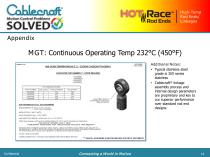
High-Temp Rod Ends/ Linkages MGT: Continuous Operating Temp 232°C (450°F) Additional Notes: • Typical stainless steel grade is 3XX series stainless • Cablecraft® linkage assembly process and internal design parameters are proprietary and key to our superior performance over standard rod end designs Connecting a W orld in M otion
Open the catalog to page 10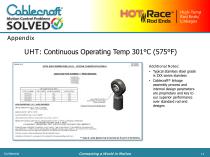
High-Temp Rod Ends/ Linkages UHT: Continuous Operating Temp 301°C (575°F) Additional Notes: • Typical stainless steel grade is 3XX series stainless • Cablecraft® linkage assembly process and internal design parameters are proprietary and key to our superior performance over standard rod end designs Connecting a W orld in M otion
Open the catalog to page 11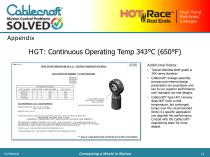
High-Temp Rod Ends/ Linkages HGT: Continuous Operating Temp 343°C (650°F) Additional Notes: • Typical stainless steel grade is 3XX series stainless • Cablecraft® linkage assembly process and internal design parameters are proprietary and key to our superior performance over standard rod end designs • Cablecraft® type HGT raceway does NOT have a melt temperature, but prolonged temps over the recommended limits in a specific application can degrade the performance. Consult with the Cablecraft® engineering team for more details.
Open the catalog to page 12All Cablecraft Motion Control catalogs and technical brochures
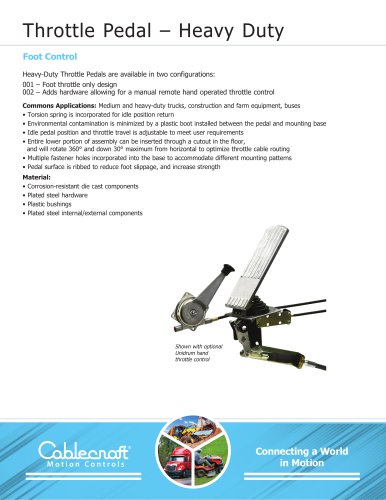 Throttle Pedal – Heavy Duty
2 Pages
 Pull-Only Tension Controls
2 Pages
 Connecting a World in Motion
84 Pages
 Push-Pull Standard
4 Pages
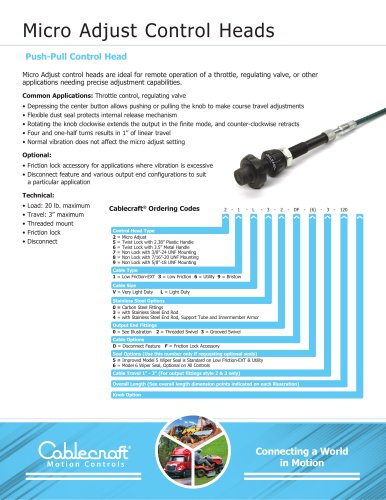 Micro Adjust Control Heads
2 Pages
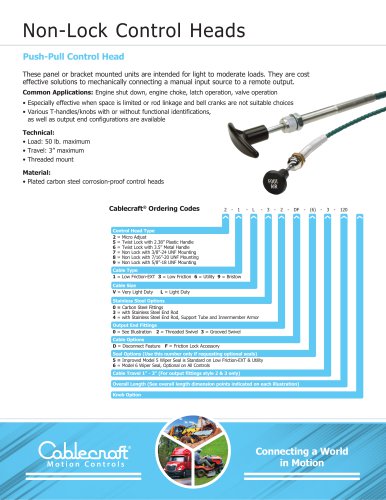 Non-Lock Control Heads
2 Pages
 Twist Lock Industrial
2 Pages
 Cablecraft Linkage
4 Pages
 High-Temp Rod Ends/Linkages
4 Pages
 Unidrum Lever
4 Pages
 Push-Pull 4B
4 Pages
 SR-G Ball Joints
2 Pages
 COM-P Sperical Bearings
2 Pages
 Leverstak
2 Pages
 Micro Adjust Industrial
2 Pages
 Button Lock Performance
2 Pages
 Pull-Only T-Flex
2 Pages
 Pull-Only Tension Cables
2 Pages
 R-G Ball Joints
2 Pages
 J/JM Sperical Bearings
2 Pages
 DBM and DBF Rod Ends
2 Pages


Archived catalogs
 DC/DH Control Swivels
2 Pages
 Manual Transmission Shifter
4 Pages
 Hardware_End
4 Pages
 Hardware/ End Fittings
4 Pages
 Button Lock
2 Pages
 Pull-Only Clutch
4 Pages
 Push-Pull Cable - 4B
4 Pages
 Pull-Only Cable - T-Flex
2 Pages
 Pull-Only Cable - Tension
2 Pages
 Pull-Only Clutch Cable
4 Pages
 Custom Linkage Assemblies
2 Pages
 Performance Push-Pull Cable
2 Pages
 DBM/DBF
2 Pages
 Custom Cable Assemblies
2 Pages
 Hardware/End Fittings
4 Pages
 Custom Hand Controls
4 Pages
 Leverstack Hand Control
2 Pages
 Unidrum Lever - METRIC
4 Pages
 Undidrum Lever
4 Pages
 Light Duty Lever
2 Pages
 Brake Lever
4 Pages
 Pull-Only Brake Cable
4 Pages
 Push-Pull Cable - Standard
4 Pages
 Linkage Assemblies - Custom
2 Pages


