
- Catalogs
- Cablecraft Motion Control
- Button Lock Performance


Button Lock Performance

Button Lock Performance
- Travel: Minimum of 3.00 inches
- Bend Radius: Minimum of 3.00 inches and 7.00 inches
- Operating Temperature: -65°F to 230°F
- Normal Load: 120lb tension and 25lb compression
- I/M Type: 553 (standard), 554 (wire)
- Output Options: T (Threaded), G (Grooved)
- End Fittings: C (Conduit Cap, available only on solid wire & wire rope I/M)
- Stroke: 3.00 inches
- Minimum Bend Radius: 3.00 inches
- Operating Temperature: -65°F to +165°F at input end, +230°F at output end
- Normal Load: Unspecified, determined by installation configuration
Catalog excerpts

Button Lock Description: Button Lock Performance Push-Pull Control Head Push-Pull Control Head Aircraft Heat control Vent control A/C control Engine cowl control Shown with optional fitting Control Head Performance • Travel: 3.00؆ minimum • Bend radius: 3.00؆ minimum & 7.00؆ minimum • Operating temperature: -65°F — 230°F • Normal load (with swivel output fitting) • 120lb tension • 25lb compression Cablecraft Motion Controls button lock control head cables remotely operate and lock in position heater, ventilation, air conditioning or numerous other mechanisms needing adjustment. Depressing the center button allows pushing or pulling the knob to make course travel adjustments. Routing of the flexible cable allows installation options that are not possible with solid linkages. Various output configurations are available to suit a specific application. The ordering code and technical descriptions show available choices. Linking Motion & Control.
Open the catalog to page 1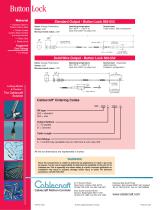
Button Lock Material • Stainless Steel or Plated Carbon Steel • Plastic Coated Carbon Steel Conduit and Innermember • Plastic Seal • Plastic Knob Standard Output - Button Lock 565-553 Notes: (Design Parameters) Stroke: 3.00؆ Minimum bend radius: 3.00؆ Operating temperature: from -65°F — +165°F at input end/+230°F at output end Normal load: 120lb tension, 25lb compression • Full Range Solid Wire Output - Button Lock 565-554 Notes: (Design Parameters) Stroke: 3.00؆ Minimum bend radius: 7.00؆ 1.00 DIA Operating temperature: from -65°F — +165°F at input end/+230°F at output end Normal load: Unspecified...
Open the catalog to page 2All Cablecraft Motion Control catalogs and technical brochures
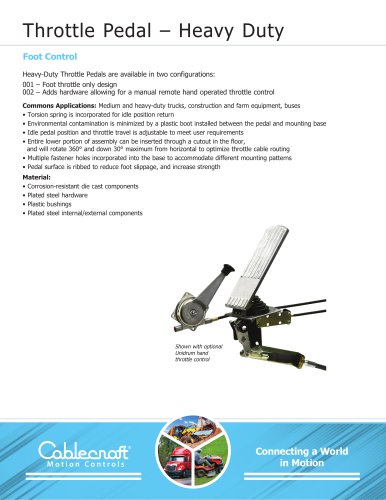 Throttle Pedal – Heavy Duty
2 Pages
 Pull-Only Tension Controls
2 Pages
 Connecting a World in Motion
84 Pages
 Push-Pull Standard
4 Pages
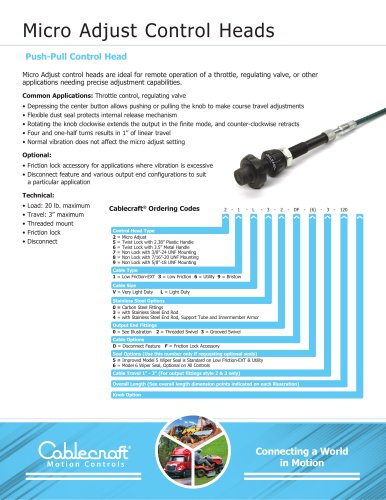 Micro Adjust Control Heads
2 Pages
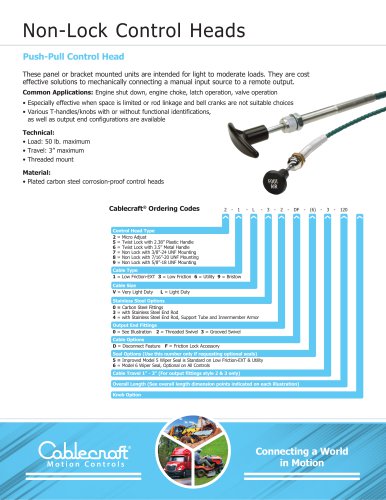 Non-Lock Control Heads
2 Pages
 Twist Lock Industrial
2 Pages
 Cablecraft Linkage
4 Pages
 High-Temp Rod Ends/Linkages
4 Pages
 Unidrum Lever
4 Pages
 Push-Pull 4B
4 Pages
 SR-G Ball Joints
2 Pages
 COM-P Sperical Bearings
2 Pages
 Leverstak
2 Pages
 Micro Adjust Industrial
2 Pages
 Pull-Only T-Flex
2 Pages
 Pull-Only Tension Cables
2 Pages
 R-G Ball Joints
2 Pages
 J/JM Sperical Bearings
2 Pages
 DBM and DBF Rod Ends
2 Pages


Archived catalogs
 DC/DH Control Swivels
2 Pages
 Manual Transmission Shifter
4 Pages
 Hardware_End
4 Pages
 Hardware/ End Fittings
4 Pages
 Turbo & EGR Platforms & Beyond
12 Pages
 Button Lock
2 Pages
 Pull-Only Clutch
4 Pages
 Push-Pull Cable - 4B
4 Pages
 Pull-Only Cable - T-Flex
2 Pages
 Pull-Only Cable - Tension
2 Pages
 Pull-Only Clutch Cable
4 Pages
 Custom Linkage Assemblies
2 Pages
 Performance Push-Pull Cable
2 Pages
 DBM/DBF
2 Pages
 Custom Cable Assemblies
2 Pages
 Hardware/End Fittings
4 Pages
 Custom Hand Controls
4 Pages
 Leverstack Hand Control
2 Pages
 Unidrum Lever - METRIC
4 Pages
 Undidrum Lever
4 Pages
 Light Duty Lever
2 Pages
 Brake Lever
4 Pages
 Pull-Only Brake Cable
4 Pages
 Push-Pull Cable - Standard
4 Pages
 Linkage Assemblies - Custom
2 Pages


