
- Catalogs
- burster Measurement Solutions GmbH
- OPERATION MANUAL Precision torque sensor model 8625

OPERATION MANUAL Precision torque sensor model 8625

OPERATION MANUAL Precision torque sensor model 8625
The manual emphasizes the importance of following safety guidelines to prevent electric shock and injuries. It uses symbols like DANGER, WARNING, and CAUTION to indicate risk levels. The torque sensor model 8625 is not suitable for safety-critical or medical applications and should not be used in explosive areas.
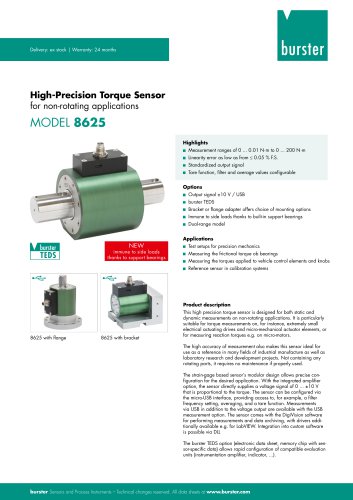
The torque sensor model 8625 is designed for measuring static and dynamic torques and is maintenance-free. It should only be used for measuring torque, rotational speed, or angular displacement and is not intended as a safety device.
The manual details the mechanical and electrical design of the torque sensor model 8625, including static, quasi-static, and dynamic torques, interference, and troubleshooting.
Instructions cover mechanical and electrical installation, alignment, fitting, power supply details, connector pin assignments, and cable management.
Factory calibration, DAkkS calibration, and recalibration procedures are outlined to ensure accurate measurements.
Specifications include electromagnetic compatibility, interference immunity, and emitted interference details.
Information on available software and proper disposal methods for the torque sensor model 8625 is provided.
Test certificates for the torque sensor model 8625 can be downloaded online using a direct link or serial number.
Avoid radiant heat or cooling from one side, protect from moisture, and do not use in corrosive environments. Keep bearings and connectors clean.
Store in a dry, dust-free atmosphere with temperatures between 0°C and 60°C.
Disconnect from power and clean with a dry cloth. Do not immerse in water or use strong cleaning agents.
Only trained personnel familiar with safety regulations should operate the sensor.
Includes the torque sensor, mating connector, operation manual, data sheet, and optional USB cable or mounting accessories.
Inspect for damage upon receipt and retain packaging for potential claims.
24-month warranty covering repairs except for improper use. Ensure proper packaging for returns.
Unauthorized modifications void the warranty. Only manufacturer personnel should service the device.
The sensor has no rotating parts, with strain gauges on the shaft acting as a torsion bar. The housing protects electronic components and provides attachment means.
The sensor offers various configurations, including mV/V output and USB connectivity for configuration and measurement. It includes a built-in amplifier for direct voltage output proportional to torque.
These torques change slowly and should remain below the rated torque.
Dynamic torques change rapidly and should be kept below the resonant frequency to avoid damage.
Potential sources include temperature changes, vibrations, and electrical interference. Measures should be taken to mitigate these.
Common faults include no signal, incorrect torque readings, and signal dropouts, with suggested remedial actions provided.
Torque sensors, especially those with small rated torques, are sensitive to overloads. Care must be taken during fitting to avoid exceeding the maximum torque value. The electrical cable should be connected during fitting to monitor the measurement signal, ensuring it does not exceed the full scale. The sensor should be supported to prevent bending moments, and impacts should be avoided to prevent damage.
Ensure a clean and lubricant-free environment when fitting the torque sensor model 8625. Use appropriate accessories like flange adapters and couplings for correct installation. Initially, fit the sensor loosely before alignment, and use tools like a dial gauge or laser for precise alignment. Tighten screws to specified torques while monitoring the measurement signal.
The torque sensor can be installed directly, using a mounting flange, or with a bracket. Direct installation involves using blind threaded holes and locating-pin holes for precise placement. The mounting flange, if supplied, is integral to the sensor and must be included in recalibrations. The bracket is an accessory that allows flexible attachment options.
Metal-bellows couplings are recommended to correct shaft misalignments. Align the sensor precisely to avoid unnecessary forces and ensure the entire clamping length of couplings is used.
The device is not galvanically isolated, so choose either the circular socket or USB socket to avoid ground loops. The USB interface complies with USB 2.0 standards, and power supply considerations are necessary, especially for laptops. The sensor operates within a voltage range of 5-30 VDC.
Use shielded, low-capacitance cables, and ensure proper grounding to form a Faraday cage, minimizing electromagnetic interference. Avoid running cables parallel to power cables to prevent interference.
The sensor can measure both clockwise and counterclockwise torques, providing positive or negative signals respectively. A Check function is available for calibration purposes, providing a precise voltage output when activated.
The document outlines the connection details for the torque sensor model 8625, emphasizing the importance of grounding the sensor housing. A diagram is provided to illustrate the check signal connection, with specific pin functions listed.
The torque sensors are factory-adjusted and tested, with optional factory calibration available. The factory calibration certificate includes measurement values, uncertainties, and other critical data. DAkkS calibration is also available, adhering to ISO-17025 standards, with a validity of 26 months. Regular recalibration is recommended every 12 months or sooner under certain conditions.
Instructions are provided for safely removing and handling the torque sensor to prevent damage, including avoiding knocks, bending moments, and drops.
Technical specifications are available in an enclosed data sheet, with the latest version accessible online. The sensor complies with EN 61326-2-3:2006 for interference immunity and emitted interference.
Additional information on accessories and the DigiVision software is available in the data sheet, accessible via a QR code.
Users are reminded to dispose of unserviceable equipment in accordance with legal requirements to support environmental protection.
Catalog excerpts

OPERATION MANUAL Precision torque sensor model 8625 Valid from: burster praezisionsmesstechnik gmbh & co kg All rights reserved Manufacturer: burster praezisionsmesstechnik gmbh & co kg Talstr. 1 - 5 P.O. Box 1432 76593 Gernsbach 76593 Gernsbach Germany Germany Tel.: +49-7224-645-0 Fax.: +49-7224-645-88 Email: [email protected] www.burster.com 3017-BA8625EN-5170-041524
Open the catalog to page 1
Exclusion of warranty liability for operating manuals All information in the present documentation was prepared and compiled with great care and reproduced subject to effective control measures. No warranty is provided for freedom from errors. We reserve the right to make technical changes. The present information as well as the corresponding technical data can change without notice. Reproduction of any part of this documentation or its processing or revision using electronic systems is prohibited without the manufacturer‘s prior written approval. Components, devices and measured value sensors...
Open the catalog to page 2
Safety instructions In this manual the following symbols warn about risks. Symbols in this manual Signal words The following signal words are used in the operation manual according to the specified hazard classification. DANGER DANGER indicates a hazard with a high level of risk which, if not avoided, will result in death or serious injury. WARNING WARNING indicates a hazard with a medium level of risk which, if not avoided, could result in death or serious injury. CAUTION CAUTION indicates a hazard with a low level or risk which, if not avoided, could result in minor or moderate injury. NOTICE...
Open the catalog to page 6
General safety instructions The torque sensor model 8625 uses state-of-the-art engineering and is safe to operate. However, if the torque sensor model 8625 is not used or operated as intended, it may present a hazard. DANGER Danger of electric shock! The following instructions must be followed to prevent electric shock and injuries: • In order to achieve high measuring characteristic value, the torque sensor model 8625 is not designed with the usual safety factors (2 … 20) for machine designs. For applicable overload factors, see the technical data (data sheet). • Observe accident prevention...
Open the catalog to page 7
IMPORTANT: Read the operation manual carefully before using the equipment, and keep for future reference. The torque sensor model 8625 measures static and dynamic torques. This measured quantity is suitable for open-loop and closed-loop control functions. The respective upper range value is shown on the type plate. Both the low mass of the torque sensor model 8625 and its high torsional rigidity are an advantage when measuring dynamic torques. However, you need to pay attention to the torsion spring constant and the sensor’s cut-off frequency with such measurements. You can find both of these...
Open the catalog to page 8
Download the test certificates You have the option to download the test certificate for your torque sensor model 8625 online. To do this, you can either use your direct download link or download it directly from our website (www.burster.com) by entering the serial number. Environmental conditions • Avoid radiant heat or cooling from one side. • Protect the torque sensor model 8625 from moisture. • The torque sensor model 8625 is not resistant to the effects of chemicals. Do not use the torque sensor model 8625 in a corrosive environment. • Keep the bearings and connectors free of dust, dirt and...
Open the catalog to page 9
Scope of delivery • Torque sensor model 8625 • Mating connector • Operation manual • Data sheet • Optional: USB cable • Optional: mounted flange or bracket CAUTION Never connect up the torque sensor model 8625 if it shows signs of damage incurred in transit. Only ever use the torque sensor model 8625 under the conditions specified in this operation manual. Inspect the torque sensor model 8625 carefully for damage. If you suspect that the torque sensor model 8625 has been damaged during shipping, notify the delivery company within 72 hours. The packaging should be retained for examination by a...
Open the catalog to page 10
Conversions and modifications If you open or dismantle the torque sensor model 8625 during the warranty period, this will void the warranty immediately. The torque sensor model 8625 does not contain any parts that are intended to be serviced by the user. Only the manufacturer's own qualified personnel are permitted to open the torque sensor model 8625. It is forbidden to make any modification to the torque sensor model 8625 without our written permission. We cannot accept liability in the event of such action. Our recommendations • Check cables and connectors annually. • It is up to you as the...
Open the catalog to page 11
Device concept and general information The figures given for the full dimensions, mass and power depend on the version of the torque sensor model 8625. Please refer to the data sheet for specific figures. Test side The test side is that end of the shaft at which you apply the torque being measured to the torque sensor model 8625. This end normally has the smallest moment of inertia. You will see these markings “TEST SIDE” on the measurement end of the torque sensor model 8625: Diagram 1: Test side of torque sensor model 8625 Drive side The drive end is the opposite end to the measurement end....
Open the catalog to page 12
Mechanical design The torque sensor model 8625 does not contain any rotating parts. The shaft is joined directly to the housing at the attachment end. Strain gauges are mounted on the shaft, which acts as the torsion bar in the torque sensor model 8625. The torque is applied to the shaft end labelled "TEST SIDE". The housing provides protection for the sensitive electronic instrumentation and contains the cable/plug connection. The housing is also used as the means of attaching the torque sensor model 8625. Diagram 2: Basic design of the torque sensor model 8625 Electrical design DANGER Electric...
Open the catalog to page 13
Torque sensor model 8625 with brigde output The torque sensor model 8625 with bridge output has a 7-pin circular connector. This connector is used to supply the sensor with its required rated excitation voltage and to output the measurement signal in mV/V. The supply voltage must be kept absolutely constant. Conventional power supplies cannot guarantee this consistency to an adequate degree. Use an instrumentation amplifier, indicator or process controller that can provide a stabilized supply voltage and processes the mV/V signal. Torque sensor model 8625-XXXX-VXX3X0 The 8625-XXXX-VXX3X0 torque...
Open the catalog to page 14All Burster Measurement Solutions GmbH catalogs and technical brochures
 Operation Manual Model 8565
24 Pages
 Data Sheet Model 8744
6 Pages
 Data Sheet Model 8742
6 Pages
 Data Sheet Model 7281
5 Pages
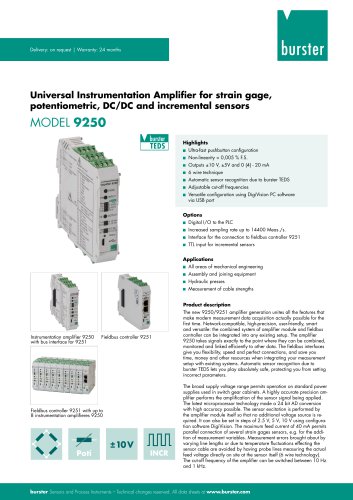 Data Sheet Model 9250
7 Pages
 Operation manual 2025
76 Pages
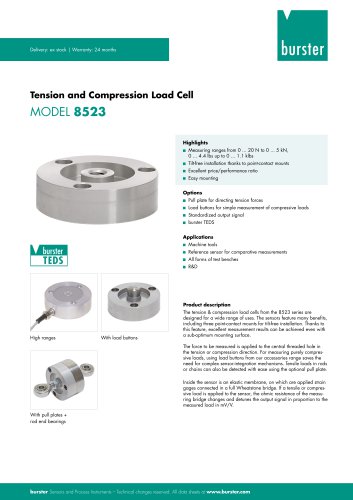 Data Sheet Model 8523 (2025)
8 Pages
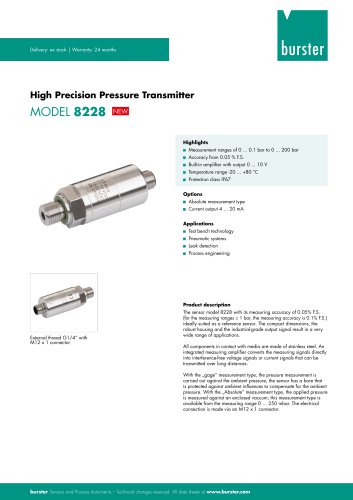 Data-Sheet- Model 8228
6 Pages
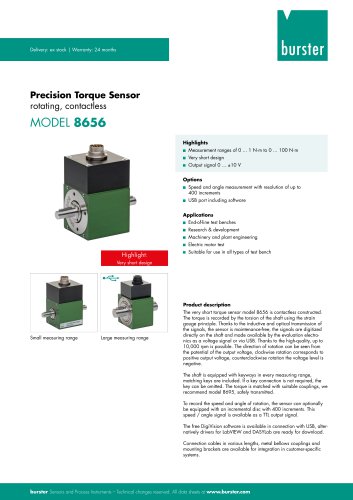 Data Sheet Model 8656
7 Pages
 Brochure Load Cell
25 Pages
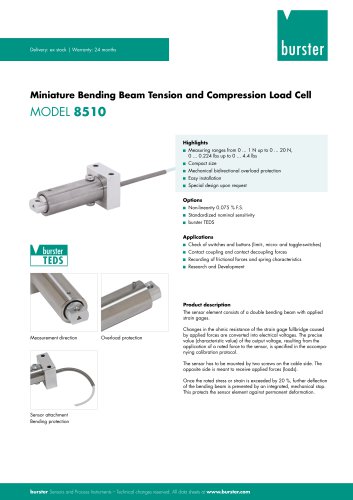 Data Sheet Model 8510 (2025)
5 Pages
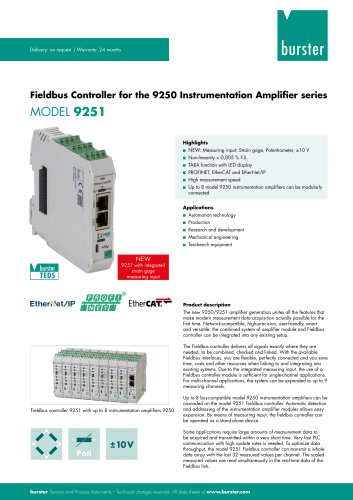 Data-Sheet - 9251
6 Pages
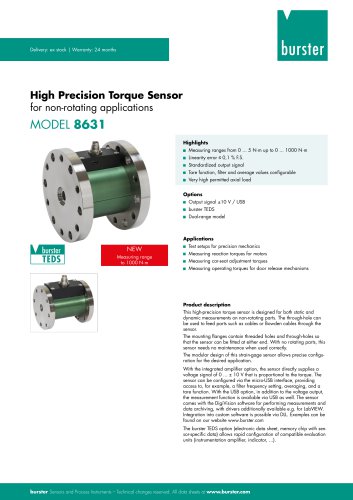 Data sheet Model 8631
5 Pages
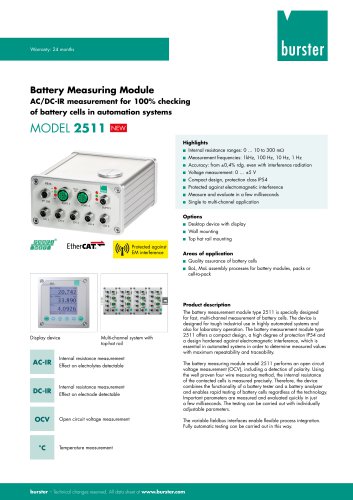 Data Sheet Model 2511
6 Pages
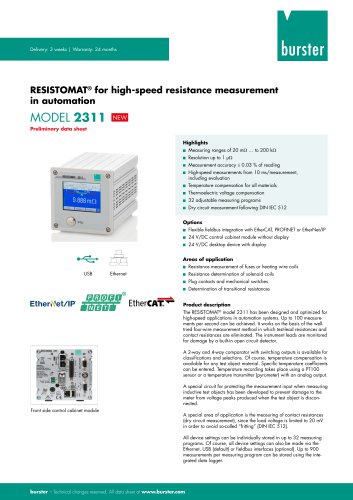 Data Sheet Model 2311
5 Pages
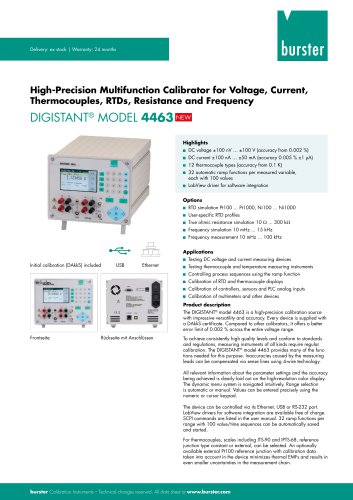 Data Sheet Model 4463
5 Pages
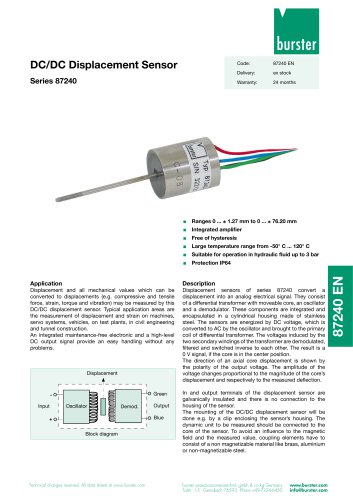 Data Sheet Typ 87240
2 Pages
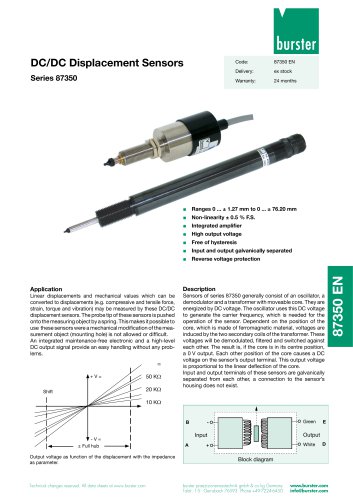 Data Sheet Series 87350
2 Pages
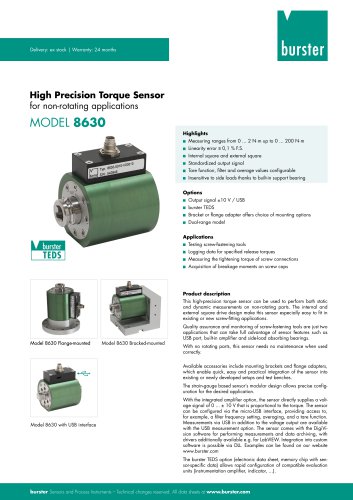 Data Sheet Model 8630
6 Pages
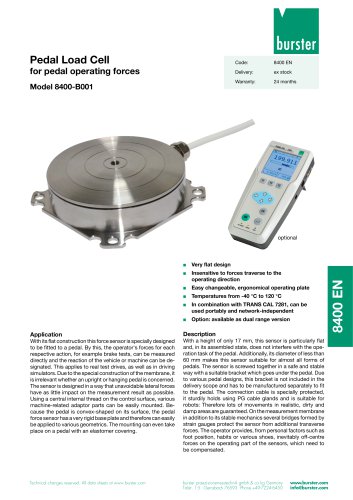 Data Sheet Model 8400-B001
2 Pages
 Load-cell
25 Pages
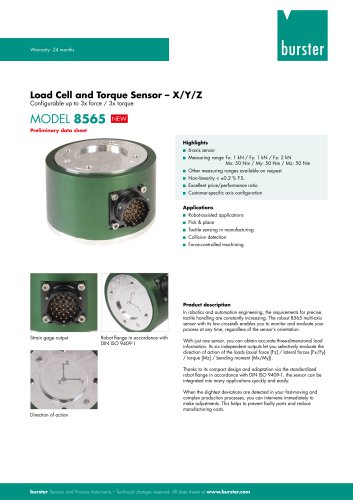 Data Sheet Model 8565
5 Pages
 Torque Sensors
9 Pages
 Data Sheet Typ 8625
7 Pages
 Data Sheet Typ 8512 (2025)
5 Pages
 Data Sheet Model 8511 (2025)
6 Pages
 Data Sheet Model 8415 (2025)
6 Pages
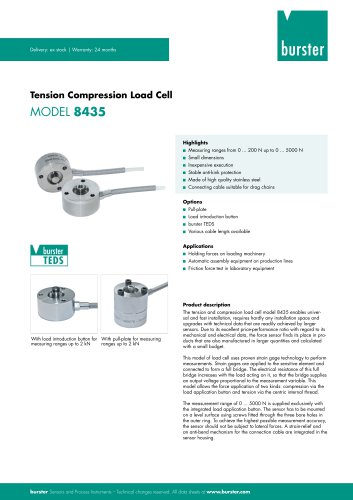 Data sheet Model 8435 (2025)
7 Pages
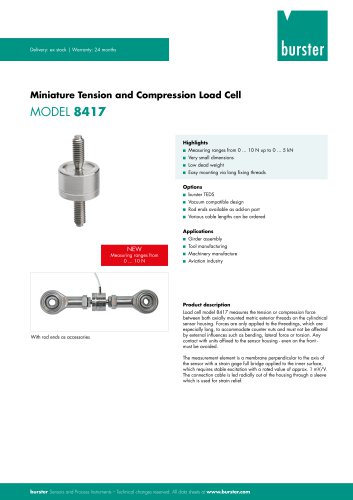 Data Sheet Typ 8417 (2025)
7 Pages
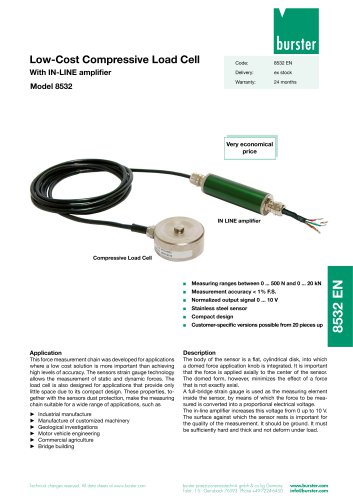 Data Sheet Typ 8532 (2025)
2 Pages
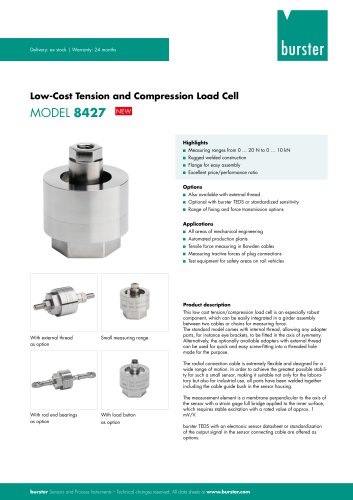 Data Sheet 8427 (2025)
7 Pages
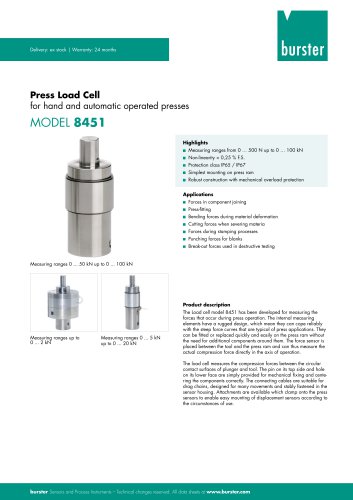 Data Sheet Motel 8451 (2025)
7 Pages
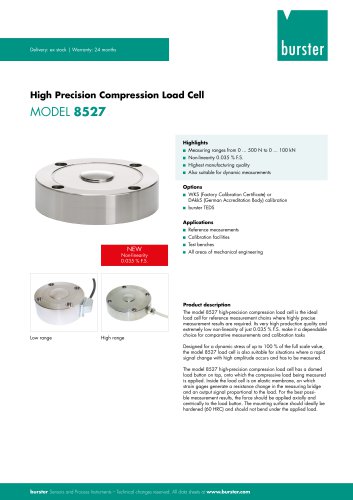 Data Sheet Model 8527 (2025)
7 Pages
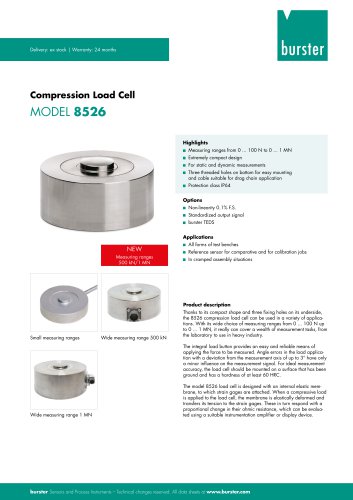 Data Sheet Model 8526 (2025)
9 Pages
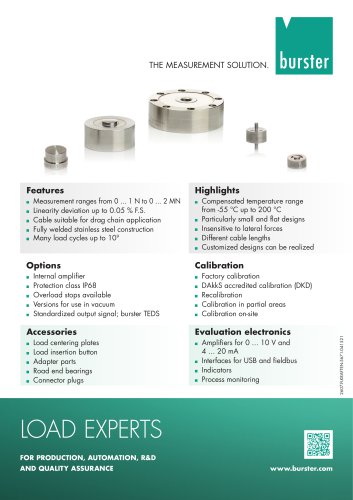 Flyer Load Experts 2025
1 Page
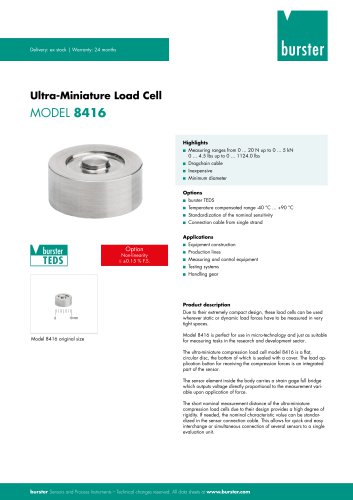 Data sheet Typ 8416 (2025)
6 Pages
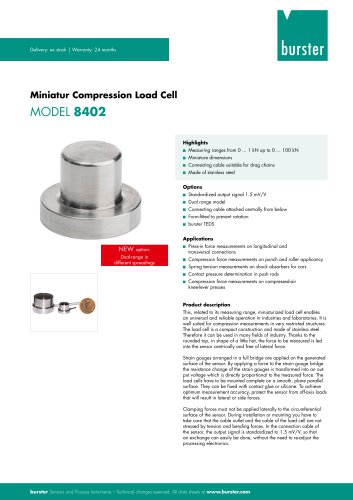 Data Sheet Model 8402 (2025)
6 Pages
 2511 BATTERY MEASURING MODULE
14 Pages
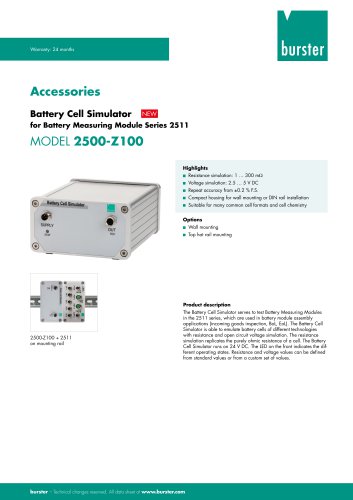 Data Sheet- Model 2500-Z100
2 Pages
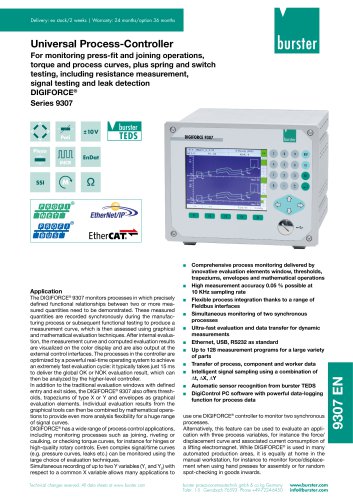 Data Sheet Typ 9307
6 Pages
 Data Sheet Model 9210
5 Pages
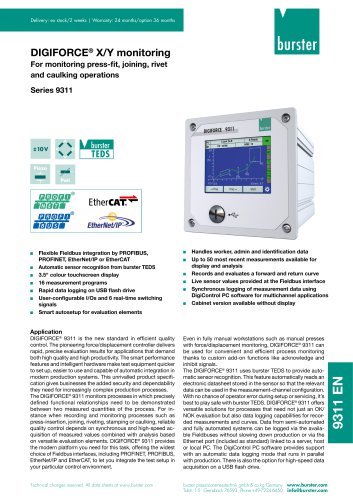 Data Sheet Typ 9311
6 Pages
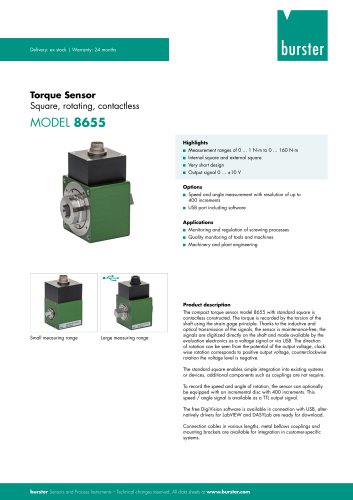 Data Sheet Typ 8655 (2025)
7 Pages
 Displacement Sensors 2025
2 Pages
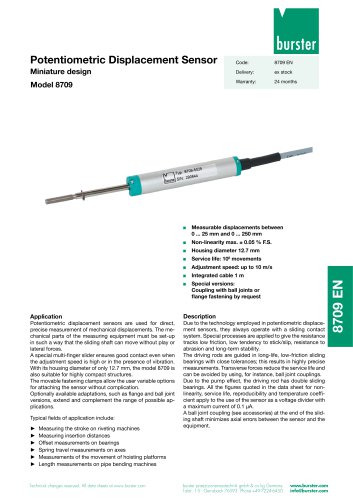 Data sheet Model 8709 (2025)
2 Pages
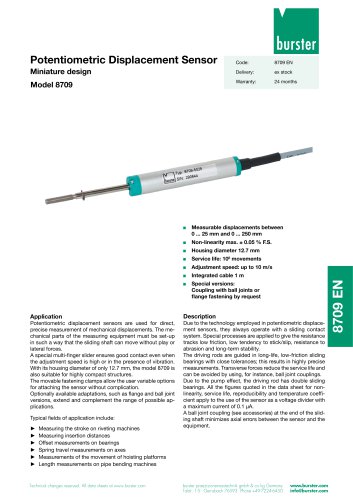 Data sheet Model 8709
2 Pages
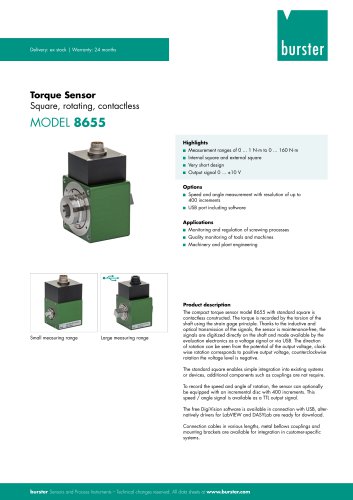 Data Sheet Typ 8655
7 Pages
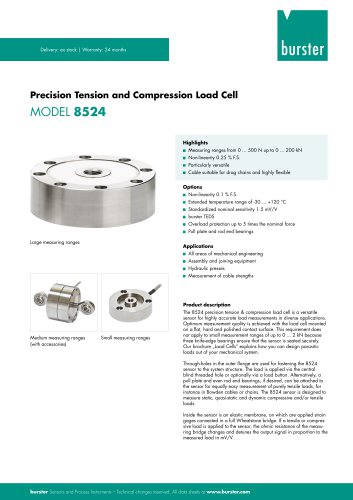 Data Sheet Model 8524
8 Pages
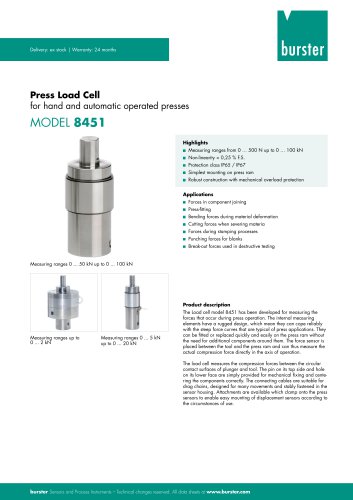 Data Sheet Motel 8451
7 Pages
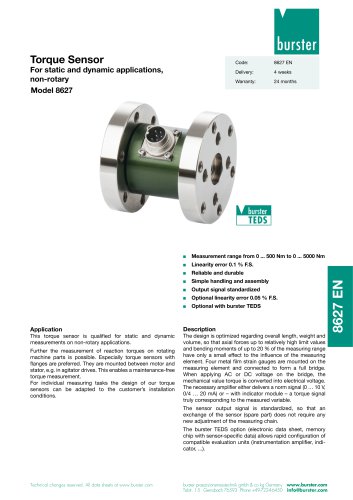 Data Sheet Typ 8627
2 Pages
 Data Sheet Model 9186/8532
2 Pages
 Data Sheet Model 8527
7 Pages
 Data Sheet Typ 8512
5 Pages
 Data Sheet Model 8511
6 Pages
 Data Sheet Typ 8625
7 Pages
 Data Sheet Typ 8532
2 Pages
 Data Sheet Model 8561
6 Pages
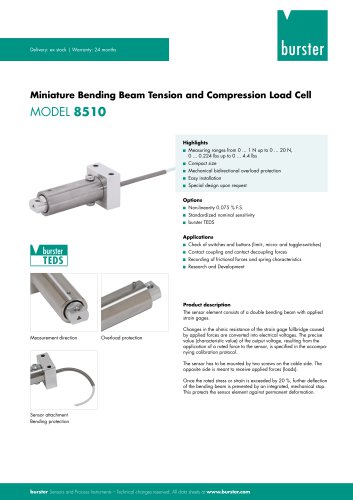 Data Sheet Model 8510
5 Pages
 Data Sheet Model 8523
8 Pages
 Data Sheet Model 8526
9 Pages
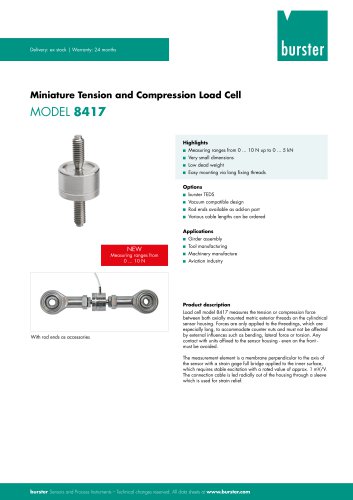 Data Sheet Typ 8417
7 Pages
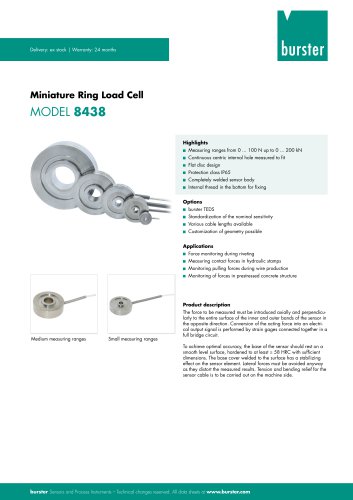 Data Sheet - Model 8438
6 Pages
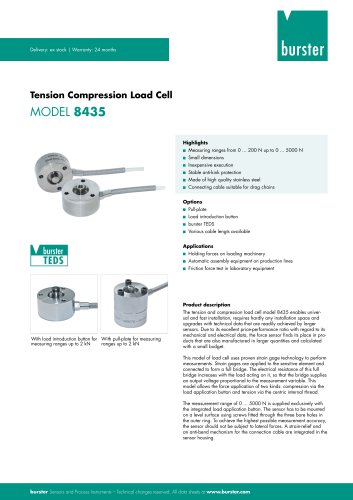 Data sheet Model 8435
7 Pages
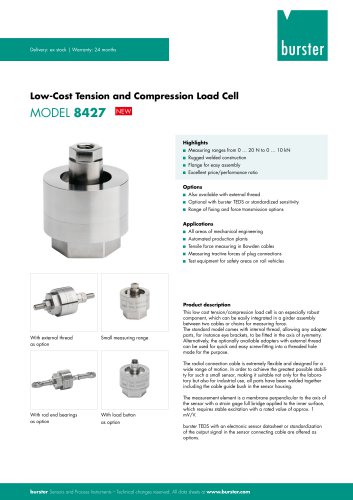 Data Sheet 8427
7 Pages
 Data Sheet Model 8402
6 Pages
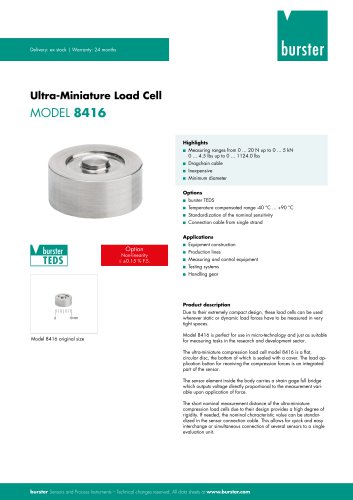 Data sheet Typ 8416
6 Pages
 Press fitting - the reliable way
11 Pages
 Data Sheet Model 9243
2 Pages
 Displacement Sensors
2 Pages
 Flyer Load Experts
1 Page
 Sensor Solutions
1 Page
 Data Sheet Model 9235
2 Pages
 Data sheet Series 8738
2 Pages
 Flyer Battery Tester
1 Page
 Data Sheet Model 2560
5 Pages
 Operation manual
76 Pages
 Data Sheet Typ 8739
2 Pages
 RESISTOMAT® Model 2329
4 Pages
 Data Sheet Model 2550
4 Pages
 Data Sheet Typ 8645
5 Pages
 Flyer Displacement Sensor
2 Pages
 Data Sheet - Model 8670
4 Pages
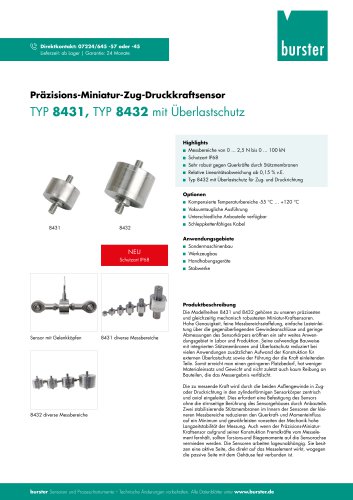



















Archived catalogs
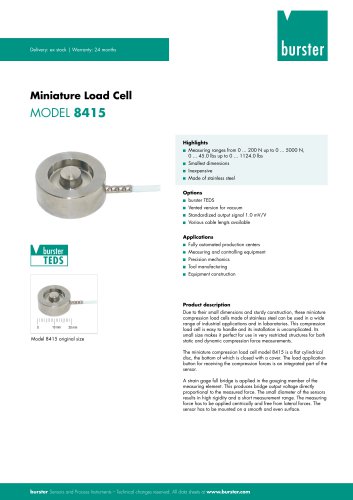 Data Sheet Model 8415
6 Pages
- Display module
- BURSTER load cell
- Pressure transmitter
- BURSTER tension/compression load cell
- BURSTER steel load cell
- Calibration system
- Analog pressure transmitter
- BURSTER strain gauge load cell
- Digital indicator
- BURSTER stainless steel load cell
- Waterproof pressure transmitter
- Membrane pressure transmitter
- Stainless steel pressure transmitter
- Panel panel meter
- Relative pressure transmitter
- Position transducer
- Beam type force sensor
- Signal amplifying integrated circuit
- BURSTER compression load cell
- Automated software