
- Catalogs
- burster Measurement Solutions GmbH
- Data sheet Model 8709 (2025)

Data sheet Model 8709 (2025)
Data sheet Model 8709 (2025)
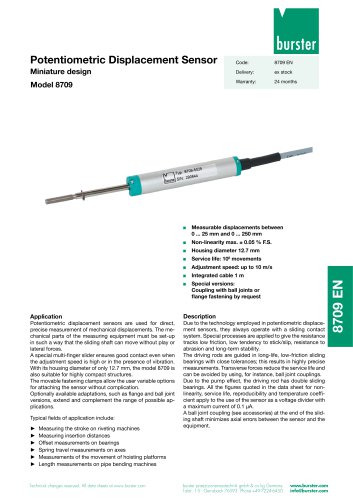
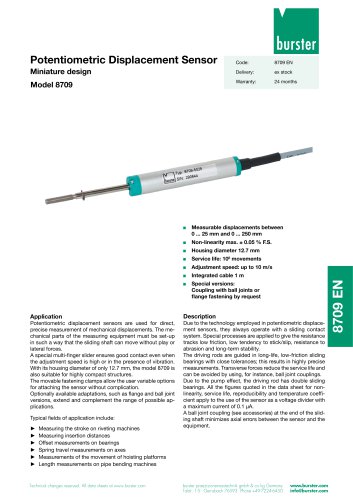
Potentiometric displacement sensors operate with a sliding contact system, ensuring low friction, resistance to abrasion, and long-term stability. They are equipped with low-friction sliding bearings for precise measurements. The sensors are used as voltage dividers with a maximum current of 0.1 µA, and ball joint couplings minimize axial errors.
Application
These sensors are used for precise mechanical displacement measurements in various applications such as riveting machines, insertion distances, bearing offsets, spring travel, hoisting platforms, and pipe bending machines. They offer measurable displacements between 0 to 25 mm and 0 to 250 mm, with a non-linearity of max. ± 0.05% F.S. and a service life of 108 movements.
Technical Data
Electrical Values: Resistance and dissipation values vary by model. The maximum operating voltage and current are specified, with a recommendation to keep the slider current below 0.1 µA to maintain linearity and durability.
Environmental Conditions: Operating temperature ranges from -30°C to 100°C, with storage temperatures from -50°C to 120°C. Temperature influences resistance and output voltage minimally.
Mechanical Values: Non-linearity, resolution, displacement force, speed, vibration, and shock resistance are detailed. The protection class is IP60, and the electrical connection is via an integrated, shielded cable.
Assembly
The sensor includes two fastening clamps for mounting, with recommended spacings provided. CAD drawings are available for download to assist with integration into systems.
Order Information
Various models are available with different ranges, linearity, resistance, dissipation, and voltage specifications. Accessories include mounting sets, ball joints, and connectors for different devices.
Calibration
Manufacturer calibration certificates are available, with calibration performed at six points in 20% increments.
Catalog excerpts
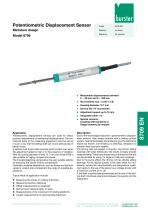
Potentiometric Displacement SensorMiniature design Model 8709 Application Potentiometric displacement sensors are used for direct, precise measurement of mechanical displacements. The mechanical parts of the measuring equipment must be set-up in such a way that the sliding shaft can move without play or lateral forces. A special multi-finger slider ensures good contact even when the adjustment speed is high or in the presence of vibration. With its housing diameter of only 12.7 mm, the model 8709 is also suitable for highly compact structures. The movable fastening clamps allow the user variable options for attaching the sensor without complication. Optionally available adaptations, such as flange and ball joint versions, extend and complement the range of possible applications. Typical fields of application include: ► Measuring the stroke on riveting machines ► Measuring insertion distances ► Offset measurements on bearings ► Spring travel measurements on axes ► Measurements of the movement of hoisting platforms ► Length measurements on pipe bending machines ■ Measurable displacements between 0 ... 25 mm and 0 ... 250 mm ■ Non-linearity max. ± 0.05 % F.S. ■ Service life: 108 movements ■ Adjustment speed: up to 10 m/s Coupling with ball joints or flange fastening by request Due to the technology employed in potentiometric displacement sensors, they always operate with a sliding contact system. Special processes are applied to give the resistance tracks low friction, low tendency to stick/slip, resistance to abrasion and long-term stability. The driving rods are guided in long-life, low-friction sliding bearings with close tolerances; this results in highly precise measurements. Transverse forces reduce the service life and can be avoided by using, for instance, ball joint couplings. Due to the pump effect, the driving rod has double sliding bearings. All the figures quoted in the data sheet for nonlinearity, service life, reproducibility and temperature coefficient apply to the use of the sensor as a voltage divider with a maximum current of 0.1 ^A. A ball joint coupling (see accessories) at the end of the sliding shaft minimizes axial errors between the sensor and the equipment. Technical changes reserved. All data sheets at www.burster.com burster praezisionsmesstechnik gmbh & co kg Germany www.burster.com Talstr. 1-5 . Gernsbach 76593 . Phone +49-7224-6450 [email protected]
Open the catalog to page 1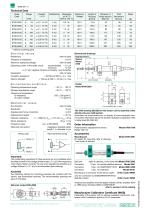
Technical Data Order * without mounting parts Electrical values Resistance: refer to table Maximum operating voltage: refer to table Operating current in the slider circuit: recommended < 0.1 pA (> 0.1 pA: negative influence to linearity and durability) Dissipation: refer to table Environmental conditions Operating temperature range: Storage temperature range: Influence of temperature: to resistance to output voltage Mechanical values Non-linearity: Displacement force, horizontal: Displacement speed: Vibration resistance: Shock resistance: Protection class: Electrical connection: integrated,...
Open the catalog to page 2All Burster Measurement Solutions GmbH catalogs and technical brochures
 Operation Manual Model 8565
24 Pages
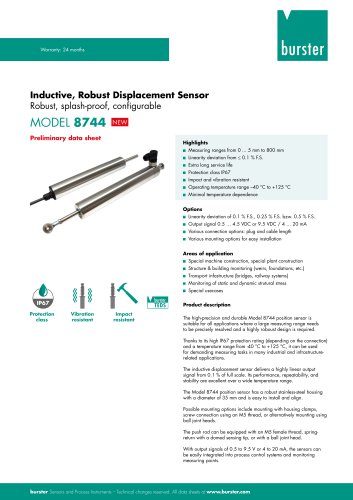 Data Sheet Model 8744
6 Pages
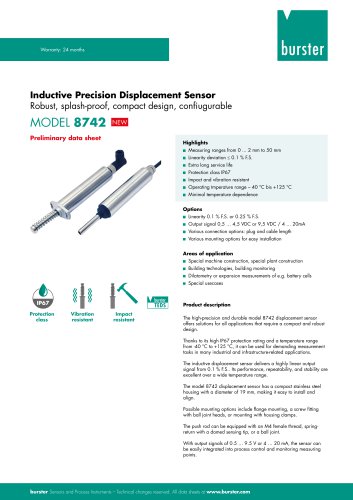 Data Sheet Model 8742
6 Pages
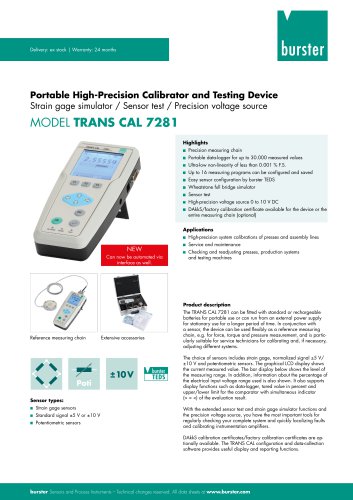 Data Sheet Model 7281
5 Pages
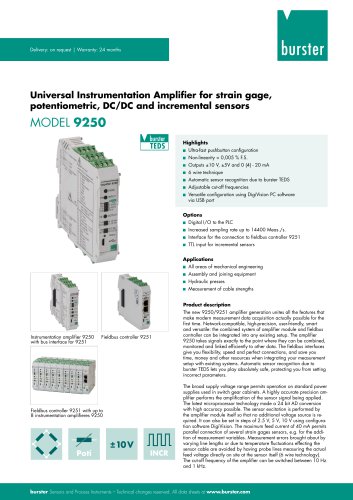 Data Sheet Model 9250
7 Pages
 Operation manual 2025
76 Pages
 Data Sheet Model 8523 (2025)
8 Pages
 Data-Sheet- Model 8228
6 Pages
 Data Sheet Model 8656
7 Pages
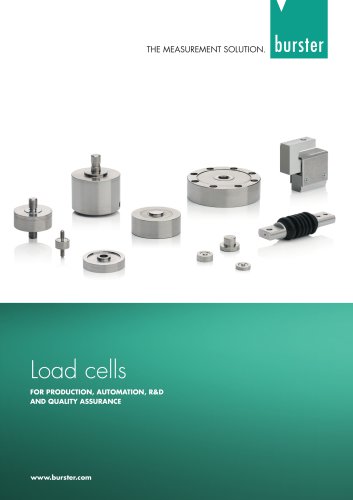 Brochure Load Cell
25 Pages
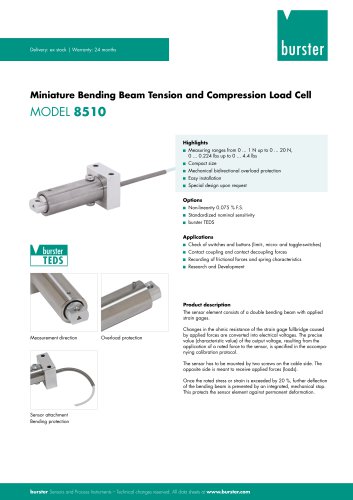 Data Sheet Model 8510 (2025)
5 Pages
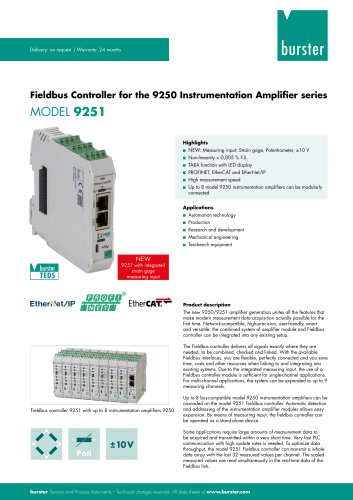 Data-Sheet - 9251
6 Pages
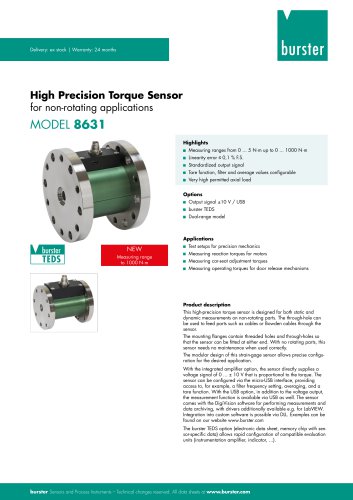 Data sheet Model 8631
5 Pages
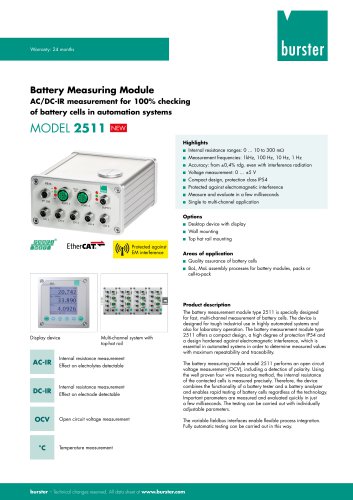 Data Sheet Model 2511
6 Pages
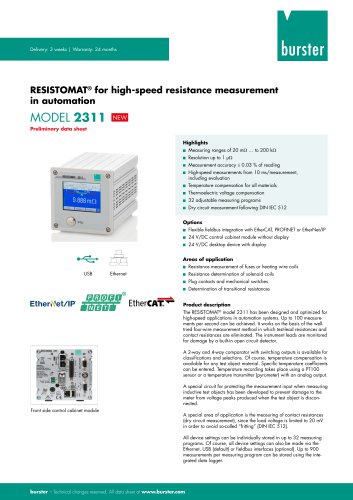 Data Sheet Model 2311
5 Pages
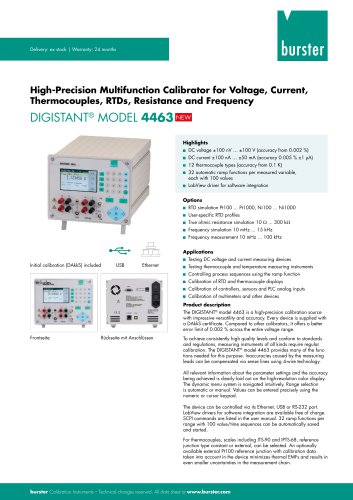 Data Sheet Model 4463
5 Pages
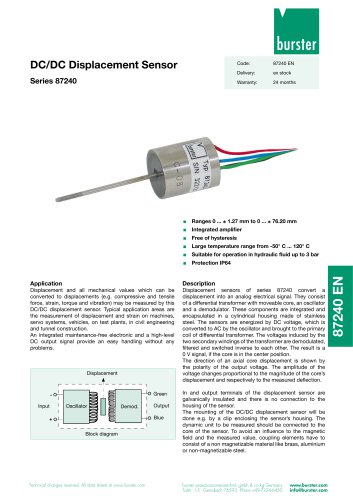 Data Sheet Typ 87240
2 Pages
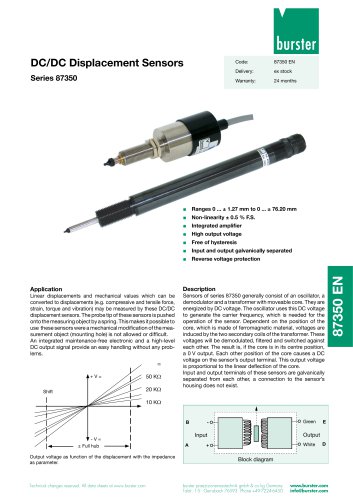 Data Sheet Series 87350
2 Pages
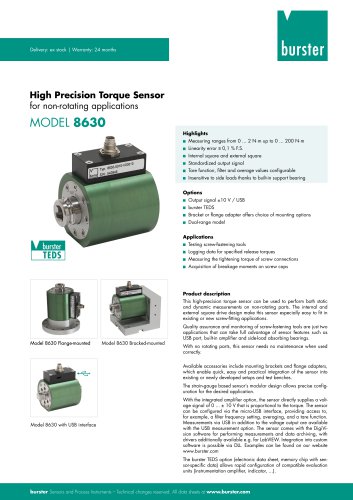 Data Sheet Model 8630
6 Pages
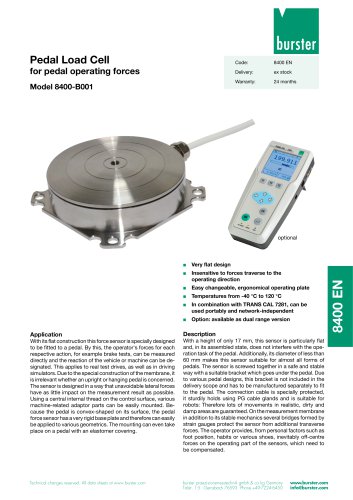 Data Sheet Model 8400-B001
2 Pages
 Load-cell
25 Pages
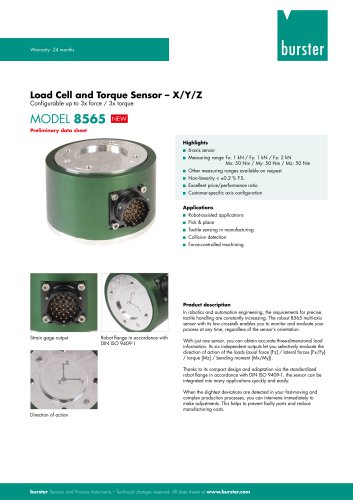 Data Sheet Model 8565
5 Pages
 Torque Sensors
9 Pages
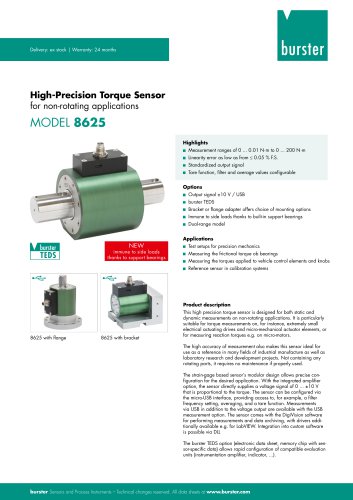 Data Sheet Typ 8625
7 Pages
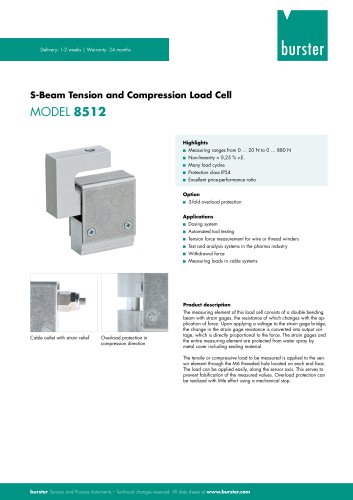 Data Sheet Typ 8512 (2025)
5 Pages
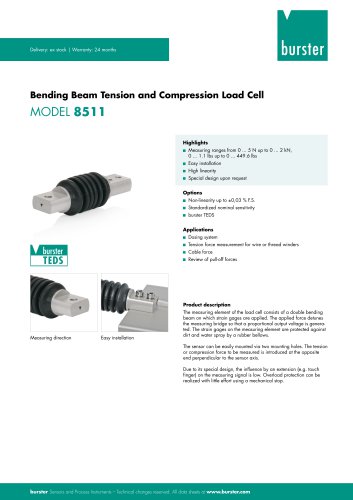 Data Sheet Model 8511 (2025)
6 Pages
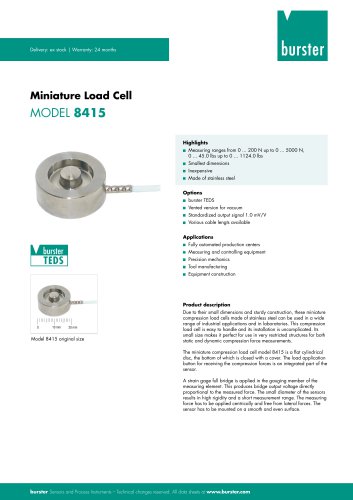 Data Sheet Model 8415 (2025)
6 Pages
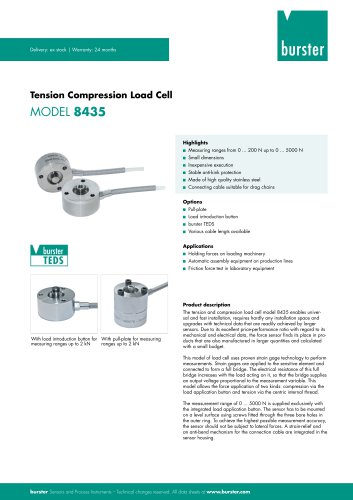 Data sheet Model 8435 (2025)
7 Pages
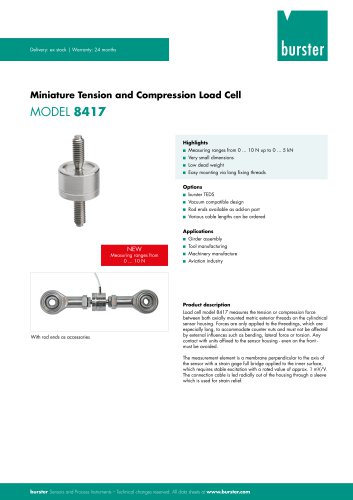 Data Sheet Typ 8417 (2025)
7 Pages
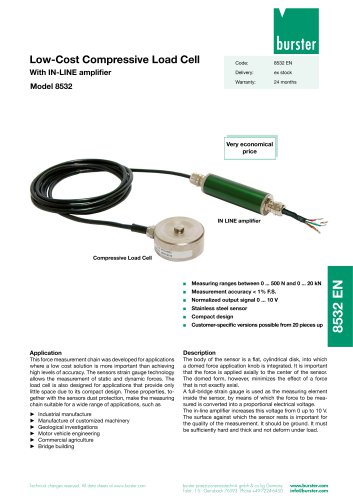 Data Sheet Typ 8532 (2025)
2 Pages
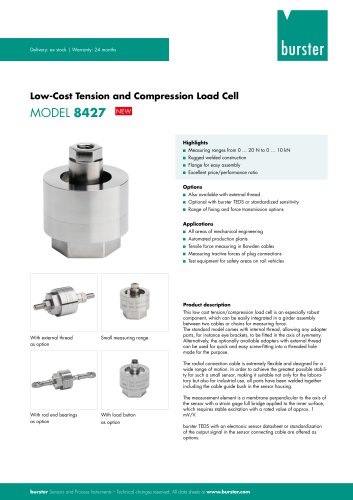 Data Sheet 8427 (2025)
7 Pages
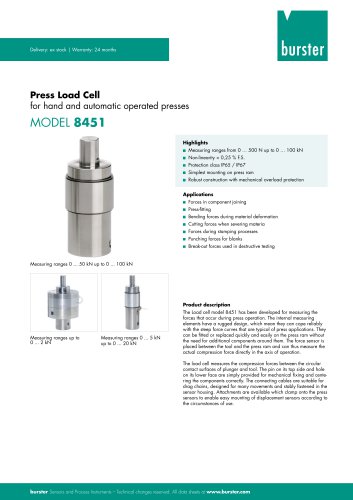 Data Sheet Motel 8451 (2025)
7 Pages
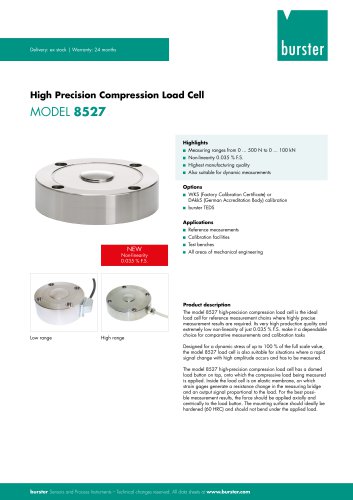 Data Sheet Model 8527 (2025)
7 Pages
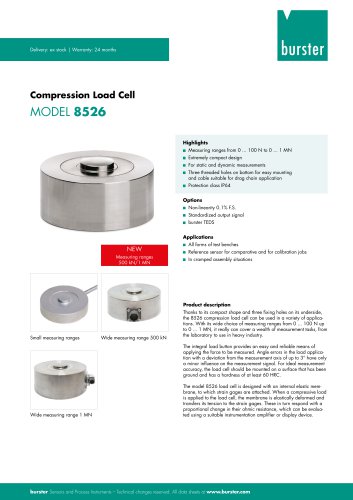 Data Sheet Model 8526 (2025)
9 Pages
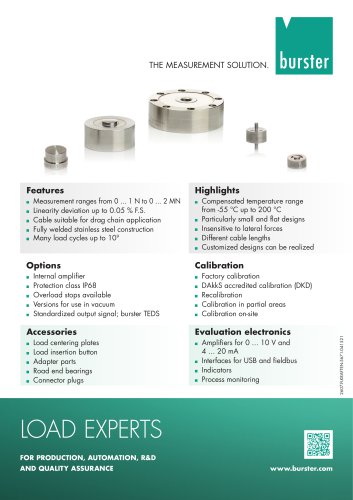 Flyer Load Experts 2025
1 Page
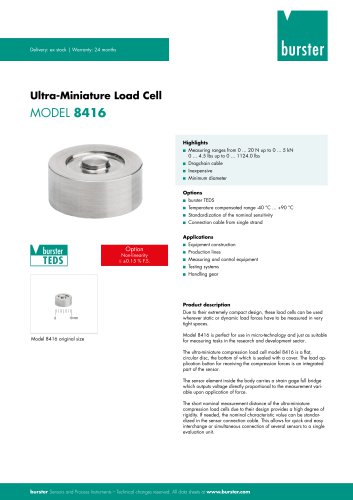 Data sheet Typ 8416 (2025)
6 Pages
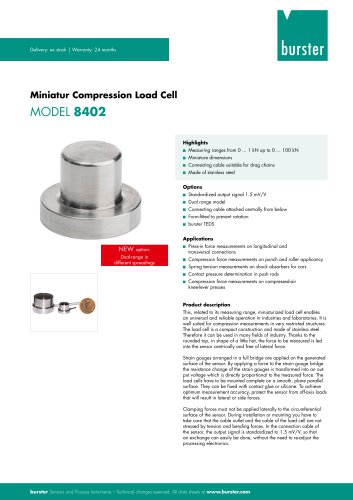 Data Sheet Model 8402 (2025)
6 Pages
 2511 BATTERY MEASURING MODULE
14 Pages
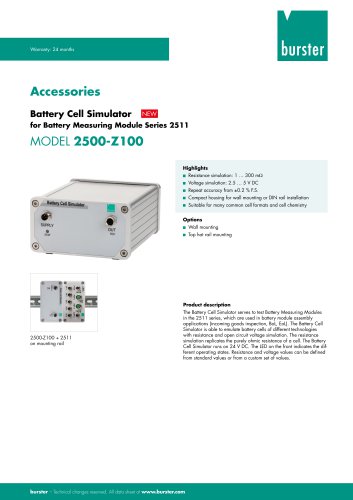 Data Sheet- Model 2500-Z100
2 Pages
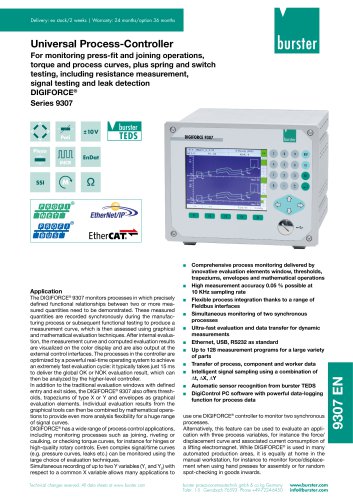 Data Sheet Typ 9307
6 Pages
 Data Sheet Model 9210
5 Pages
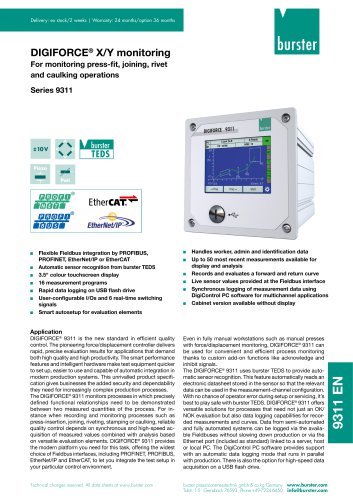 Data Sheet Typ 9311
6 Pages
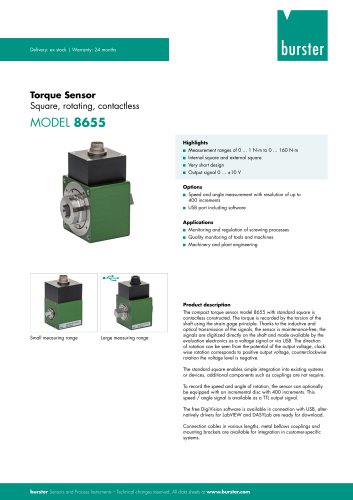 Data Sheet Typ 8655 (2025)
7 Pages
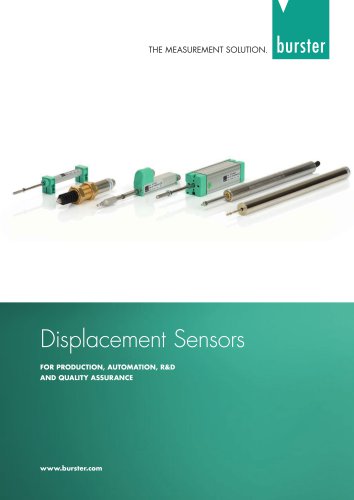 Displacement Sensors 2025
2 Pages
 Data sheet Model 8709
2 Pages
 Data Sheet Typ 8655
7 Pages
 Data Sheet Model 8524
8 Pages
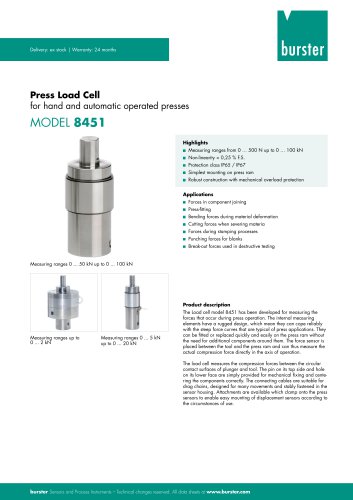 Data Sheet Motel 8451
7 Pages
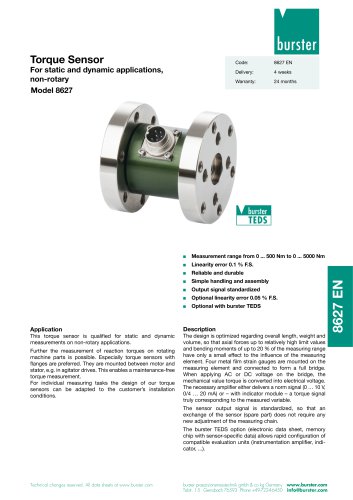 Data Sheet Typ 8627
2 Pages
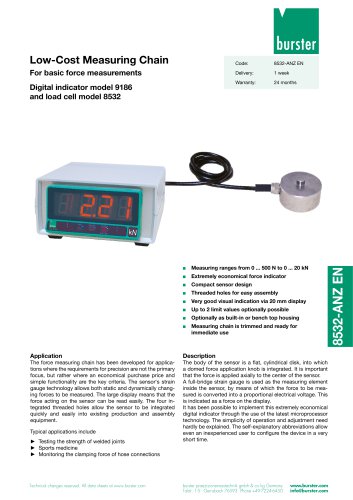 Data Sheet Model 9186/8532
2 Pages
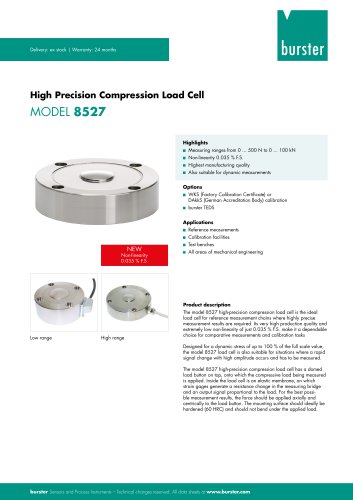 Data Sheet Model 8527
7 Pages
 Data Sheet Typ 8512
5 Pages
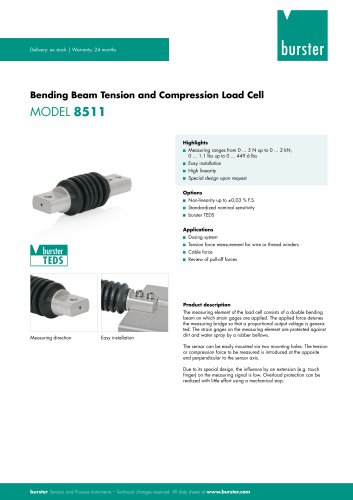 Data Sheet Model 8511
6 Pages
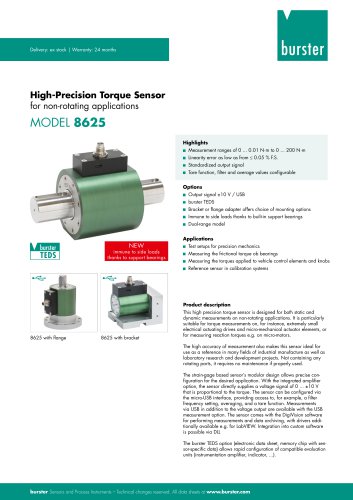 Data Sheet Typ 8625
7 Pages
 Data Sheet Typ 8532
2 Pages
 Data Sheet Model 8561
6 Pages
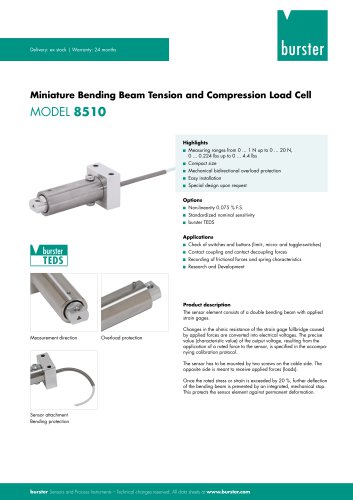 Data Sheet Model 8510
5 Pages
 Data Sheet Model 8523
8 Pages
 Data Sheet Model 8526
9 Pages
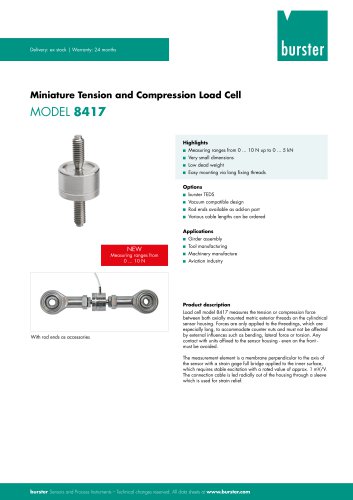 Data Sheet Typ 8417
7 Pages
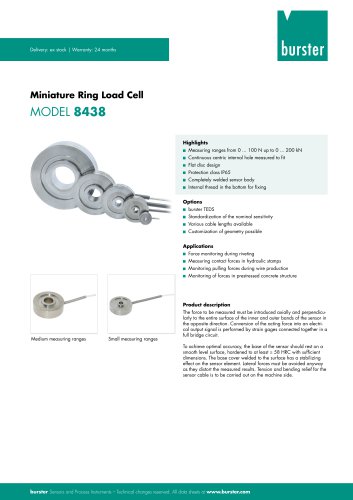 Data Sheet - Model 8438
6 Pages
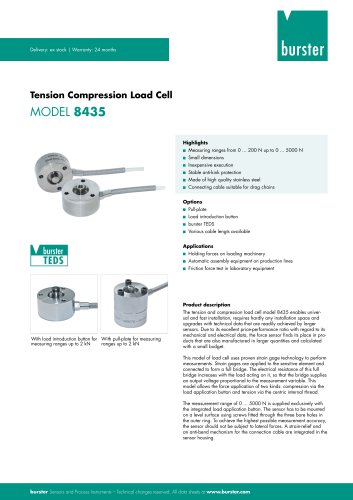 Data sheet Model 8435
7 Pages
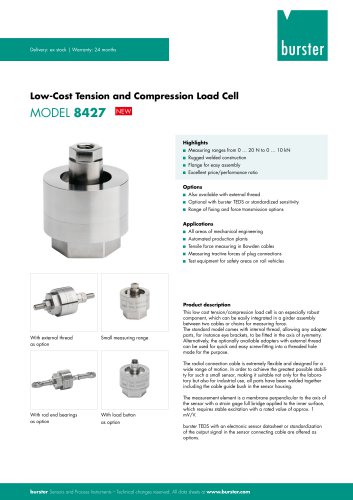 Data Sheet 8427
7 Pages
 Data Sheet Model 8402
6 Pages
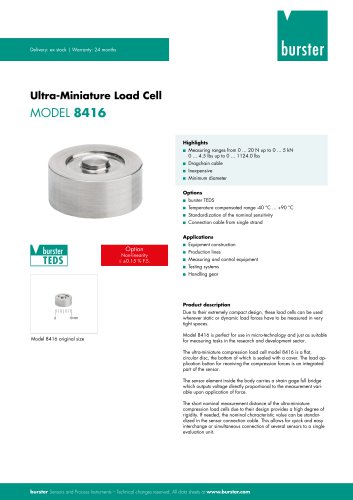 Data sheet Typ 8416
6 Pages
 Press fitting - the reliable way
11 Pages
 Data Sheet Model 9243
2 Pages
 Displacement Sensors
2 Pages
 Flyer Load Experts
1 Page
 Sensor Solutions
1 Page
 Data Sheet Model 9235
2 Pages
 Data sheet Series 8738
2 Pages
 Flyer Battery Tester
1 Page
 Data Sheet Model 2560
5 Pages
 Operation manual
76 Pages
 Data Sheet Typ 8739
2 Pages
 RESISTOMAT® Model 2329
4 Pages
 Data Sheet Model 2550
4 Pages
 Data Sheet Typ 8645
5 Pages
 Flyer Displacement Sensor
2 Pages
 Data Sheet - Model 8670
4 Pages



















Archived catalogs
 Data Sheet Model 8415
6 Pages
- Display module
- BURSTER load cell
- Pressure transmitter
- BURSTER tension/compression load cell
- BURSTER steel load cell
- Calibration system
- Analog pressure transmitter
- BURSTER strain gauge load cell
- Digital indicator
- BURSTER stainless steel load cell
- Waterproof pressure transmitter
- Membrane pressure transmitter
- Stainless steel pressure transmitter
- Panel panel meter
- Relative pressure transmitter
- Position transducer
- Beam type force sensor
- Signal amplifying integrated circuit
- BURSTER compression load cell
- Automated software