

- Company
- Products
- Catalogs
- News & Trends
- Exhibitions
heliX+
heliX+
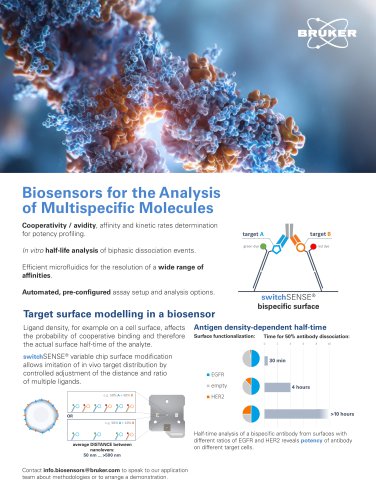
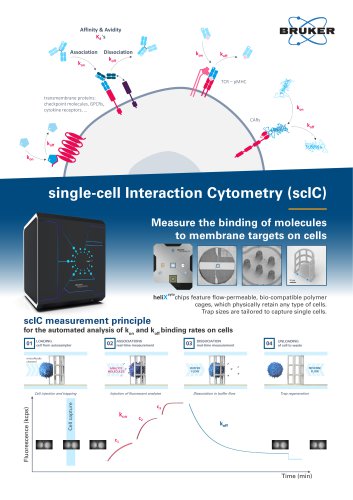
This document provides an overview of biosensors used for analyzing multispecific molecules, focusing on cooperativity, avidity, affinity, and kinetic rates for potency profiling. It highlights the use of switchSENSE® technology for in vitro half-life analysis and efficient microfluidics for resolving a wide range of affinities.
- Automated, pre-configured assay setup and analysis options.
- switchSENSE® technology allows for variable chip surface modification to mimic in vivo target distribution.
- Surface functionalization affects ligand density, influencing cooperative binding and analyte surface half-time.
- Target surface modeling in biosensors is used to analyze antigen density-dependent half-time.
- Half-time analysis of bispecific antibodies on surfaces with different EGFR and HER2 ratios reveals antibody potency on various target cells.
- Real-time association and dissociation traces of therapeutic bispecific antibodies, such as Hemlibra®, are provided.
- The document includes a rate scale plot of association and dissociation rates for Thrombin-binding aptamers, demonstrating the cooperation of affinities leading to avidity.
- For research use only, not for clinical diagnostic procedures.
- Continuous product improvement by Bruker Daltonics, with specifications subject to change without notice.
- References to relevant publications and webinars are provided for further reading and understanding of bispecific antibodies and their characterization.
- For more details or to arrange a demonstration, contact [email protected].
- Additional resources and tutorials are available online.
Catalog excerpts
Biosensors for the Analysis of Multispecific Molecules Cooperativity / avidity, affinity and kinetic rates determination for potency profiling. In vitro half-life analysis of biphasic dissociation events. Efficient microfluidics for the resolution of a wide range of affinities. Automated, pre-configured assay setup and analysis options. Target surface modelling in a biosensor Ligand density, for example on a cell surface, affects the probability of cooperative binding and therefore the actual surface half-time of the analyte. Antigen density-dependent half-time Surfaceempty functionalization: Time for 50% antibody dissociation: 0 EGFR empty Contact [email protected] to speak to our application team about methodologies or to arrange a demonstration. average DISTANCE betweenbetween nanolevers: average DISTANCE 30 nanolevers: nm … >300 nm 50 nm ... >500 nm switchSENSE® variable chip surface modification allows imitation of in vivo target distribution by controlled adjustment of the distance and ratio of multiple ligands. switchSENSE® bispecific surface Half-time analysis of a bispecific antibody from surfaces with empty different ratios of EGFR and HER2 reveals potency of antibody HER2target cells. on differen
Open the catalog to page 1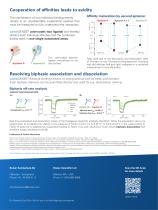
Cooperation of affinities leads to avidity Affinity maturation by second aptamer 108 The combination of two individual binding events results in an unpredictable cooperation (avidity) that must be measured to fully understand the interaction. switchSENSE® color-codes two ligands and thereby obtains both individual affinities and the combined avidity rates in one single automated assay. Made with www.affinity-avidity.com Two color-coded aptamer ligands immobilized on the chip surface. Rate scale plot of the association and dissociation rates of Thrombin to two Thrombin-binding aptamers. Individual...
Open the catalog to page 2All Bruker Optics GmbH & Co. KG catalogs and technical brochures
 ELIO
8 Pages
 QUANTAX EBSD
2 Pages
 HI 90
2 Pages
 SIGIS 2
12 Pages
 EM 27/SUN Series
8 Pages
 EM 27
2 Pages
 OPS
8 Pages
 MATRIX-MF II
2 Pages
 TANGO II
5 Pages
 MATRIX-F II
16 Pages
 BEAM
8 Pages
 MOBILE-IR II
12 Pages
 INVENIO
12 Pages
 ALPHA II
12 Pages
 BRAVO
12 Pages
 LUMOS II
8 Pages
 OMEGA 5
8 Pages
 MATRIX II-MG Series
8 Pages
Archived catalogs
 MPA III
7 Pages
- Gas analyzer
- Concentration analyzer
- Monitoring analyzer
- Automatic analyser
- Microscope
- Benchtop analyser
- Bruker spectrometer
- Process analyzer
- Gas detector
- Continuous analyzer
- Real-time analyzer
- Laboratory microscope
- Laboratory analyzer
- Digital analyzer
- Compact analyzer
- Infrared analyser
- Temperature analyzer
- Laboratory spectrometer
- Inspection microscope
- In-line analyzer