
- Catalogs
- Bruker Daltonics
- timsTOF PRO


timsTOF PRO

timsTOF PRO
The document introduces the timsTOF Pro with PASEF technology, highlighting its revolutionary improvements in scan speed, specificity, and sensitivity while maintaining ultra-high resolution. This technology is designed to enhance the analysis of complex biological samples, particularly in proteomics.
Specifications and Design
The timsTOF Pro features a novel dual TIMS design that allows for near 100% duty cycle by accumulating ions in parallel and releasing them based on mobility. It offers high mass resolving power independent of sequencing speed, with a resolving power of 50,000 (FWHM @ m/z 1222).
Performance and Capabilities
PASEF technology enables deeper exploration of the proteome by adding an additional dimension of separation, resulting in high speed and sensitivity. The system is optimized for shotgun proteomics, allowing for high MS and MS/MS spectra quality at high speeds. The PASEF cycle time allows for the fragmentation of an average of 12 precursors within a 100 ms timescale.
Applications and Benefits
The timsTOF Pro is particularly beneficial for analyses requiring low sample amounts, reducing preparation costs and making it suitable for clinical proteomics. It provides deep proteome coverage and improved spectra quality, enabling higher identification rates of peptides and protein groups.
Technological Advancements
The document details the integration of TIMS with QTOF technology, enhancing the separation and identification of post-translational modifications (PTMs). The system's high throughput and sensitivity allow for faster proteomic analyses and better separation of PTMs.
Conclusion
The timsTOF Pro with PASEF technology sets a new standard for high-speed, high-sensitivity shotgun proteomics, offering significant advancements in specificity, sensitivity, and speed. It is expected to become popular among proteomics researchers due to its performance and data quality.
Catalog excerpts

timsTOF • Powered by PASEF TIMS-QTOF MS Innovation with Integrity
Open the catalog to page 1
The new standard for high speed, high sensitivity shotgun proteomics The timsTOF Pro with PASEF technology delivers revolutionary improvements in scan speed, coupled with enhanced specificity and high sensitivity. It does so while simultaneously maintaining ultra-high resolution for both precursors and MS/MS spectra. This unique performance quintet gives scientists the tools to dig deeper into the complex biology of the deep proteome. Novel dual TIMS design delivers near 100% duty cycle The novel design allows incoming ions to be accumulated in parallel in the first section and for ions to be...
Open the catalog to page 2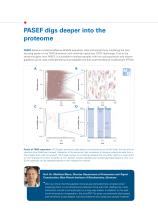
PASEF digs deeper into the proteome PASEF delivers unmatched effective MS/MS acquisition rates and sensitivity by interfacing the time focusing power of the TIMS dimension with ultra-high resolution QTOF technology. Due to the s ensitivity gains from PASEF it is possible to analyze samples with low cell populations and shorter , gradients can be used while identifying more peptides and their post-translational modifications (PTMs). Retention time Retention time Power of TIMS separation: (A) Shotgun proteomics data feature two dimensions at the MS level, the m/z and the retention time (MaxQuant...
Open the catalog to page 3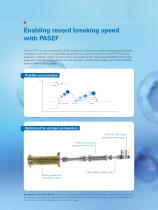
Enabling record breaking speed with PASEF The timsTOF Pro was engineered by Bruker experts for scientists to enable breakthrough discoveries in shotgun proteomics. Using parallel accumulation, all ions that enter the timsTOF Pro can be analyzed. In addition, higher ion transmission is provided by the newly designed TIMS synchronized quadrupole. The high speed collision cell and ultra-high resolution TOF enables high MS and MS/MS spectra quality at high speeds. Optimized for shotgun proteomics UHR-TOF with high efficiency technology TIMS synchronized quadrupole mass filter High speed collision...
Open the catalog to page 4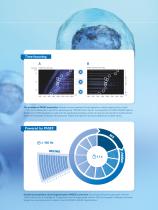
B PASEF MS/MS Heat Map Mobility TIMS MS Heat Map 1/K0 The principle of PASEF acquisition: Peptide ions are separated using trapped ion mobility spectrometry, eluted (~ 100 ms) and detected in the QTOF, generating the TIMS MS heat map (A). For acquisition of PASEF MS/MS spectra (B) the same TIMS separation is used with the quadrupole isolating a certain ion species only during its mobility elution time and immediately shifting to next precursor. Parent and fragment spectra are aligned by mobility values. Parallel accumulation serial fragmentation (PASEF) cycle time: By synchronizing the quadrupole...
Open the catalog to page 5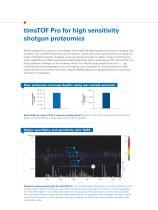
timsTOF Pro for high sensitivity shotgun proteomics Recent advances in proteomic technologies have made MS-based proteomics a central research tool. However, truly complete proteomes are still elusive, mainly due to the high complexity and dynamic range of biological samples. Analyses using low sample amounts or where a range of post-translational modifications (PTMs) need to be located additionally remain challenging. With the timsTOF Pro, deep proteome coverage can be achieved without the need for large sample amounts ( > 1 µg), reducing the sample preparation costs and making it very attractive...
Open the catalog to page 6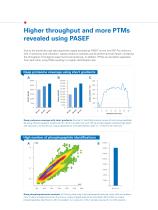
Higher throughput and more PTMs revealed using PASEF Due to the extremely high data acquisition speed provided by PASEF on the timsTOF Pro without a loss in sensitivity and resolution, typical proteomic analyses can be performed even faster, increasing the throughput of biological experiments tremendously. In addition, PTMs can be better separated from each other using TIMS resulting in a higher identification rate. Deep proteome coverage using short gradients A protein groups Deep proteome coverage with short gradients: Number of identified proteins groups (A) and unique peptides (B) using different...
Open the catalog to page 7
Specificity Sensitivity Speed Prof. Dr. Jürgen Cox, Group Leader Computational Systems Biochemistry, Max-Planck-Institute of Biochemistry, Germany “ e have been impressed with the quality of the data that we`ve W seen and therefore we expect that the performance of the timsTOF Pro with the PASEF technology will make it very popular among proteomics researchers.” List of timsTOF patents TIMS cell (BIL 031/08), Title: “Apparatus and method for parallel flow ion mobility spectrometry combined with mass spectrometry”, Issued: US7838826B1; US 8288717B2 Parallel Accumulation TIMS (BRE 398/15), Title:...
Open the catalog to page 8All Bruker Daltonics catalogs and technical brochures
 DE-tector flex
8 Pages
 MATRIX II-MG
8 Pages
 RoadRunner
8 Pages
 RAPIDplus
12 Pages
 RAID-XP
8 Pages
 Maritime Detection Systems
7 Pages
 SVGps
SVGps4 Pages
 TIMON
TIMON13 Pages
 MALDI Biotyper® CA System
12 Pages
 RAID-M Series
7 Pages
 HDX Solution
2 Pages
 EVOQ GC-TQ
8 Pages
 Agri Solutions brochure
8 Pages
 PesticideScreener
8 Pages
 Elute LC series
8 Pages
 nanoElute®
6 Pages
 timsTOF™
8 Pages
 rapifleX™
8 Pages
 amaZon SL
6 Pages
 compact
8 Pages
 MALDI Biotyper
56 Pages
 rapifleX™ MALDI Tissuetyper™
8 Pages
 MALDI PharmaPulse™
4 Pages
 Toxtyper
6 Pages
 impact II
12 Pages
 maxis II
12 Pages
 amaZon speed
10 Pages
 Albira Brochure
12 Pages
 prime
prime12 Pages
 solarix
10 Pages
 Metabolomics
12 Pages
 aurora M90
10 Pages
 Clean Room Pack
4 Pages
 MATRIX-F FT-NIR Spectrometer
2 Pages
 TANGO
TANGO12 Pages
 The new autoflex? series
10 Pages
 MM 2
MM 26 Pages
 µRAID
µRAID4 Pages
 Radiation Backpack Sentry
4 Pages
 Posterbook Metabolomics ebook
14 Pages
 CaptiveSpray nanoBooster
8 Pages
 Scion SQ Series GC-MS
8 Pages
 solariX XR
12 Pages
 aurora Elite
6 Pages
 nano-Advance UHPLC
8 Pages
 EVOQ
EVOQ12 Pages
 CaptiveSpray
4 Pages
 ImagePrep
4 Pages
 micrOTOF-Q II
12 Pages
 PROTEINEER fc II
4 Pages
 Ultraflextreme
16 Pages
 Autoflix speed
10 Pages
 microflex
6 Pages
 SCION 436-GC
4 Pages
 SCION 456-GC
4 Pages
 GC CARE
8 Pages


Archived catalogs
 Brochure BioTools 2.2
10 Pages
 Brochure EASY-nLC
6 Pages
 Brochure micrOTOF II
8 Pages
 RAID-M 100
6 Pages
 compact?
6 Pages
 MALDI Biotyper
12 Pages
 Toxtyper
8 Pages
 micrOTOF-Q III
6 Pages
 impact HD
12 Pages
 Brochure MetaboliteTools 1.1
8 Pages
 Brochure ProfileAnalysis
4 Pages


- Automation software solution
- Bruker analysis software
- Process software
- Real-time software
- Microscope
- Control software
- Bruker spectrometer
- Gas detector
- Monitoring software solution
- Optical microscope
- 3D software solution
- Industrial software
- Measurement software
- Interface software
- Visualization software solution
- Laboratory microscope
- Quality software
- Automated software
- Bruker industrial detector
- Monitoring detector