
- Catalogs
- Bruker Daltonics
- New Generation of GC/High Resolution TOF-MS: APCI/APLI Source for Increased Flexibility


New Generation of GC/High Resolution TOF-MS: APCI/APLI Source for Increased Flexibility

1 / 2 PagesView full catalog
New Generation of GC/High Resolution TOF-MS: APCI/APLI Source for Increased Flexibility
Product catalog summary
Introduction
The document discusses the integration of a new APCI/APLI source with high-resolution TOF-MS, enhancing its application with both liquid chromatography (LC) and gas chromatography (GC). This innovation allows for high mass resolution and accuracy without being affected by the chromatographic system used.
Apparatus
The main challenge in combining LC-MS with GC is the difference in ionization methods. The new Bruker Daltonics source overcomes this by using atmospheric pressure ionization (API) even in GC applications, offering advantages over traditional vacuum ionization.
New Generation of GC/High Resolution TOF-MS
The document describes the setup of the APCI/APLI source, including a schematic of the GC-TOF-MS coupling. The system uses a heated transfer line to prevent condensation and allows for both chemical and laser ionization.
Applications
Pesticide Screening: The GC-TOF-MS system is ideal for complex pesticide mixtures, offering superior screening capabilities compared to quadrupole MS. A high-resolution extracted ion chromatogram (hrEIC) demonstrates the system's ability to identify pesticides with high accuracy.
PAH Analysis: APLI is particularly effective for analyzing polycyclic aromatic hydrocarbons (PAHs), providing enhanced selectivity and sensitivity. The document highlights the significant improvement in sensitivity over conventional methods.
Metabolomics
GC-MS is highlighted as a powerful tool for metabolite analysis, requiring chemical derivatization to make analytes volatile. The document includes a chromatogram of a derivatized mouse urine sample, showcasing the system's capabilities.
Summary
The integration of APCI-TOF-MS with GC opens new analytical possibilities, offering high mass accuracy and resolution. APLI further enhances sensitivity for specific applications, setting new benchmarks in analytical chemistry.
References
The document cites several studies and references that support the discussed technologies and applications.
The document discusses the integration of a new APCI/APLI source with high-resolution TOF-MS, enhancing its application with both liquid chromatography (LC) and gas chromatography (GC). This innovation allows for high mass resolution and accuracy without being affected by the chromatographic system used.
Apparatus
The main challenge in combining LC-MS with GC is the difference in ionization methods. The new Bruker Daltonics source overcomes this by using atmospheric pressure ionization (API) even in GC applications, offering advantages over traditional vacuum ionization.
New Generation of GC/High Resolution TOF-MS
The document describes the setup of the APCI/APLI source, including a schematic of the GC-TOF-MS coupling. The system uses a heated transfer line to prevent condensation and allows for both chemical and laser ionization.
Applications
Pesticide Screening: The GC-TOF-MS system is ideal for complex pesticide mixtures, offering superior screening capabilities compared to quadrupole MS. A high-resolution extracted ion chromatogram (hrEIC) demonstrates the system's ability to identify pesticides with high accuracy.
PAH Analysis: APLI is particularly effective for analyzing polycyclic aromatic hydrocarbons (PAHs), providing enhanced selectivity and sensitivity. The document highlights the significant improvement in sensitivity over conventional methods.
Metabolomics
GC-MS is highlighted as a powerful tool for metabolite analysis, requiring chemical derivatization to make analytes volatile. The document includes a chromatogram of a derivatized mouse urine sample, showcasing the system's capabilities.
Summary
The integration of APCI-TOF-MS with GC opens new analytical possibilities, offering high mass accuracy and resolution. APLI further enhances sensitivity for specific applications, setting new benchmarks in analytical chemistry.
References
The document cites several studies and references that support the discussed technologies and applications.
See more
All Bruker Daltonics catalogs and technical brochures
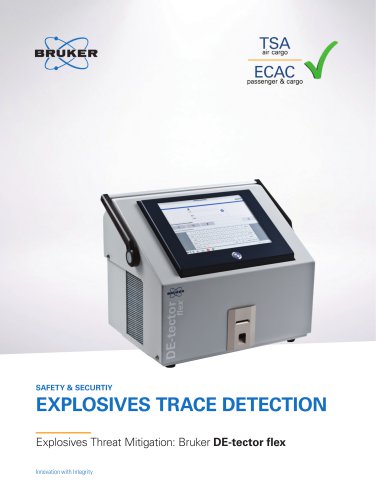 DE-tector flex
8 Pages
 MATRIX II-MG
8 Pages
 RoadRunner
8 Pages
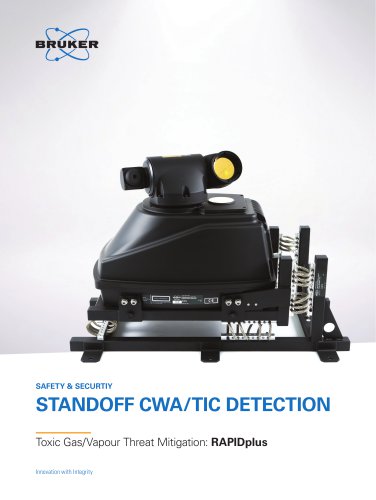 RAPIDplus
12 Pages
 RAID-XP
8 Pages
 Maritime Detection Systems
7 Pages
 SVGps
SVGps4 Pages
 TIMON
TIMON13 Pages
 MALDI Biotyper® CA System
12 Pages
 RAID-M Series
7 Pages
 HDX Solution
2 Pages
 EVOQ GC-TQ
8 Pages
 timsTOF PRO
8 Pages
 Agri Solutions brochure
8 Pages
 PesticideScreener
8 Pages
 Elute LC series
8 Pages
 nanoElute®
6 Pages
 timsTOF™
8 Pages
 rapifleX™
8 Pages
 amaZon SL
6 Pages
 compact
8 Pages
 MALDI Biotyper
56 Pages
 rapifleX™ MALDI Tissuetyper™
8 Pages
 MALDI PharmaPulse™
4 Pages
 Toxtyper
6 Pages
 impact II
12 Pages
 maxis II
12 Pages
 amaZon speed
10 Pages
 Albira Brochure
12 Pages
 prime
prime12 Pages
 solarix
10 Pages
 Metabolomics
12 Pages
 aurora M90
10 Pages
 Clean Room Pack
4 Pages
 MATRIX-F FT-NIR Spectrometer
2 Pages
 TANGO
TANGO12 Pages
 The new autoflex? series
10 Pages
 MM 2
MM 26 Pages
 µRAID
µRAID4 Pages
 Radiation Backpack Sentry
4 Pages
 Posterbook Metabolomics ebook
14 Pages
 CaptiveSpray nanoBooster
8 Pages
 Scion SQ Series GC-MS
8 Pages
 solariX XR
12 Pages
 aurora Elite
6 Pages
 nano-Advance UHPLC
8 Pages
 EVOQ
EVOQ12 Pages
 CaptiveSpray
4 Pages
 ImagePrep
4 Pages
 micrOTOF-Q II
12 Pages
 PROTEINEER fc II
4 Pages
 Ultraflextreme
16 Pages
 Autoflix speed
10 Pages
 microflex
6 Pages
 SCION 436-GC
4 Pages
 SCION 456-GC
4 Pages
 GC CARE
8 Pages


Archived catalogs
 Brochure BioTools 2.2
10 Pages
 Brochure EASY-nLC
6 Pages
 Brochure micrOTOF II
8 Pages
 RAID-M 100
6 Pages
 compact?
6 Pages
 MALDI Biotyper
12 Pages
 Toxtyper
8 Pages
 micrOTOF-Q III
6 Pages
 impact HD
12 Pages
 Brochure MetaboliteTools 1.1
8 Pages
 Brochure ProfileAnalysis
4 Pages


Related Searches
- Automation software solution
- Bruker analysis software
- Process software
- Real-time software
- Microscope
- Control software
- Bruker spectrometer
- Gas detector
- Monitoring software solution
- Optical microscope
- 3D software solution
- Industrial software
- Measurement software
- Interface software
- Visualization software solution
- Laboratory microscope
- Quality software
- Automated software
- Bruker industrial detector
- Monitoring detector
*Prices are pre-tax. They exclude delivery charges and customs duties and do not include additional charges for installation or activation options. Prices are indicative only and may vary by country, with changes to the cost of raw materials and exchange rates.
About DirectIndustry
DirectIndustry is a marketplace that offers B2B players a complete experience, from product sourcing to purchase. DirectIndustry is an entity of VirtualExpo Group.
Are you a buyer?
Are you a supplier?