
- Catalogs
- Bruker Daltonics
- Electron Transfer Dissociation (ETD)


Electron Transfer Dissociation (ETD)

Electron Transfer Dissociation (ETD)
Bruker Daltonics has been a leader in electron transfer dissociation (ETD) technology since its commercial introduction in 2005. ETD is crucial for in-depth protein characterization and top-down sequencing analysis, offering complementary and confirmatory identification of post-translational modifications (PTMs).
ETD is essential for identifying non-tryptic peptides, determining protein termini, localizing PTMs such as phosphorylation and sulfonation, analyzing glycopeptides, and characterizing disulfide linkages. It preserves labile PTMs, enabling precise site localization.
The amaZon speed ETD system features high sensitivity and efficiency, using fluoranthene as a reagent for ETD and PTR. It supports various workflows, including data-dependent MS3 and targeted smartMRM approaches. The system offers robust ion trapping and efficient ion-ion reactions in 3D ion traps.
ETD facilitates detailed glycopeptide analysis, crucial for understanding glycan structures and functions. It also supports disulfide bond mapping, essential for studying protein folding and function.
Bruker provides software solutions like ProteinScape and RapiDeNovo for protein sequencing and profile analysis. Source options include the CaptiveSpray nanoBooster for enhanced ionization and various ESI sources for direct analysis.
Bruker's ETD technology offers comprehensive solutions for protein analysis, ensuring high-quality data for research applications. The system's flexibility and advanced features make it a valuable tool for proteomics and glycomics research.
Catalog excerpts

Electron Transfer Dissociation (ETD) Look Beneath the Surface Innovation with Integrity
Open the catalog to page 1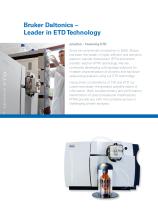
Bruker Daltonics – Leader in ETD Technology amaZon – Featuring ETD Since its commercial introduction in 2005, Bruker has been the leader in highly efficient and sensitive electron transfer dissociation (ETD) and proton transfer reaction (PTR) technology. We are constantly developing cutting-edge solutions for in-depth characterization of proteins and top-down sequencing analysis using our ETD technology. Using smart combinations of CID and ETD our customers obtain the greatest possible depth of information. Both complementary and confirmatory identification of post-translational modifications...
Open the catalog to page 2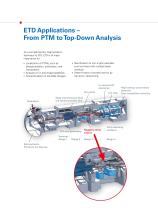
ETD Applications – From PTM to Top-Down Analysis As a complementary fragmentation technique to CID, ETD is of major importance for: Localization of PTMs, such as phosphorylation, sulfonation, and nitrosylation Analysis of O- and N-glycopeptides Characterization of disulfide linkages Identification of non-tryptic peptides, such as those with multiple basic residues Determination of protein termini by top-down sequencing In vacuum RF detection Ion guide High-transmission dual ion funnel transfer line Off-axis geometry Vacuum Stage 1 AtmosphericPressure Ion Source High energy conversion detector...
Open the catalog to page 3
ETD and PTR on the amaZon – Technology Leadership Key technical facts ETD cleaves N-Cα bonds producing c- and z-ions Labile bonds of PTMs remain intact The most efficient reagent – Fluoranthene – is used for both ETD and PTR Highest sensitivity for low-abundance peptides on an LC timescale: Identification of 18 peptides with a Mascot score > 20 from 500 amol BSA on column The 3D advantage The “3D advantage” of the spherical ion trap is the decisive factor for the highest efficiency ETD and PTR reactions: Robust and fast trapping of cations and anions for direct ETD reaction Better cross section...
Open the catalog to page 4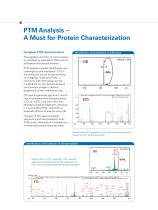
A Must for Protein Characterization The regulatory function of many proteins is controlled by reversible PTMs such as PTM analysis includes identification and unambiguous site localization. ETD is the method of choice for site-profiling of biologically important PTMs. In modification on the peptide backbone and therefore enables a definite assignment of the modification site. CID spectra generate significant neutral loss of sulfonation and phosphorylation abundance peptide fragments. Because it is a very labile PTM, sulfonation is especially difficult to analyze using CID. However, ETD supports...
Open the catalog to page 5
Complete Glycopeptide Analysis Glycopeptide analysis is of particular interest in glycomics, because detailed information about glycan, peptide and glycosylation site is needed to under- stand relationships between structure, Tools for in-depth characterization of Dramatic enhancement of glyco- peptide ionization and shift to higher charge states for highest ETD spectra quality Identification of glycan composition and structure with GlycoQuest localization of glycosylation sites Fragment triggered ETD enables targeted glycopeptide profiling. ETD is only triggered if diagnostic oxonium ions have...
Open the catalog to page 6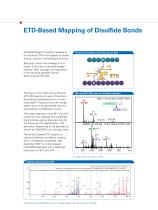
ETD-Based Mapping of Disulfide Bonds Disulfide linkage of cysteine residues is an important PTM with regards to protein folding, structure, and biological function. Because it favors the cleavage of S-S bonds, ETD is key to disulfide linkage analysis. After cleavage, the sequences Preferred disulfide bond cleavage by ETD The figure on the right shows MS and ETD MS2 spectra of a pair of interchain disulfide-bound peptides from a mono- clonal lgG2. Precursor ions with charge states up to 4+ are generated with the CaptiveSpray nanoBooster source. result from the cleavage of the disulfide bond and...
Open the catalog to page 7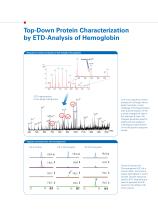
Top-Down Protein Characterization Sequence variant analysis of full-length hemoglobin Until now, sequence variant analysis of full-length hemo- globin has been a major after precise isolation of the multiply charged Hb chains charged) generates specific fragments that enable an unambiguous identification Typical extracted ion chromatograms sample. Several sequence- chain variants
Open the catalog to page 8
Technical Specifications Technology-driven solutions Source options Patented SmartICC™ for optimal ion storage SmartFrag™ Enhanced for reproducible high-quality MS/MS spectra generation and confident library searches Panorama fragmentation (PAN) enabling CID fragmentation without 1/3 cut-off CaptiveSpray nanoBooster: robust and reliable plug-and-play nano/cap ESI source for flow rates from 50-5000 nL/min ESI, APCI, APPI, and DIP source for direct analysis of solids and liquids Advion Triversa NanoMate Smart CE-MS coupling with grounded spray needle MS/MS modes Software solutions • ProteinScape...
Open the catalog to page 9
Further Reading Bruker brochures CaptiveSpray nanoBooster The revolution in Proteomics Ionization Glyco Analysis Solutions Expanding the frontier in Glycobiology amaZon speed Ion Trap Performance Beyond Imagination Bruker Application Notes App-Note LCMS-57 In-depth Characterization of Neutral and Acidic Glycopeptides by ZIC-HILIC Enrichment and Mass Spectrometry Jessica Wohlgemuth, Sven Andrecht, Merck KGaA, Darmstadt, Germany; Andrea Schneider, Anja Resemann, Arndt Asperger, Bruker Daltonik GmbH, Bremen, Germany (2010) App-Note LCMS-66 Straightforward N-glycopeptide analysis combining fast ion...
Open the catalog to page 10All Bruker Daltonics catalogs and technical brochures
 DE-tector flex
8 Pages
 MATRIX II-MG
8 Pages
 RoadRunner
8 Pages
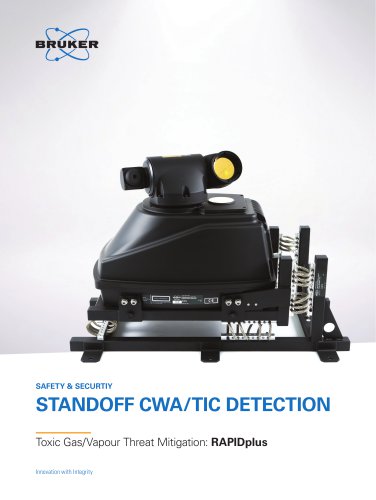 RAPIDplus
12 Pages
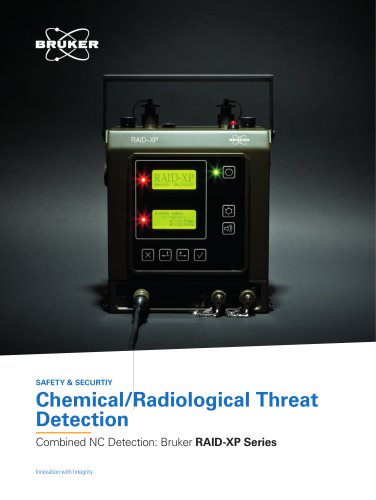 RAID-XP
8 Pages
 Maritime Detection Systems
7 Pages
 SVGps
SVGps4 Pages
 TIMON
TIMON13 Pages
 MALDI Biotyper® CA System
12 Pages
 RAID-M Series
7 Pages
 HDX Solution
2 Pages
 EVOQ GC-TQ
8 Pages
 timsTOF PRO
8 Pages
 Agri Solutions brochure
8 Pages
 PesticideScreener
8 Pages
 Elute LC series
8 Pages
 nanoElute®
6 Pages
 timsTOF™
8 Pages
 rapifleX™
8 Pages
 amaZon SL
6 Pages
 compact
8 Pages
 MALDI Biotyper
56 Pages
 rapifleX™ MALDI Tissuetyper™
8 Pages
 MALDI PharmaPulse™
4 Pages
 Toxtyper
6 Pages
 impact II
12 Pages
 maxis II
12 Pages
 amaZon speed
10 Pages
 Albira Brochure
12 Pages
 prime
prime12 Pages
 solarix
10 Pages
 Metabolomics
12 Pages
 aurora M90
10 Pages
 Clean Room Pack
4 Pages
 MATRIX-F FT-NIR Spectrometer
2 Pages
 TANGO
TANGO12 Pages
 The new autoflex? series
10 Pages
 MM 2
MM 26 Pages
 µRAID
µRAID4 Pages
 Radiation Backpack Sentry
4 Pages
 Posterbook Metabolomics ebook
14 Pages
 CaptiveSpray nanoBooster
8 Pages
 Scion SQ Series GC-MS
8 Pages
 solariX XR
12 Pages
 aurora Elite
6 Pages
 nano-Advance UHPLC
8 Pages
 EVOQ
EVOQ12 Pages
 CaptiveSpray
4 Pages
 ImagePrep
4 Pages
 micrOTOF-Q II
12 Pages
 PROTEINEER fc II
4 Pages
 Ultraflextreme
16 Pages
 Autoflix speed
10 Pages
 microflex
6 Pages
 SCION 436-GC
4 Pages
 SCION 456-GC
4 Pages
 GC CARE
8 Pages


Archived catalogs
 Brochure BioTools 2.2
10 Pages
 Brochure EASY-nLC
6 Pages
 Brochure micrOTOF II
8 Pages
 RAID-M 100
6 Pages
 compact?
6 Pages
 MALDI Biotyper
12 Pages
 Toxtyper
8 Pages
 micrOTOF-Q III
6 Pages
 impact HD
12 Pages
 Brochure MetaboliteTools 1.1
8 Pages
 Brochure ProfileAnalysis
4 Pages


- Automation software solution
- Bruker analysis software
- Process software
- Real-time software
- Microscope
- Control software
- Bruker spectrometer
- Gas detector
- Monitoring software solution
- Optical microscope
- 3D software solution
- Industrial software
- Measurement software
- Interface software
- Visualization software solution
- Laboratory microscope
- Quality software
- Automated software
- Bruker industrial detector
- Monitoring detector