
- Catalogs
- Bruker AXS
- X4 POSEIDON application report – Food and Pharmaceutical


X4 POSEIDON application report – Food and Pharmaceutical
X4 POSEIDON application report – Food and Pharmaceutical
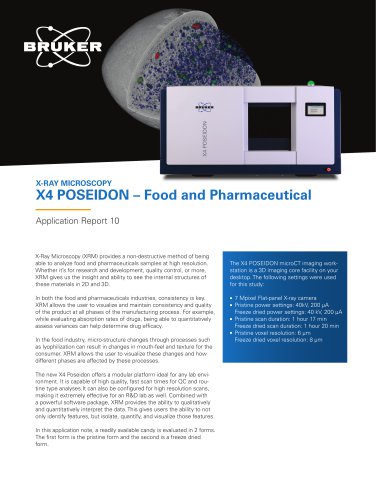
X-Ray Microscopy (XRM) offers a non-destructive method for analyzing food and pharmaceutical samples at high resolution. It is crucial for research, development, and quality control, providing insights into the internal structures of materials in both 2D and 3D.
Applications in Industry
In the food and pharmaceutical industries, XRM ensures product consistency and quality throughout the manufacturing process. For pharmaceuticals, it aids in evaluating drug absorption rates and efficacy. In the food industry, it helps visualize micro-structure changes affecting texture and mouth-feel.
X4 Poseidon Features
The X4 Poseidon is a modular platform suitable for lab environments, offering high-quality, fast scan times for quality control and high-resolution scans for research and development. It is equipped with powerful software for qualitative and quantitative data interpretation, allowing users to identify, isolate, quantify, and visualize features.
Case Study: Candy Analysis
The application note evaluates a candy in two forms: pristine and freeze-dried. The X4 POSEIDON microCT imaging workstation was used with the following settings:
- 7 Mpixel Flat-panel X-ray camera
- Power settings: 40kV, 200 μA for both forms
- Scan duration: 1 hour 17 min (pristine), 1 hour 20 min (freeze-dried)
- Voxel resolution: 6 μm (pristine), 8 μm (freeze-dried)
Results and Analysis
Figure 3 shows that the pristine sample has a concentrated average pore size peaking at 128μm, while the freeze-dried sample has a broader distribution peaking at 224μm. The Data Viewer visualizes these differences, highlighting the chewier texture of the pristine sample versus the crunchier texture of the freeze-dried sample.
Using Bruker’s CT Analyzer (CTAn), various quantitative analyses were performed. Figure 2 illustrates a structure thickness analysis of voids in each sample, enhancing understanding and presentation of the analysis.
Conclusion
XRM, particularly with the X4 Poseidon, provides significant advantages in analyzing and ensuring the quality and consistency of food and pharmaceutical products.
Catalog excerpts

X-RAY MICROSCOPY X4 POSEIDON – Food and Pharmaceutical Application Report 10 X-Ray Microscopy (XRM) provides a non-destructive method of being able to analyze food and pharmaceuticals samples at high resolution. Whether it’s for research and development, quality control, or more, XRM gives us the insight and ability to see the internal structures of these materials in 2D and 3D. In both the food and pharmaceuticals industries, consistency is key. XRM allows the user to visualize and maintain consistency and quality of the product at all phases of the manufacturing process. For example, while evaluating absorption rates of drugs, being able to quantitatively assess variances can help determine drug efficacy. The X4 POSEIDON microCT imaging workstation is a 3D imaging core facility on your desktop. The following settings were used for this study: In the food industry, micro-structure changes through processes such as lyophilization can result in changes in mouth-feel and texture for the consumer. XRM allows the user to visualize these changes and how different phases are affected by these processes. The new X4 Poseidon offers a modular platform ideal for any lab environment. It is capable of high quality, fast scan times for QC and routine type analyses.It can also be configured for high resolution scans, making it extremely effective for an R&D lab as well. Combined with a powerful software package, XRM provides the ability to qualitatively and quantitatively interpret the data. This gives users the ability to not only identify features, but isolate, quantify, and visualize those features. In this application note, a readily available candy is evaluated in 2 forms. The first form is the pristine form and the second is a freeze dried form. 7 Mpixel Flat-panel X-ray camera Pristine power settings: 40kV, 200 μA Freeze dried power settings: 40 kV, 200 μA Pristine scan duration: 1 hour 17 min Freeze dried scan duration: 1 hour 20 min Pristine voxel resolution: 6 μm Freeze dried voxel reso
Open the catalog to page 1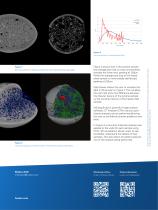
Figure 1 2D cross section of pristine sample left) and freeze dried sample (right). Figure 3 shows that in the pristine sample the average pore size is more concentrated towards the lower end, peaking at 128μm. While the average pore size of the freeze dried sample is more broadly distributed, peaking at 224μm. Data Viewer allows the user to visualize the data in 2D as seen in Figure 1. This visualization can help show the difference between the chewier texture of the pristine sample vs the crunchier texture of the freeze dried sample. Utilizing Bruker’s powerful image analysis software, CT Analyzer...
Open the catalog to page 2All Bruker AXS catalogs and technical brochures
 XRF SPECTRA ELEMENTS
4 Pages
 D8 DISCOVER Plus
4 Pages
 S2 LION - Spectrometry Solutions
12 Pages
 S2 PUMA - Spectroscopy Solutions
20 Pages


- Microscope
- Bruker spectrometer
- 3D software solution
- Visualization software solution
- Laboratory microscope
- Bruker laboratory spectrometer
- Desktop microscope
- Inspection machine
- 2D software
- Compact spectrometer
- Benchtop spectrometer
- Process spectrometer
- Analysis spectrometer
- High-resolution microscope
- Optical spectrometer
- Measurement spectrometer
- High-resolution spectrometer
- Compact microscope
- Bruker XRF spectrometer