
- Catalogs
- Bruker AXS
- X4 POSEIDON application report – Chocolate “pepernoot” cookie


X4 POSEIDON application report – Chocolate “pepernoot” cookie
X4 POSEIDON application report – Chocolate “pepernoot” cookie
Taste and texture perception are crucial for consumer acceptance of food products. The microstructure of food, influenced by formulation and manufacturing processes, plays a significant role in texture. 3D X-Ray Microscopy (XRM) offers high-resolution, three-dimensional images to analyze food microstructure, aiding in the development and improvement of food products.
Application Example
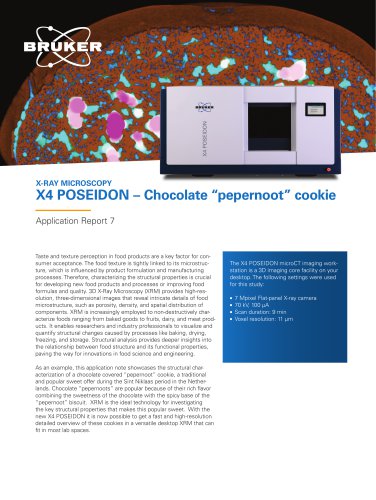
This report focuses on the structural characterization of a chocolate-covered "pepernoot" cookie, a traditional Dutch sweet. The X4 POSEIDON XRM is used to investigate the structural properties that contribute to the cookie's popularity.
X4 POSEIDON Specifications
- 7 Mpixel Flat-panel X-ray camera
- 70 kV, 100 µA
- Scan duration: 9 minutes
- Voxel resolution: 11 µm
Structural Analysis
The orthogonal slice (Figure 1) reveals the chocolate coating and the aerated structure of the cookie. The distribution of air pores and the quality of the chocolate are visible. The pore size analysis (Figure 2) shows variation in pore size, with smaller pores on the periphery and larger ones towards the center, indicating a successful baking process. No cracks or large air bubbles were detected.
Textural Analysis
Thickness analysis of the cookie crumb, combined with porosity analysis, helps understand the textural appreciation (crunchiness) of the cookie. The thickness distribution is color-coded in Figure 3.
Conclusion
The X4 POSEIDON provides detailed insights into the microstructure of food products, enabling improvements in food science and engineering.
Catalog excerpts
X-RAY MICROSCOPY X4 POSEIDON – Chocolate “pepernoot” cookie Application Report 7 Taste and texture perception in food products are a key factor for consumer acceptance. The food texture is tightly linked to its microstructure, which is influenced by product formulation and manufacturing processes. Therefore, characterizing the structural properties is crucial for developing new food products and processes or improving food formulas and quality. 3D X-Ray Microscopy (XRM) provides high-resolution, three-dimensional images that reveal intricate details of food microstructure, such as porosity, density, and spatial distribution of components. XRM is increasingly employed to non-destructively characterize foods ranging from baked goods to fruits, dairy, and meat products. It enables researchers and industry professionals to visualize and quantify structural changes caused by processes like baking, drying, freezing, and storage. Structural analysis provides deeper insights into the relationship between food structure and its functional properties, paving the way for innovations in food science and engineering. As an example, this application note showcases the structural characterization of a chocolate covered “pepernoot” cookie, a traditional and popular sweet offer during the Sint Niklaas period in the Netherlands. Chocolate “pepernoots” are popular because of their rich flavor combining the sweetness of the chocolate with the spicy base of the “pepernoot” biscuit. XRM is the ideal technology for investigating the key structural properties that makes this popular sweet. With the new X4 POSEIDON it is now possible to get a fast and high-resolution detailed overview of these cookies in a versatile desktop XRM that can fit in most lab spaces. The X4 POSEIDON microCT imaging workstation is a 3D imaging core facility on your desktop. The following settings were used for this study: 7 Mpixel Flat-panel X-ray camera 70 kV, 100 µA Scan duration: 9 min
Open the catalog to page 1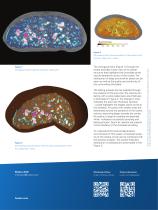
Figure 3 3D rendering with thickness analysis of the cookie crumb Figure 1 Orthogonal slice through the chocolate “pepernoot“. The orthogonal slice (Figure 1) through the sweet provides a clear view of its overall structure that highlights the chocolate enrobing the aerated structure of the cookie. The distribution of large and small air pores can be seen as well as the quality and continuity of the surrounding chocolate. The baking process can be qualified through the analysis of the pore size. The volume rendering with a color-coded pore size thickness is illustrated in Figure 2. The change...
Open the catalog to page 2All Bruker AXS catalogs and technical brochures
 XRF SPECTRA ELEMENTS
4 Pages
 D8 DISCOVER Plus
4 Pages
 S2 LION - Spectrometry Solutions
12 Pages
 S2 PUMA - Spectroscopy Solutions
20 Pages


- Analysis software solution
- Microscope
- Bruker spectrometer
- 3D software solution
- Visualization software solution
- Laboratory microscope
- Bruker laboratory spectrometer
- Desktop microscope
- Inspection machine
- 2D software
- Compact spectrometer
- Benchtop spectrometer
- Process spectrometer
- Analysis spectrometer
- High-resolution microscope
- Optical spectrometer
- Measurement spectrometer
- High-resolution spectrometer
- Compact microscope
- Bruker XRF spectrometer