
- Catalogs
- Hottinger Brüel & Kjaer
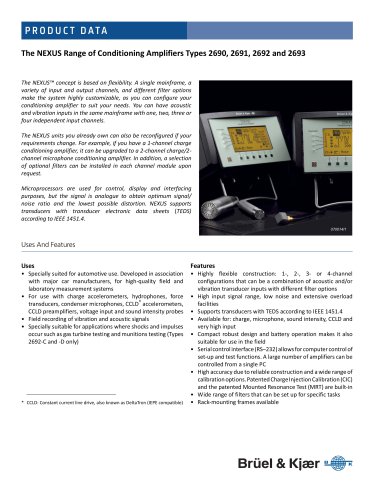
- The NEXUS Range of Conditioning Amplifiers Types 2690, 2691, 2692 and 2693


The NEXUS Range of Conditioning Amplifiers Types 2690, 2691, 2692 and 2693
1 /130Pages
The NEXUS Range of Conditioning Amplifiers Types 2690, 2691, 2692 and 2693
1 /130Pages
Catalog excerpts
Technical Documentation The NEXUS™ Range of Conditioning Amplifiers Types 2690, 2691, 2692 and 2693 User Manual: Operation and Inte
Open the catalog to page 1
The NEXUS™ Range of Conditioning Amplifiers Types 2690, 2691, 2692 and 2693 User Manual: Operation and Interface
Open the catalog to page 3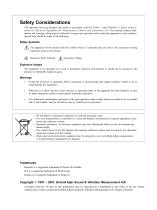
Safety Considerations This apparatus has been designed and tested in accordance with IEC 61010 – 1 and EN 61010 – 1 Safety Requirements for Electrical Equipment for Measurement, Control and Laboratory Use. This manual contains information and warnings which must be followed to ensure safe operation and to retain the apparatus in safe condition. Special note should be made of the following: Safety Symbols The apparatus will be marked with this symbol when it is important that you refer to the associated warning statements given in the manual. Protective Earth Terminal Hazardous Voltage Explosion...
Open the catalog to page 4
Introduction The NEXUS™ Range of Conditioning Amplifiers are low noise, 1-, 2-, 3- or 4-channel conditioning amplifiers with a large dynamic range. They can be configured with different input modules and different numbers of channels, according to your requirements. NEXUS Conditioning Amplifiers are equally suited for laboratory and field use and are particularly used within the automotive area. The size of NEXUS and its built-in rechargeable battery make it ideal for high-quality field measurements with a portable DAT recorder. Fig.1.1 NEXUS amplifiers are flexible – they are constructed with...
Open the catalog to page 9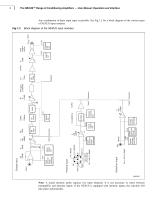
DeltaTron Input Transd. voltage overload 4.7V Input common mode overload Transd. current overload Input Common Input Common 4.7V Input common mode overload 7 pin Lemo (input plug) Zin: 1 M Ω // 300pF Preamp Input Input common mode overload Dual output buffer Charge Input 2 The NEXUS™ Range of Conditioning Amplifiers – User Manual: Operation and Interface Any combination of these input types is possible. See Fig.1.2 for a block diagram of the various types of NEXUS input modules. Block diagram of the NEXUS input modules Note: A sound intensity probe requires two input channels. It is not necessary...
Open the catalog to page 10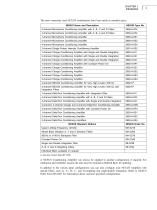
The most commonly used NEXUS combinations have been made as standard types: a. See also Product Data (BP 1976) A NEXUS Conditioning Amplifier can always be updated to another configuration if required. For calibration and reliability reasons the unit must be returned to Bruel&Kj^r for updating. In addition to the various input configurations you can also configure your NEXUS Amplifier with special filters, such as: A-, B-, C- and D-weighting and single/double integration. Refer to NEXUS Order Form BA 0287 for information about customer specified configurations.
Open the catalog to page 11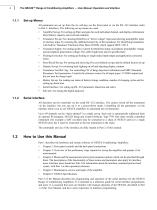
The NEXUS™ Range of Conditioning Amplifiers - User Manual: Operation and Interface All parameters are set up from the six soft-keys on the front panel or via the RS-232 interface (refer to Part 2: Interface). The following set-up menus are used: • Amplifier Set-up: For setting up filters and gain for each individual channel, and displays information about battery capacity and overload condition • Transducer Set-up: For choosing DeltaTron or “direct voltage” input and selecting preamplifier input or intensity input. For entering the calibrated sensitivity of the transducer. For identifying transducers...
Open the catalog to page 12
The following chapters describe the operation of the NEXUS serial interface: • Chapter 7: Specifications and the set-up procedure for the serial interface • Chapter 8: Interface message formats • Chapters 9 and 10: How the individual messages are used in the control of data flow between a NEXUS unit and an interface controller. Chapter 9 is solely about channel independent messages • Chapter 11: Interface error messages • Chapter 12: Summary of interface commands
Open the catalog to page 13
The NEXUS™ Range of Conditioning Amplifiers – User Manual: Operation and Interfac
Open the catalog to page 14
The NEXUS™ Range of Conditioning Amplifiers – User Manual: Operation and Interfac
Open the catalog to page 16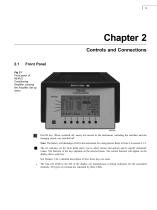
Chapter 2 Controls and Connections 2.1 Front Panel Fig.2.1 Front panel of NEXUS Conditioning Amplifier showing the Amplifier Set-up menu On/Off key. When switched off, nearly all circuits in the instrument, including the interface and the charging circuit, are switched off. Note: The battery will discharge if left in the instrument for a long period. Refer to Note 2 in section 3.1.2. The six soft-keys on the front panel allow you to select menus and options and to specify parameter values. The function of the keys depends on the selected menu. The current function will appear on the display above...
Open the catalog to page 17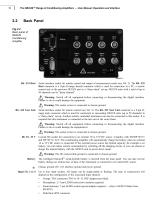
The NEXUS™ Range of Conditioning Amplifiers – User Manual: Operation and Interface Back Panel Fig.2.2 Back panel of NEXUS Conditioning Amplifier Serial interface socket for remote control and output of measurement results (see Vol. 2). The RS–232 Host connector is a 9-pin D-range female connector which is used for connection to a PC, a remote control unit or the previous NEXUS unit in a “daisy-chain” set-up. NEXUS units with a total of up to 99 channels can be “daisy-chained”. Warning: Switch off all equipment before connecting or disconnecting the digital interface. Failure to do so could damage...
Open the catalog to page 18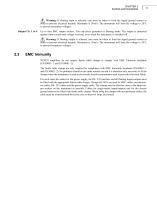
CHAPTER 2 Controls and Connections Warning: If floating input is selected, care must be taken to limit the signal ground current in order to prevent electrical hazards. Maximum is 50 mA. The instrument will limit the voltage to 20 V, to prevent hazardous voltages. Output Ch. 1 to 4 Up to four BNC output sockets. You can select grounded or floating mode. The output is protected against short-circuits and voltage overload, even when the instrument is switched off. Warning: If floating output is selected, care must be taken to limit the signal ground current in order to prevent electrical hazards....
Open the catalog to page 19
The NEXUS™ Range of Conditioning Amplifiers – User Manual: Operation and Interfac
Open the catalog to page 20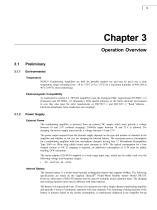
Chapter 3 Operation Overview 3.1 Environmental Temperature NEXUS Conditioning Amplifiers are built for portable outdoor use and may be used over a wide temperature range extending from –10 to +55°C (14 to 131°F) at a maximum humidity of 90% RH at 40°C (104°F) (non-condensing). Electromagnetic Compatibility As mentioned in section 2.3, NEXUS Amplifiers meet the European EMC requirements EN 50081–1/2 (Emission) and EN 50082–1/2 (Immunity). With special reference to the harsh electrical environment in cars they also meet the strict requirements os ISO 7637–1 and ISO 7637–2 “Road Vehicles – Electrical...
Open the catalog to page 21All Hottinger Brüel & Kjaer catalogs and technical brochures
 Artificial Mastoid Type 4930
6 Pages
 Power Amplifier Type 2718
2 Pages
 DISCOM Mobile
6 Pages
 DISCOM NVH Analysis Systems
4 Pages
 TEDS Microphones
8 Pages
 LDS V8
4 Pages
 LDS Comet USB
4 Pages
 LDS Laser USB
16 Pages
 2690-A
16 Pages
 4374
43742 Pages
 4326-A-001
8 Pages
 4152
41524 Pages
 4191
41912 Pages
 2719
27192 Pages
 LDS V8900
4 Pages
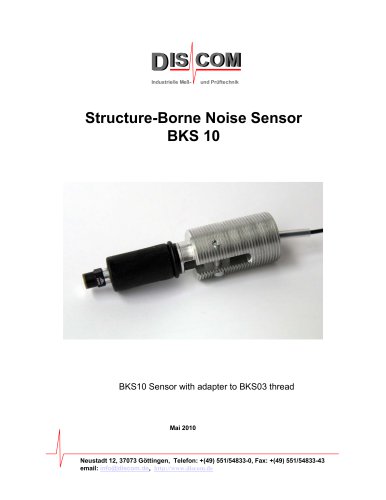 BKS 10
8 Pages
 1704-A-001
4 Pages
 4939
49392 Pages
 4138
41384 Pages
 4101-B and 4965-B
4 Pages
 Sonoscout NVH Recorder
8 Pages
 LDS Power Amplifiers
8 Pages
 Type 2720
2 Pages
 Type 2721
2 Pages
 TYPE 3668
4 Pages
 3656-A
4 Pages
 TYPE 2270-S
28 Pages
 LDS V994
2 Pages
 TYPE 8702
16 Pages
 BZ-7848-A
40 Pages
 TYPE 9718-A:bp0317
12 Pages
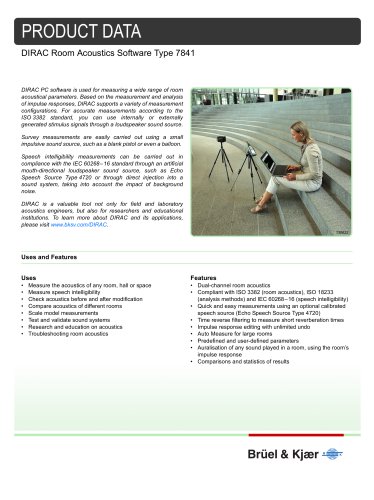 TYPE 4720:bp1974
12 Pages
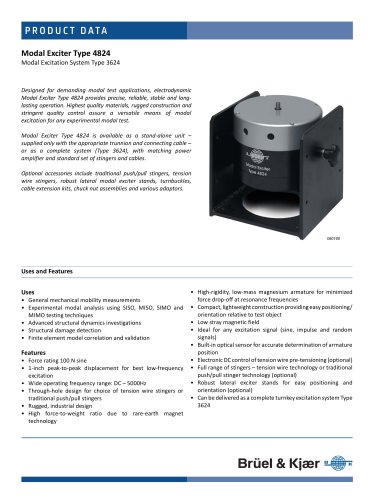 TYPE 4824:bp1936
4 Pages
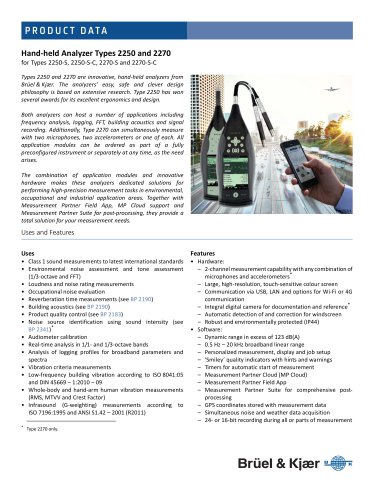 SOUND LEVEL METER:bp 2025
28 Pages
 Transducers and conditioning
188 Pages
 Noise Sentinel Overview
3 Pages
 Analyzer Catalogue
39 Pages
 Noise Logger Type 3659
1 Page
 Sound level meters
17 Pages
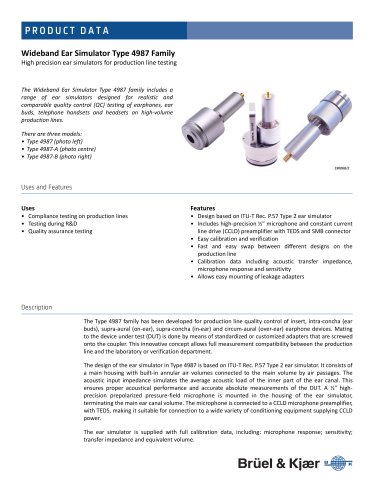




Archived catalogs
 B&K 2245 Sound Level Meter
8 Pages
 HBK 2255 Sound Level Meter
10 Pages
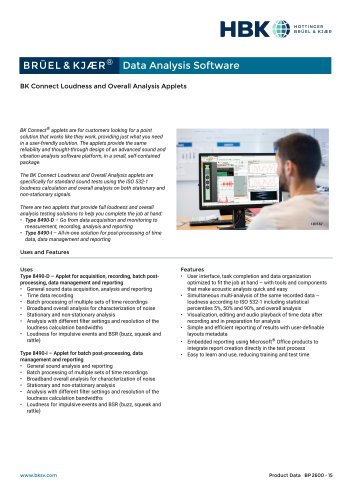 Data Analysis Software
6 Pages
- Power supply unit
- DC power supply
- AC/DC power supply
- Brüel & Kjaer calibrator
- Brüel & Kjaer accelerometer
- Analog I/O
- Single-output power supply
- Digital indicator
- Portable analyzer
- Communication gateway
- Measurement software
- Brüel & Kjaer signal amplifier
- Turntable
- Piezoelectric accelerometer
- Tabletop power supply
- Tilt sensor
- Ethernet gateway
- Automated software
- Real-time analyzer
- Laboratory analyzer