

BAS-311HN_326H

BAS-311HN_326H
This manual provides essential instructions for the safe and effective use of the Brother BAS-311HN and BAS-326H programmable electronic pattern sewers. It emphasizes the importance of reading safety instructions and understanding machine operations before use.
- Indications and Symbols: Terms like 'DANGER', 'WARNING', and 'CAUTION' indicate the severity of potential hazards. Symbols denote actions to be taken or avoided.
- General Safety: Users must wait five minutes after turning off the power before opening the control box to avoid electric shock. Liquids should not contact the machine to prevent fire or electrical issues.
- Environmental Requirements: The machine should be used in environments free from electrical noise, with stable power supply and appropriate temperature and humidity levels.
- Installation and Maintenance: Installation should be performed by qualified technicians. Proper grounding is crucial to prevent electric shock. Regular maintenance should be conducted by professionals using genuine Brother parts.
- Machine Setup: Detailed instructions are provided for installing various components such as the control box, oil pan, machine head, LCD panel, and foot switch.
- Electrical Connections: Guidelines for connecting cords, ground wire, and power cord are included to ensure safe operation.
- Needle and Thread Setup: Instructions for installing the needle, threading the upper thread, winding the lower thread, and adjusting thread tension are provided.
- Machine Startup: Steps for starting the machine are outlined to ensure readiness for sewing.
- Basic Sewing: The manual describes the sewing process and the use of the STOP switch for safety.
- Regular Cleaning: Procedures for cleaning the rotary hook, control box air inlet ports, and other components are detailed.
- Lubrication: Instructions for applying grease and checking lubrication levels are included to maintain machine performance.
- Machine Adjustments: The manual provides guidance on adjusting various machine components, such as the needle bar height, rotary hook timing, and thread wiper.
The manual highlights the importance of adhering to warning labels on the machine to prevent injury and ensure proper operation.
This section lists the major components of the BAS-311HN and BAS-326H sewing machines, including the power switch, control box, LCD panel, foot switch, work clamp switch, and various safety devices such as finger and eye guards.
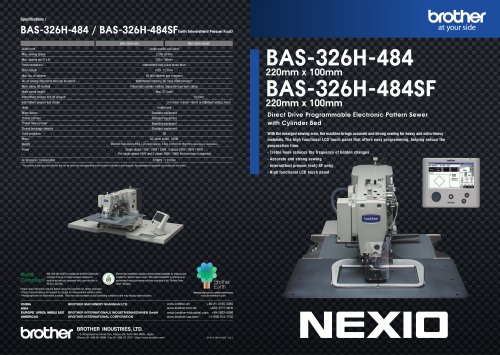
The document details the specifications of the BAS-311HN and BAS-326H models, highlighting features such as the single needle lock stitch formation, maximum sewing speed of 2,800 stitches per minute, and maximum sewing areas of 150 x 100 mm for BAS-311HN and 220 x 100 mm for BAS-326H. It also covers the feed mechanism, stitch length, and storage capacity for sewing data items.
The pneumatic unit, including the solenoid valve assembly, washers, wood screws, and optional rubber hose, should be installed beneath the work table. Ensure the unit does not touch the control box or table leg. Adjust air pressure as per section 7-18.
Use the knobs to adjust the lifting and dropping speeds of the work clamp. The upper knob controls lifting speed, while the lower knob controls lowering speed. Manual operation is possible with the power off.
Attach the eye guard using bolts and washers. Ensure all safety devices are installed to prevent injury.
Attach the side and rear covers with screws, ensuring cords are not clamped.
Lubricate the machine before use and after long periods of non-use. Use specified lubricating oil and ensure oil levels are maintained to prevent machine seizure.
Secure the machine head with fixing bolts during transport. Remove bolts during operation.
Ensure no error numbers appear when the power is on. Adjust the machine head switch if errors [E050], [E051], or [E055] occur.
- Ensure the power switch is off before cleaning to prevent accidental operation.
- Wear protective gear when handling lubricants to avoid skin or eye contact.
- Clean the rotary hook by removing the shuttle race cover and bobbin case, then clean dust and lint.
- Use a vacuum to clean the control box air inlet ports monthly.
- Regularly drain and replace the waste oil tank.
- Wipe the eye guard with a soft cloth, avoiding solvents.
- Check the needle for damage before sewing.
- Lubricate the machine as per guidelines.
- Apply grease to the feed mechanism if sewing heavy materials or in dusty environments.
- Only qualified technicians should perform maintenance and inspections.
- Ensure the machine head switch is on to avoid error codes.
- Adjust the thread breakage sensor sensitivity by turning the control until the LED indicates proper function.
- Adjust the thread take-up spring height and tension based on material weight.
- Adjust the needle bar height and rotary hook timing for optimal performance.
- Ensure proper clearance between the needle and rotary hook tip to prevent thread issues.
- Adjust the rotary hook lubrication amount by aligning the set screw with the bed edge.
- Replace and adjust the movable and fixed knives for clean thread cutting.
- Install the feed plate correctly, ensuring alignment with base plate Y.
- Adjust the thread wiper position for optimal thread handling.
- Communication Errors: Errors E401, E410, and E411 indicate communication issues between various P.C. boards. The remedy involves turning off the power and checking the connections of specific connectors (P10, P2, P3) on the main and motor P.C. boards.
- Storage Media Errors: Errors E420 to E427 relate to issues with storage media, such as no media inserted, invalid program numbers, or insufficient space. Solutions include inserting media, checking data, and using different media if necessary.
- Data Backup Errors: Errors E430 and E440 indicate problems with backing up data to the main P.C. board. The suggested action is to turn off and then back on the power.
- Machine Head Memory Errors: Errors E450 to E453 involve issues with machine head memory, such as improper connections or data problems. Checking connector P16 and restarting the machine are recommended.
- Data Editing Errors: Errors E500 to E583 cover issues like enlargement ratio settings and memory switch mismatches. Adjusting settings and ensuring data compatibility are advised.
- Device-Related Errors: Errors E600 and E670 involve thread breakage and lower thread detector issues. Checking connections and adjusting settings are suggested.
- P.C. Board-Related Errors: Errors E700 to E730 involve voltage and current abnormalities. Checking input voltage and connections is recommended.
- Version Updating Errors: Errors E860 to E890 relate to missing or incomplete control programs. Installing the correct programs and repeating update procedures are advised.
- Machine Operation Issues: Problems like the machine not starting or work clamps not functioning are addressed by checking connections, adjusting settings, and ensuring proper air pressure.
- Thread and Needle Issues: Solutions for thread breakage, needle problems, and skipped stitches include selecting appropriate needles, adjusting tensions, and ensuring correct threading.
- Seam and Stitch Quality: Remedies for poor seam finishes and irregular thread lengths involve adjusting tensions, replacing blunt knives, and ensuring proper thread trailing lengths.
Catalog excerpts

INSTRUCTION MANUAL Please read this manual before using the machine. Please keep this manual within easy reach for quick reference. DIRECT DRIVE PROGRAMMABLE ELECTRONIC PATTERN SEWER
Open the catalog to page 1
Thank you very much for buying a BROTHER sewing machine. Before using your new machine, please read the safety instructions below and the explanations given in the instruction manual. With industrial sewing machines, it is normal to carry out work while positioned directly in front of moving parts such as the needle and thread take-up lever, and consequently there is always a danger of injury that can be caused by these parts. Follow the instructions from training personnel and instructors regarding safe and correct operation before operating the machine so that you will know how to use it correctly....
Open the catalog to page 2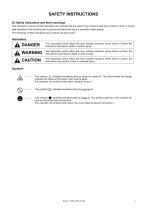
[1] Safety indications and their meanings This instruction manual and the indications and symbols that are used on the machine itself are provided in order to ensure safe operation of this machine and to prevent accidents and injury to yourself or other people. The meanings of these indications and symbols are given below. This symbol (A) indicates something that you should be careful of. The picture inside the triangle indicates the nature of the caution that must be taken. (For example, the symbol at left means “beware of injury”.) This symbol ((^)) indicates something that you must not do....
Open the catalog to page 3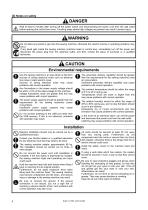
AWait at least 5 minutes after turning off the power switch and disconnecting the power cord from the wall outlet before opening the control box cover. Touching areas where high voltages are present can result in severe injury. Do not allow any liquids to get onto this sewing machine, otherwise fire, electric shocks or operating problems may occur. If any liquid gets inside the sewing machine (machine head or control box), immediately turn off the power and disconnect the power plug from the electrical outlet, and then contact the place of purchase or a qualified technician. Environmental requirements...
Open the catalog to page 4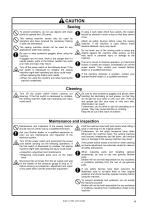
To prevent problems, do not use objects with sharp points to operate the LCD panel. This sewing machine should only be used by operators who have received the necessary training in safe use beforehand. The sewing machine should not be used for any applications other than sewing. Be sure to wear protective goggles when using the machine. If goggles are not worn, there is the danger that if a needle breaks, parts of the broken needle may enter your eyes and injury may result. Turn off the power switch at the following times. If the foot switch is depressed by mistake, the sewing machine might start...
Open the catalog to page 5
The following warning labels appear on the sewing machine. Please follow the instructions on the labels at all times when using the machine. If the labels have been removed or are difficult to read, please contact your nearest Brother dealer. _ CAUTION *Safety devices Devices such as eye guard, finger guard, thread take-up cover, side cover, rear cover, solenoid cover, inner cover, outer cover, fixed cover and gas spring support cover Be careful not to get your hand caught when tilting back the machine head and returning it to its original position. brother Lubricating Oil for Machining Be sure...
Open the catalog to page 6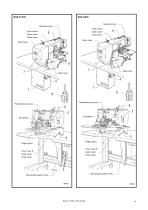
Solenoid cover Inner cover L Inner cover L Outer cover Outer cover Fixed cover Fixed cover Rear cover Rear cover Side cover Side cover Thread take-up cover Thread take-up cover Finger guard Finger guard Outer cover Outer cover Fixed cover Fixed cover Gas spring support cover Gas spring support cover
Open the catalog to page 7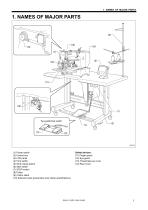
1. NAMES OF MAJOR PARTS 1. NAMES OF MAJOR PARTS Two-pedal foot switch (1) Power switch (2) Control box (3) LCD panel (4) Foot switch (5) Work clamp switch (6) Start switch (7) STOP switch (8) Pulley (9) Cotton stand (10) Solenoid valve (pneumatic work clamp specifications) Safety devices: (11) Finger guard (12) Eye guard (13) Thread take-up cover (14) Rear cover
Open the catalog to page 9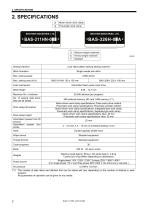
(*1) The number of data items and stitches that can be stored will vary depending on the number of stitches in each program. No guarantees of operation can be given for any media.
Open the catalog to page 10
Machine installation should only be carried out by a qualified technician. Contact your Brother dealer or a qualified electrician for any electrical work that may need to be done. The sewing machine head weighs approximately 88kg. The installation should be carried out by three or more people. Do not connect the power cord until installation is complete. If the foot switch is depressed by mistake, the sewing machine might start operating and injury could result. Hold the machine head with both hands when tilting it back or returning it to its original position. Furthermore, do not apply excessive...
Open the catalog to page 11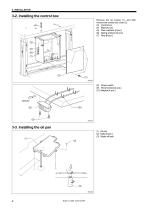
3-2. Installing the control box Remove the six screws (1), and then remove the control box cover (2). (3) Control box (4) Bolts [4 pcs.] (5) Plain washers [4 pcs.] (6) Spring washers [4 pcs.] (7) Nuts [8 pcs.] (8) Power switch (9) Wood screws [2 pcs.] (10) Staples [4 pcs.] 3-3. Installing the oil pan (1) Oil pan (2) Nails [6 pcs.] (3) Waste oil tank
Open the catalog to page 12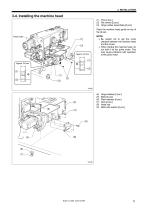
3-4. Installing the machine head (1) Pins [2 pcs.] (2) Set screws [2 pcs.] (3) Hinge rubber assemblies [2 pcs.] Place the machine head gently on top of the oil pan. Pulse motor NOTE: • Be careful not to get the cords clamped between the machine head and the oil pan. • When holding the machine head, do not hold it by the pulse motor. This may cause problems with operation of the pulse motor. Hinge holders [2 pcs.] Bolts [4 pcs.] Plain washers [4 pcs.] Nuts [4 pcs.] Head rest Bolts with washer [4 pcs.]
Open the catalog to page 13
(10) Auxiliary plate (11) Bolts with washer [8 pcs.] Loosen the eight bolts with washer (11), and adjust so that the auxiliary plate (10) is 0 to 0.5 mm above the needle plate. Needle plate NOTE: • Install the auxiliary plate (10) so that it is horizontal. If the auxiliary plate (10) is lower than the needle plate, the feed plate may get caught on the needle plate. Move the work clamp arm all the way to the right when looking from the front of the sewing machine (the direction of the arrow in the illustration), and then gently tilt back the machine head. NOTE: • Three or more people should tilt...
Open the catalog to page 14All Brother catalogs and technical brochures
 WF1
WF14 Pages
 T-8421C,T-8422C
12 Pages
 SL-777B
2 Pages
 RH-9820
4 Pages
 S-7300A DigiFlex Feed
8 Pages
 S-7250A
4 Pages
 BE-438HX/HS
4 Pages
 BAS-370H / BAS-375H
8 Pages
 HE-800C
2 Pages
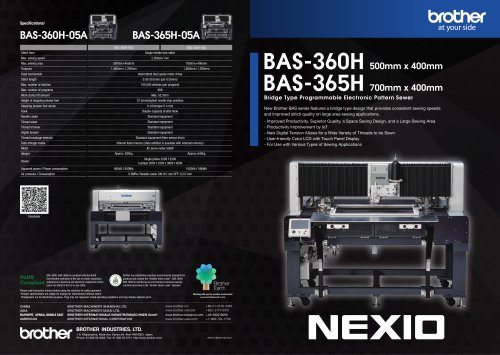 BAS-360H / BAS-365H
2 Pages
 BAS-300Series
8 Pages
 GT-3
GT-32 Pages
 S-7300A
108 Pages
 S-7220C
63 Pages
 S-7100A
53 Pages
 KE-430FX / BE-438FX
6 Pages
 KE-430HX/HS
4 Pages
 S-1000A
2 Pages
 KE-430FS
2 Pages
 HE-800B
4 Pages
 BAS-311HN/-326H/-341H/-342H
8 Pages
 BE-438FX
6 Pages
 BAS-342G
6 Pages
 BAS-326G
6 Pages
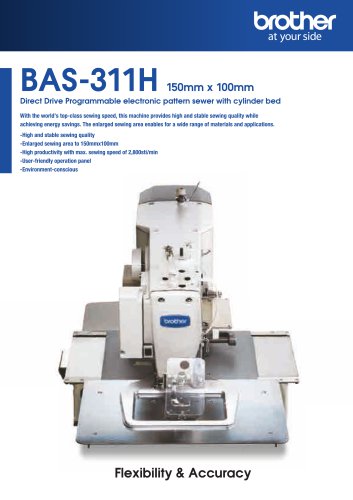 BAS-311H
6 Pages
 BAS-300G-484/484SF
2 Pages

- Brother fixed sewing machine
- Industrial printer
- Brother fabric sewing machine
- Brother single-needle sewing machine
- Brother lockstitch sewing machine
- Brother single-thread sewing machine
- Ink
- Color printer
- Thermal transfer printer
- High-speed sewing machine
- Brother twin-needle sewing machine
- Brother direct-drive sewing machine
- Brother sewing machine with thread trimmer
- USB interface printer
- High-speed printer
- Brother electronic sewing machine
- Floor-standing printer
- High-quality printer
- Chain stitch sewing machine
- Brother programmable sewing machine