
- Catalogs
- Brodersen Controls
- RTU870 Data Sheet

RTU870 Data Sheet

RTU870 Data Sheet
The RTU870 is a compact utility outstation designed for industrial environments, featuring 24 inputs/outputs and serial port options. It is housed in a 216 mm wide module suitable for DIN-rail mounting, conforming to DIN 43880 standards for easy installation. The unit supports various power supply options, including battery backup, ensuring operation during power interruptions. It can be expanded with additional I/O modules and supports meter interfaces and communication protocols like EN/IEC60870-5-101.
Input/Output: The RTU870 includes 24 I/O terminals, with configurations such as 16 digital inputs, 4 relay outputs, and 4 analogue inputs. Digital I/Os are opto-coupled, and analogue inputs are galvanically isolated.
Wiring Diagram: Detailed wiring instructions are provided for proper installation.
I/O Expansion: The RTU can be expanded with BC modules, supporting up to 104 analogue or 496 digital I/Os. Expansion is limited by current consumption and I/O capacity.
Indicators: System indicators provide status on I/O configuration, power, and system health.
Local Control: The RTU supports IEC 1131-3 (B-CON) programming for local control, with tools for editing, compiling, and downloading programs via RS232.
The RTU870 offers multiple power supply options, including AC, DC, and battery backup configurations. It includes a power monitor and guidelines for battery performance.
The RTU supports various communication interfaces, including RS232 and Current Loop, with modem options for V.23 and PSTN. It uses the EN/IEC60870-5-101 protocol for main communication and supports ModbusRTU for programming.
Programming is achieved using the EN/IEC61131-3 standard, with a focus on mapping I/O and configuring local processing. The RTU can handle simple control sequences and data logging.
Detailed specifications cover digital and analogue I/O, power supply options, communication interfaces, and environmental considerations such as EMC and temperature stability.
The RTU870 is a compact utility outstation featuring 24 I/O and serial ports. It supports various interfaces including RS232C and TTY with protocols like Modbus and IEC1107. The device operates with a baud rate of up to 9600 and supports hardware handshakes such as RTS and DTR.
Control and Programming:
Programming is based on IEC 1131-3 (B-CON) with a flash memory of 23 Kbytes. It supports up to 1500 instruction lines and features a real-time clock with automatic leap year correction. The device does not support data logging.
Power Supply and Battery:
The RTU870 operates on a nominal supply voltage of 110-240V AC/DC with a power consumption of up to 20W. It includes a 24V lead acid battery backup with a capacity of 3-12 Ah and a charging current of up to 0.5 A.
Digital and Analog Inputs/Outputs:
Digital inputs are activated at 10-30V DC with a typical input delay of 1ms. The device supports 4 multiplexed analog channels with a resolution of 12 bits. Analog inputs have various configurations and measuring ranges.
Modem and Communication:
The RTU870 includes a V.23 modem interface supporting half/full duplex modes. It features automatic gain control and isolation of 3500 V.
Indicators and General Features:
Indicators are available for digital inputs, counter inputs, relay outputs, system status, I/O, power, and communication. The device is designed for ambient temperatures between -10°C and +55°C and complies with EMC standards EN 50081-1/EN50082-2.
Configuration:
The RTU870 can be configured using the RTU870 Configuration program or IO Explorer for advanced users. Configuration includes setting baud rates, response delays, retry counts, and modem initialization.
Notes:
Ensure proper isolation and connection to avoid permanent damage. The device requires a safety earth and is protected against overcurrent and thermal conditions.
The RTU870 is a series of compact utility outstations designed for industrial environments. It features a compact design for easy installation and offers various power supply options, including battery backup for uninterrupted operation. The main communication protocol is EN/IEC60870-5-101, with RS232 as the communication interface.
Technical Specifications
The RTU870 supports up to 32 input/output terminals with various configurations available, including digital and analog inputs and outputs. All digital I/Os are equipped with opto-couplers, and analog inputs have galvanic isolation. The unit supports simple control sequences using EN/IEC1131-3 IL programming language.
Power Supply and Battery Management
The RTU870 offers multiple power supply options, including UPS and solar panel compatibility. Battery capacity should be selected based on consumption and backup time requirements, considering factors like temperature and age for reliability.
Communication and Configuration
The RTU870 supports modem dial-up features and can be programmed using a standard PC with the IOTOOL870 software. It includes a programmer port using the ModbusRTU protocol.
Input/Output and Expansion
The RTU870 allows for I/O expansion via an expansion bus. It includes indicators for local control and supports various input/output configurations, including digital and analog options.
Meter Port Configuration
The meter port configuration includes options for disabling the meter port protocol or using IEC1107. Baud rates range from 300 to 9600 baud, with a fixed data format.
Environmental and Safety Considerations
The RTU870 is designed to operate within specific environmental conditions, with protections against short circuits and overloads. The maximum load current should be adjusted for high ambient temperatures.
- Analog Inputs: 4 multiplexed channels with differential configuration, various input ranges, and 12-bit resolution.
- Relay Outputs: 12 SPST-N/O contacts with a maximum voltage of 240V AC and current of 1A AC.
- Digital Inputs/Outputs: Input voltage range of 10-30V DC, with specific current and delay characteristics.
- Power Supply: Multiple supply versions with varying voltage ranges and power consumption, including options for battery backup.
- Serial Interface: RS232C with a baud rate of 9600, supporting Modbus slave protocol.
- Main Interface: RS232 with support for IEC870-5-101 protocol, including modem control and dial-up capabilities.
- Memory: Program memory of 23 Kbytes, with a typical maximum program size of 1500 instruction lines.
- Real-Time Clock: Automatic correction for leap years, with accuracy specifications across temperature ranges.
- Environmental and Mechanical: Operating temperature range of -10 to +55°C, with specific EMC and climatic standards compliance.
This document is an appendix to the general RTU870 data sheet, focusing on the RTU870 with an additional mirrored IEC870-5-101 Slave driver. It highlights the technical specifications, configuration, and operational guidelines for the RTU870, particularly when using the mirrored Slave driver on the RS232 Meter port.
Specifications
- Telephone Numbers: Maximum of 30 numbers, each up to 20 characters, including special characters for modem control.
- Modem Initialization: String length up to 60 characters, sent cyclically and upon connection establishment. Default: ATV0E0&C1S0.
- PIN Code: Required for GSM modems if SIM card PIN is needed. Incorrect entries may require a PUK code.
- Modem Reinitialization: Time between re-initializations ranges from 0 to 999 minutes. Default: 0 minutes.
- Dial Back: Function can be enabled or disabled.
- Date/Time: Real-time clock can be adjusted manually or synced with a PC clock.
Technical Description
- Wiring Diagram: Details the RS232 COM interface and pin configurations for data transmission and reception.
- Code Switch/Address Selector: Defines ASDU address using an 8-bit binary system. Additional switches are available for application use.
Configuration
The RTU870 Configuration program allows setup of hardware and protocol-specific parameters. Experienced users can use the IO Explorer for advanced configurations.
- Baud Rate: Default is 9600 for IEC870-5-101.
- Response Delay: Configurable in 10ms units.
- RTS Leading/Trailing: Configurable delays for RTS activation and deactivation.
- Retry Count: Default is 3, with a range of 0 to 10.
- Max Communication Count: Default is 256, controlling input/output read/write cycles before hang-up.
Notes/Remarks
- Scan intervals are user-selectable but limited by micro-controller capacity.
- Battery management includes periodic disconnection for voltage checks and considerations for temperature and age-related degradation.
- Power supply and charger specifications include current limits and thermal protection features.
- Analog input configurations and limitations are detailed, including the need for external resistors and considerations for noise levels.
The document outlines various configuration parameters for a Remote Terminal Unit (RTU) and its modem. Key specifications include:
- Number of Subscribers: Defines how many phone numbers to try after retries on the first number. Default is 1, with a range of 1-10.
- Redial Delay: Time delay between unsuccessful dial attempts. Default is 90 seconds, ranging from 2 to 120 seconds.
- Telephone Numbers: Maximum of 30 numbers can be stored, each up to 20 characters long, including special characters for modem control.
- Modem Initialization: Initialization string for modem configuration, up to 60 characters. Default is ATV0E0&C1S0.
- PIN Code: Required for GSM modems if a SIM card is used. Incorrect entries may require a PUK code.
- Modem Reinitialization: Time between cyclic re-initializations, default is 0 minutes, ranging from 0 to 999 minutes.
- Dial Back: Option to enable or disable the dial-back function.
- User Configuration: User-defined values can be used in B-CON applications or IEC870.
- Date/Time Adjustment: Real-time clock can be adjusted manually or synced with a PC clock.
- Boot Delay: Ensures master boot does not start until the I/O bus is operational, especially with multiple analogue I/O modules.
- S0 Counter Type: Defines counter type as absolute or accumulated values.
- S0 Interval: Time between counter value transfers to the IEC870-5-101 queue, ranging from 1 to 240 minutes.
- Analog Range: Selects analogue input range; 0-20mA or 4-20mA, with underflow alarm valid only in 4-20mA range.
- PORT C Configuration: Header for mirrored 101 Slave port configuration.
- Baud Rate: Defines baud rate for the serial port with 101 slave mirrored driver.
- Use E5 Response: Options include not used, used as acknowledge, or used as acknowledge with no data.
- Response Delay: Defines response delay in 10ms increments.
- RTS Leading/Trailing: Defines delays related to RTS activation and deactivation during transmission.
Catalog excerpts
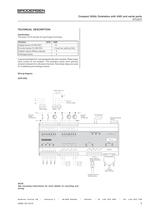
Input/output The basic I/O fit include 24 input/output terminals. Version UCR-24IO Digital inputs (10-30V DC)14 Counter inputs (10-30V DC) 2 (can be used as DIs) Digital outputs (Relay outputs)4 Analogue inputs4In general all digital I/Os are equipped with opto-couplers. Relay outputhave contact to coil isolation. The analogue inputs have galvanic isolation between the individual channels. Solid state relays are used for multiplexing the analogue inputs. Wiring diagramUCR-24IO.. > External fuse 1A +-+- +- +- Externalsupply 10 - 30V DC External supply 10 - 30V DC I/O Expansion Wiring see specialsection...
Open the catalog to page 3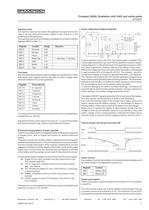
Real time clock > The real time clock can be used in the application programme to start /stop or do any other time function related to the control or to the monitoring of the application. The real time clock and the time base is available in a number of internal registers (BM10 to BM 17). Power supply block diagram (type 60) Typical charge / discharge cycle (type 60) Power monitor > +24V(20-28V) 0 +5V+12V & + 5VReg. 12V Reg. RegisterContentRangeRemarks > Expan-sion >20V>24V 110V-240V>100V C BM10Seconds0-59 BM11Minutes0-59 BM12Hours0-23 > Externalbattery BatteryOKMainsOK BM13Week day1-71=Monday,...
Open the catalog to page 7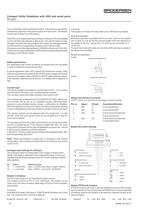
Any application with a back-up battery connected has to be calculated in order to define the actual backup time.A typical application with a RTU without I/O Expansion module, otherexternal equipment connected to the 24VDC power supply will have an current consumption of about 300mA at 24VDC battery backup supply. It will typically a backup time of 6hours on a battery with a capacity of 3Ah. Counter input Two 32 bit counters is provided on counter input 0 and 1. The counters can be used for S0 input, only via potential free contacts. The counters values are battery backed, when power is off.The...
Open the catalog to page 8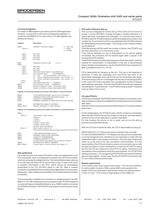
RTU calls CS/Active Dial up RTU can be configured for active call up. RTU calls CS if an event of priority 1 occurs (RTU870: change of single or double indication or if active dial back is enabled and activated). If a priority event occurs, RTU870 calls CS. RTU870 starts to call the first telephone number in the number list. If connection to CS is not established the RTU870 will wait the Redial delay time and try again. That will go on the number of Retry counts defined. If the dial attempt still fail under the number of retries, the RTU870 use the next subscriber no on the phone no list. If...
Open the catalog to page 11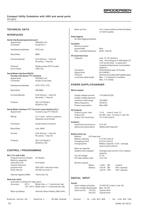
Data logging No data logging possible. > Counters: I/O expansion bus Minimum pulse / pause width:6ms Max. counting frequency:60Hz, note 20 > Capacity:max. 31 I/O sectionsmax. 104 analogue or 496 digital I/O (104 words total), or expansion modules limited power consumption (300mA.).Connector:RJ45 Modular jack, 8/10 pole.Signal level:5V (CMOS). Protocol:Synchronous data (shift register type). Local bus cable length:Max. 1 m between 2 modules.Max. 5 m totally. > Serial interface/programmer port: Signal level:RS232C/v.24.Connector:6 pole RJ11.Hardware handshake:RTS onlyBaud Rate:9600Format (default):8...
Open the catalog to page 12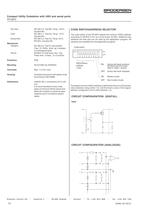
Dry heat:IEC 68-2-2, Test Bd, Temp. +55C,Duration 8h.Cold:IEC 68-2-1, Test Ad, Temp. -10аC,Duration 8h.Damp heat:IEC 68-2-3, Test Ca, Temp. 40C,RH 95%, Duration 8h. > The code switch of the RTU870 selects the common ASDU addressaccording to IEC870-5-101 as a 8-bit binary (0-255). Additional twoswitches are free and can be used by the application program. All switches are readable from the application program.Code switchONActive dial back enabled-RTU870 call CS if newdata in class 1 queue.OFFActive dial back disabled.ONModem modeOFFNull modem modeThe logical common ASDU address is defined as the...
Open the catalog to page 14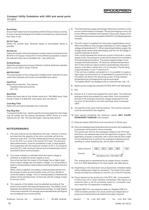
Boot Delay Ensure that master boot is not started until the I/O bus is fully up running. In case of several analogue I/O modules connected you may encrease this value in sec. S0 Cnt Type Define the counter type. Absolute values or acumulated values is possible. S0 Interval Define the length of the time between counter values is tranfered to the IEC870-5-101 queue. Values from 1min to 240min is posssible, however the selected value has to dividable into 1 day (24hours). Analog Range Select the analogue input range; 0-20mA or 4-20mA. Note that underflow alarm is only valid in range 4-20mA. METER...
Open the catalog to page 16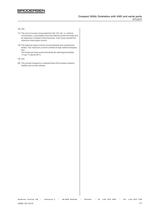
Compact Utility Outstation with 24IO and serial ports RTU870 > 16)N/A17)The sum of current consumed from the 12V rail, i.e. internalconsumption, consumption from the external screw terminals and by expansion modules at the local bus, must never exceed the maximum total output current.18) The external output is short circuit protected and overload pro-tected. The maximum current is limited at high ambient tempera ture. The maximum load current should be de-rated approximately 1% per C above 25аC.19)N/A20)The counter frequency is reduced when the module is heavilyloaded, see counter section. Brodersen...
Open the catalog to page 17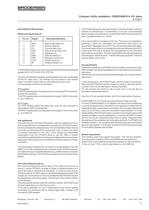
Modem requirement The modems used must support even parity. This can be a problem for some (older) modems. When using GSM communication the master (CS) must implement long timeout delays for retransmission, 10 sec or more. This is due to large delays on the GSM net. > Serial RS232 COM interfaceRS232 port (9 pole sub-D) The RTU870 keeps the state dial requestӔ until all information, which is marked for transmission, is transmitted CS calls RTU870 . If the link is disconnectedbefore all data is transferred (i.e. by the CS) RTU870 tries to dial the CS after a predefined time e.g. 10 min.CS is responsible...
Open the catalog to page 24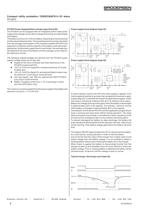
Externalbattery BatteryOKMainsOK +24V(20-28V) 0 +5V+12V & + 5VReg. 12V Reg. Expan-sion >20V>24V 110V-240V>100V յ C Externalbattery BatteryOKMainsOK >
Open the catalog to page 25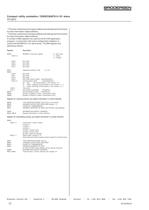
RegisterDescription BM30IEC60870 Command register0 = Idle mode m30.0..31 = dialup2 = hangup m30.4Not Used m30.5Not Used m30.6Not Used m30.7Not UsedBM31Telephone number to dial ( 0..19 )BM32 m32.0Not Used m32.1Not Used m32.2Not Used m32.3DCD Data Carrier Detect ( Input/ReadOnly ) m32.4..5Communication state ( Input/ReadOnly )00IdleNo communication ( com counter = 0 ) 01Active: outgoing Communication ( com counter >= 1 ) 10Active: Incoming Communication ( com counter >=1 )m32.6 Not Usedm32.7Dial request suspended ( ReadOnly )BM33Communication counter ( Read/Write ) WM34Number of ASDUs in Class...
Open the catalog to page 29All Brodersen Controls catalogs and technical brochures
 UDC-32
4 Pages
 UDC-35
4 Pages
 Signal Converters & Isolators
19 Pages
 Power Supplies
3 Pages
 Operator Interfaces
12 Pages
 Power Supplies
8 Pages
 PX Signal Converters
6 Pages
 igital timer eliro
3 Pages
 control & monitoring relays
35 Pages


Archived catalogs
 Data Radios Data Sheet
32 Pages
 Data Radios Sales Brochure
4 Pages
 X Timer data Sheet
31 Pages
 Data Radios Sales Brochure
4 Pages
 RTU870 Selection Guide
6 Pages
 RTU32 Data sheet
9 Pages
 RTU Overview Brochure
2 Pages
 RTU32 Sales Brochure
8 Pages


- Display module
- DC power supply
- AC/DC power supply
- Digital indicator
- Switched-mode power supply
- Panel panel meter
- Electronic display panel
- DIN rail power supply
- Information display
- Time relay
- DIN rail converter
- Regulated power supply
- LCD operator terminal
- Process panel meter
- Illuminated indicator
- LED indicator
- Monitoring relay
- Position indicator
- Temperature indicator
- VirtualExpo Group
- Our Partners
- Recruitment
- Testimonials