


- Products
- Catalogs
- News & Trends
- Exhibitions
V series

V series
Brevini Power transmission S.p.A. V series gear units are three-stage, helical geared hoist drum drive units designed for high precision and durability. They feature a monoblock design for rigid mounting, extended input and output center distances for larger drums, and are capable of handling high radial loads. The gear units are made from GG20 - GG22 cast iron and high-quality case carburized steel, available in five sizes for loads from 0.5 to 50 tons, and compatible with single and double-speed brake motors.
- High technology
- Reliability
- High power density
- High efficiency
- Compatible mounting
- Flexible solutions
- Illustrative drawings are not binding.
- Brevini reserves the right to make changes without notice.
- Follow operating instructions before commissioning.
- Oil quantities are indicative; verify with oil level plugs.
- Warranty void if mounting position is altered.
- Weights are average and may vary with accessories and ratios.
Crane Classes
Crane classes depend on total operating hours and load type, ranging from M1 to M8 (ISO 4301-1) and 1Dm to 5m (FEM 9.511/86).
Load collective factor is calculated using provided equations, with loading states categorized as Light, Medium, Heavy, and Very Heavy.
- Crane Classification: Based on working hours and load state, following ISO and FEM standards.
- Load State: Categorized as Light, Moderate, Heavy, and Very Heavy.
- Load Capacity: Maximum load a crane can handle.
- Hook Path: Maximum height a crane can lift or lower a load.
- Rope Reeving Arrangement: Expressed with three numbers indicating total falls, rope number, and hook number.
- Falls: Ratio between lifting speed and rope velocity at the drum.
- Drum Diameter: Calculated using rope diameter and a coefficient from a specified table.
- Output Torque (M2): Calculated by multiplying motor output torque by transmission ratio and efficiency.
- Nominal Power (Pe): Power a gearbox can resist under ISO/FEM classification.
- Ratio (i): Ratio between output and input shaft speeds.
- Permissible Radial Loads (Fqam): Defined at the midpoint of the gearbox's output shaft.
- Noise Level: Below VDI 2159 guidelines.
- Coating and Corrosion Protection: Painted with RAL 7031, with options for different colors and protective coatings.
- Lubrication: Specific oils as per lubrication tables.
- Accessories: Include drum connection flange, special sealing solutions, oil level indicator, electromagnetic brakes, thermistor, and manual brake.
- Definition: A safety coefficient considering operating conditions, with fs=1 for uniform loads, 8-hour daily operation, and up to 100 starts per hour.
- Factors Influencing Service Factor: Operating time, load nature, start-up frequency, driver type, and other considerations.
- Selection Process: Determine operation time, load type, and start-up frequency to select the appropriate service factor from a provided table.
The document outlines the process for determining the service factor for gearboxes used in cranes and lifting equipment. It emphasizes calculating operating time, load type, frequency of starts, and drive type to establish the correct service factor. The service factor ensures safe operation under specified conditions, with a base factor of 'fs=1' representing uniform load, 8 hours of operation per day, and up to 100 cycles per hour.
Refers to ISO 4301-1 (FEM 9.511/86) standards for crane classification. It explains calculating average daily utilization time using parameters such as hook path, cycles per hour, working hours per day, and lifting speed. Total use time is determined by multiplying average daily utilization time by the number of working days per year and expected service years. There are 10 utilization classes based on total use time.
Describes different states of loading for cranes, ranging from light (L1) to very heavy (L4), and provides a method to calculate the load spectrum factor.
Includes a table for determining the required service factor for a specific crane class and maximum input motor power.
- Service factors for different load types and operating conditions.
- Utilization classes based on total duration of use.
- Load spectrum factors for different states of loading.
Recommends using ISO grouping (FEM) for selecting V series gearboxes and provides a comparison table to determine the appropriate service factor for specific crane classes.
Outlines efficiency calculations for crane systems, focusing on cable passages and pulley systems. Specifies that efficiency of individual idle pulleys is generally considered zero. Total efficiency of pulleys, excluding idle pulleys, can be calculated using a provided formula.
Provides a detailed procedure for selecting a gearbox for cranes, including calculating required output torque and speed. Emphasizes matching gearbox output speed with calculated speed and ensuring nominal power meets or exceeds required input power. Gearbox efficiency is approximately 0.94.
Radial loads for crane systems can be calculated using a specific formula, assuming the crane rope is closest to the gearbox output shaft.
Defines the direction of rotation for V Series gearboxes, detailing how output shaft rotation corresponds to input shaft rotation.
Provides a step-by-step tutorial for determining crane class and selecting the appropriate gearbox based on performance tables. Includes technical specifications such as load, lifting speed, drum diameter, and expected service life.
Provides a detailed guide on selecting gearboxes for cranes, focusing on specific parameters such as load, lifting speed, drum diameter, and crane class. Includes performance tables and formulas for calculating necessary specifications.
Outlines specifications for two gearbox models: VR573.1K-132M/4-L10 and VR673.1K-160L/4-L20. Key specifications include:
- VR573.1K-132M/4-L10: 7.5 kW motor power, 1400 rpm motor speed, 100 Nm brake, 3742 Nm output torque, 18 rpm output speed, and 83834 N permissible radial load.
- VR673.1K-160L/4-L20: 15 kW motor power, 200 Nm brake, 18 rpm output speed, and 61142 N permissible radial load for M8 (5m) crane class.
Provides step-by-step procedures for calculating:
- Output torque using load, drum diameter, falls, and rope reeving efficiency.
- Output speed using lifting speed and drum diameter.
- Input power using output torque, output speed, and gearbox efficiency.
Emphasizes ensuring permissible radial loads exceed occurring radial loads for safety. Provides guidelines for selecting gearboxes based on crane class and operational conditions.
Several formulas are provided for calculating necessary parameters, including:
- Output torque: M = (Load x Drum Diameter x 9.81) / (2000 x Efficiency)
- Output speed: n = (Lifting Speed x 1000) / (Drum Diameter x π)
- Input power: P = (Output Torque x Output Speed) / (9550 x Efficiency)
Includes a gearbox selection form to assist in specifying requirements such as crane class, load, drum diameter, lifting speed, motor power, and environmental conditions.
Three-phase asynchronous motors are widely used due to their low maintenance, simple construction, high reliability, and cost-effectiveness. The motor's start-up behavior is characterized by the torque-speed curve, which it follows until reaching a stable operating point where the curve intersects with the load torque line.
Permissible deviations for nominal values include slip (±20%), start-up current (±20%), start-up torque (-15/+25%), moment of inertia (±10%), and efficiency (up to 37 kW) with a deviation of -0.15 (1-η).
Motors are designed for continuous operation (S1), with other modes such as short-time duty (S2), periodic duty without temperature influence (S3), and others listed in a table.
Standard motors have an IP54 protection class, with other classes available upon request. The standard insulation class is F, with H class available on request.
The efficiency measurement method for low voltage three-phase asynchronous motors has been updated to IEC 60034-2-1:2007. Efficiency classes (IE1, IE2, IE3, IE4) are applicable for motors from 0.75 to 375 kW.
An inverter converts DC to AC, using a rectifier to convert AC supply to DC, which is then converted back to variable frequency and voltage AC using an inverter bridge.
An inverter is an electronic device that converts direct current (DC) into alternating current (AC). It is commonly used in electronic speed controllers for AC motors.
General Specifications: DC drive systems have become more feasible with advancements in electronic components, offering features like guided startup, torque and current monitoring, and overload protection.
These brakes have two friction surfaces and operate on the fail-safe principle, where brake torque is generated by springs when no voltage is applied.
Brakes without Cooling: Suitable for short working cycles.
Fan Cooled Brakes: Used for long working times and in enclosed spaces.
Brakes with Hand Release: Useful in cases of power failure or mechanical issues.
Brakes are provided with a standard supply voltage of 230 V and a half-wave rectifier. For specific applications, contact Brevini Power Transmission S.p.A.
- Delayed Braking: Used for slow and sliding brake systems.
- Immediate/Fast Braking: Used when short braking times are needed.
Used for high power brakes to quickly generate the electromagnetic field.
To select the correct brake, the following data is necessary: total inertia of rotating parts, maximum motor speed, maximum admitted braking time, required static torque, and safety coefficient (C ≥ 2).
After calculating the braking torque, the thermal capacity must be checked to ensure it is within the limit curve of dissipable work.
The brake air-gap must be re-adjusted after a certain period to maintain performance.
Includes data on drum diameter, lifting speed, crane class, power, output speeds, output torque, ratio, type, permissible radial loads, weight, and dimensions.
- Specifications: Lists specifications for different crane components, including drum diameter, lifting speed, power, output speeds, output torque, and gear ratio.
- Procedures: Emphasizes that crane classes are provided only for gearboxes and must be calculated for other crane equipment.
- Norms and Standards: Follows ISO (FEM) standards for crane classification.
- Recommendations: Users are advised to calculate crane classes for components other than gearboxes.
- Specifications: Lists specifications for different gearbox models.
- Crane Classifications: Notes that crane classifications provided apply only to the gearboxes.
- Data Tables: Contains extensive tables detailing specifications for various gearbox models.
- Drum Diameter: Ranges from Ø150 to Ø230.
- Lifting Speed and Power: Varies significantly across models.
- Output Torque and Speeds: Critical for determining efficiency and suitability.
- Permissible Radial Loads: Important for ensuring operational safety.
- Lifting Speed: Varies across models.
- Power Output: Specified in kilowatts (kW).
- Output Speeds and Torque: Critical for determining mechanical performance.
- Permissible Radial Loads: Defines maximum load the output can handle.
Provides detailed specifications for various lifting equipment components.
Emphasizes that crane classes are specified only for gearboxes.
Adhere to specified parameters for optimal performance and safety.
Contains extensive tabular data detailing specifications of various components.
Ensure crane class calculations are performed for all components.
Catalog excerpts

Indice Index Inhaltsverzeichnis Info generali General Info. Einfuhrung Significato dei simboli Caratteristiche generali dei riduttori serie V Key of Symbols General Specifications of V Series Gearboxes Erklarung der Bezeichnungen Allgemeine Eigenschaften Von V Serie Getrieben Spiegazioni tecniche Caratteristiche tecniche Accessori Technical Explanations Technical Specifications Accessories Technische Erlauterungen Technische Informationen Zubehor Designazione unita Rapporti possibili, in funzione della grandezza del motore Fattore di servizio Unit Designation Geomet. Possible Combinations of...
Open the catalog to page 3
Indice Index Inhaltsverzeichnis d- Controllo della velocita di rotazione dei motori CC d- Speed Control of DC motors d- Drehzahl Kontrolle DC Motoren Freni Brakes Bremsen Freni elettromagnetici Tipi di freni Tipi di connessione Scelta dei freni Capacita termica dei freni Electromagnetic Brakes Brake Types Connection Types Brake Selection Brake Thermal Capacity Elektromagnetische Bremsen Bremsenarten Schaltungsarten Bremswahl Therm. Kapazitat der Bremsen TabeNe prestazionali Perform. Tables Leistung-Drehzahl Tabellen. Tabelle prestazionali dei motoriduttori Geared Motors Performance Tables Getriebenmotoren...
Open the catalog to page 4
Informazioni generali General Information EinfuhrungSignificato dei simboli Key of Symbols dispos. dei passaggi del cavo
Open the catalog to page 5
Informazioni generali General Information Einführung Note / Notes / Notizen
Open the catalog to page 6
Informazioni generali General Information Einführung Note / Notes / Notizen
Open the catalog to page 7
Informazioni generali General Information Einführung Caratteristiche generali dei riduttori serie V General Specifications of V Series Gearboxes Allgemeine Eigenschaften von V Serie Getrieben I riduttori serie V di Brevini Power Transmission S.p.A. sono riduttori di tipo elicoidale tristadio, in esecuzione monoblocco, utilizzati per azionare il tamburo di apparecchi di sollevamento. Brevini Power transmission S.p.A. V series gear units are three stage, helical geared hoist drum drive units produced according to the monoblock principle. Brevini Power transmission S.p.A. V Serie Getriebe sind Antriebseinheiten...
Open the catalog to page 8
Informazioni generali General Information Einfuhrung Spiegazioni tecniche - Classificazione degli apparecchi di sollevamento I fattori da tenere in considerazione nel determinare il gruppo di cui fa parte l'apparecchio di sollevamento sono: totale ore lavoro prevista di vita e stato di carico. Le classi a cui possono appartenere gli apparecchi vanno dalla M1 alla M8 secondo la norma ISO 4301 / 1 e dalla 1Dm alla 5m secondo la norma FEM 9.1511 / 86. - Stato di carico (Fattore di spettro di carico) Per calcolare lo stato di carico di un apparecchio di sollevamento si possono utilizzare le formule riportate...
Open the catalog to page 9
Informazioni generali General Information Einfuhrung - Coppia trasmessa (M2) [Nm] Moltiplicando la coppia in uscita dal motore per il rapporto di trasmissione e il rendimento si ottiene la coppia trasmessa a livello dell'albero in uscita dal riduttore. - Potenza nominale (Pe) [kW] La potenza nominale e la potenza a cui il riduttore, sottoposto a sollecitazioni meccaniche, e in grado di resistere secondo la classificazione ISO / FEM richiesta. I valori della potenza nominale sono indicati nelle tabelle prestazionali. - Rapporto (i) Rapporto tra il numero di giri dell'albero in uscita e quello...
Open the catalog to page 10
Informazioni generali General Information Einführung
Open the catalog to page 11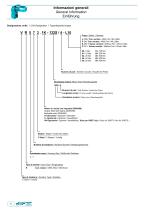
Informazioni generali General Information Einführung Designazione unità / Unit Designation / Typenbezeichnungen Freno / Brake / Bremse L-230V Con ventola / With Fan / Mit Lüfter P-24V Con ventola / With Fan / Mit Lüfter S-230 V Senza ventola / Without Fan / Ohne Lüfter Z-24 V Senza ventola / Without Fan / Ohne Lüfter 00- 5 Nm 01- 10 Nm 02- 25 Nm 04- 40 Nm 05- 50 Nm Numero di poli / Number of poles / Anzahl der Polen Grandezza motore /Motor Size / Motorbaugröße 132S / 4 Numero di poli / Pole Number / Anzahl der Polen Lunghezza corpo / Frame Lenght / Gehäuselänge des Motors Grandezza motore / Motor...
Open the catalog to page 12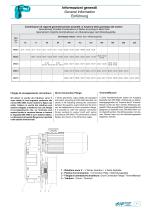
Informazioni generali General Information Einfuhrung Flangia di accoppiamento col tamburo Gli alberi in uscita dei riduttori serie V sono dotati di una linguetta conforme alla norma DIN 5480. Come mostra la figura qui sotto, l'albero in uscita dal riduttore puo essere collegato al tamburo con una flangia di accoppiamento che, su richiesta, puo essere fornita in versione idonea a ricevere la linguetta DIN 5480 di cui e dotato l'albero. Le dimensioni di queste flange sono riportate nelle tabelle dimensionali. Drum Connection Flange V series gearboxes output shafts are equipped with spline according...
Open the catalog to page 13
Informazioni generali General Information Einführung I riduttori per apparecchi di sollevamento indistriali possono essere selezionati utilizzando il fattore di servizio o il sistema di classificazione degli apparecchi di sollevamento secondo le norme ISO 4301 / 1 (FEM 9.511 / 86). Per scegliere i riduttori serie V, progettati appositamente per essere utilizzati sugli apparecchi di sollevamento, si raccomanda l'utilizzo delle classificazioni ISO (FEM) illustrate a pagina 13. Il valore del fattore di servizio per una specifica classe di apparecchi di sollevamento è indicato nella tabella comparativa...
Open the catalog to page 14
Informazioni generali General Information Einfuhrung Classificazione apparecchi di sollevamento ISO 4301 / 1 ( FEM 9.511 / 86 ) Per determinare la classe di utilizzo di un apparecchio di sollevamento, occorre calcolare il tempo di utilizzo giornaliero medio in ore. Essendo noti la corsa del gancio dell'apparecchio di sollevamento, il numero di cicli per ora, il tempo di lavoro al giorno e la velocita di sollevamento, si puo calcolare il tempo di utilizzo giornaliero medio applicando la formula seguente. Crane Classifications ISO 4301 /1 ( FEM 9.511 / 86 ) For determining the utilization class...
Open the catalog to page 15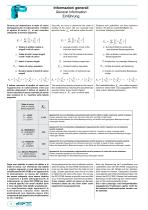
Informazioni generali General Information Einfuhrung Occorre poi determinare lo stato di carico deM'apparecchio di sollevamento. Il fattore di spettro di carico Km si puo calcolare utilizzando la formula seguente. Secondly we have to determine the state of loading of the crane. We can calculate load spectrum factor Km with below written formula. Zweitens soil Lastkollekiv von Kran bestimmt werden. Wir konnen Lastkollektiffaktor Km mit unterer Gleichung berechnen. t: Tempo di utilizzo medio ai singoli livelli di carico. ti: Average duration of use at the individual load levels. t: Durchschnittliche...
Open the catalog to page 16All Brevini Power Transmission catalogs and technical brochures
 S series
164 Pages
 Slewing drives
112 Pages
 BGM
BGM18 Pages
 S6CV
S6CV64 Pages
 MEDIUM PRESSURE MOTORS AND PUMPS
124 Pages
 series 498
2 Pages
 series 492
2 Pages
 series 392/393
2 Pages
 SH11C
SH11C24 Pages
 H1C
H1C18 Pages
 INDUSTRIAL SERIES
260 Pages
 LEONESSA BREVINI
57 Pages
 Hand pumps
40 Pages
 Valves and Electronics
274 Pages
 VPS Mobile Valves
68 Pages
 MC Tubes kit / Kit tub
38 Pages
 MC Hydraulic power pack
64 Pages
 FP Hydraulic power pack
100 Pages
 MB Orbital geared motors
20 Pages
 Low speed high torque Orbital Motors
192 Pages
 Axial piston Pumps and Motors
530 Pages
 Rotary Drilling
5 Pages
 Bulk Mining Industrail
11 Pages
 Deck Crane Brochure
5 Pages
 Off-highway Product Range
13 Pages
 Hoisting and Recovery Winches
125 Pages
 MOBILE SLEWING DRIVES
106 Pages
 SU IM SERIES
40 Pages
 ML B RD SERIES
48 Pages
 MR
MR4 Pages
 MP
MP1 Page
 MC
MC38 Pages
 MB
MB20 Pages
 BFP
BFP4 Pages
 M series
408 Pages
 K series
488 Pages
 Hoisting&Recovery Winches
115 Pages
 WINCH DRIVES
16 Pages
 INDUSTRIAL PLANETARY GEARBOXES
260 Pages
 ASu Series
3 Pages
 ASu66 Series
3 Pages
 SP MkII Series
2 Pages
 TAC MkII Series
2 Pages
 TLu Series
2 Pages
 TLu66 series
2 Pages
 VT Series
8 Pages
 MC4 Series
8 Pages
 MC2 Series
8 Pages
 Powerpacks
4 Pages
 FP Series
80 Pages
 Take Up Winches for mining
16 Pages
 S Series Big
20 Pages
 Marine Technologies
14 Pages
 Winches overview
16 Pages
 Sugar mill drives
22 Pages
 Hydraulic Cylinders
2 Pages
 OT Silent Plus Pumps
10 Pages
 OT 300 Group 3 pumps
68 Pages
 OT 200 Group 2 pumps
127 Pages
 OT 100 Group 1 pumps
84 Pages
 S6CV Pumps
68 Pages
 SH11C Pumps
20 Pages
 SH5AV Pumps
28 Pages
 MD10V Pumps
99 Pages
 BRZ Orbital Motors
10 Pages
 HT Orbital Motors
19 Pages
 HR Orbital Motors
27 Pages
 AR - ARS Orbital Motors
22 Pages
 BR-BS Orbital Motors
30 Pages
 BGM Orbital Motors
19 Pages
 BG-BH Orbital Motors
31 Pages
 SH7VR Series
49 Pages
 SH7V Series
74 Pages
 MD11V Series
13 Pages
 SH11CR Series
16 Pages
 SH11C Series
24 Pages
 Twin Screw Extruder Drives
12 Pages
 Planetary Bevel Helical Posiplan
125 Pages
 S-Series Planetary Gearboxes
162 Pages
 Industrial Planetary Gearboxes
260 Pages
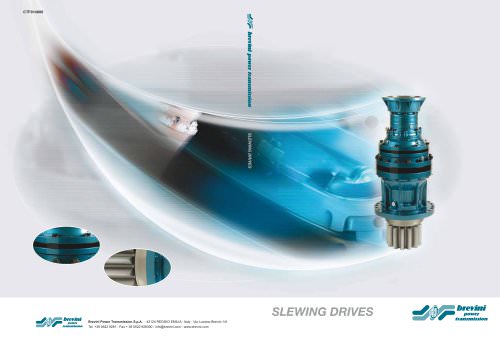 Yaw and Pitch Drives
106 Pages
 Planetary wheel drives
129 Pages
 Helical & Bevel helical Gearboxes
171 Pages
 Lifting / Hoisting Gearboxes
37 Pages
 Long Travel Drives
12 Pages
 Conveyor Drives
12 Pages
 Single Screw Extruder Drives
115 Pages
 Injection Molding Drives
12 Pages
 Recovery winches
115 Pages
 Winch drives
108 Pages
 Atex Gearboxes Catalogue
30 Pages
 Slewing drives
110 Pages
 S-Series
160 Pages
 Catalog
250 Pages



Archived catalogs
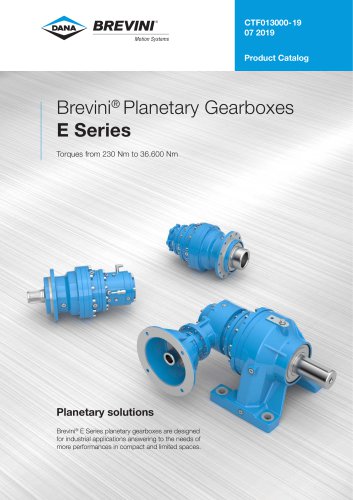 E series_2019
272 Pages
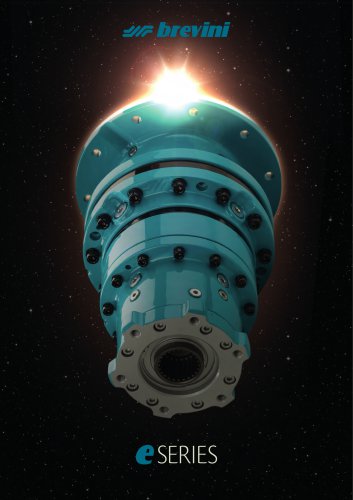 E Series
5 Pages
 CATALOGUE E series
274 Pages
- Electric gearmotor
- Planetary gearbox
- Coaxial gearhead
- Right angle gearhead
- Compact gearhead
- Solid-shaft gearhead
- Hollow-shaft gearhead
- Winch
- Gear train gear reducer
- Gearbox for industrial applications
- Transmission gearhead
- Multi-stage gearhead
- Single-stage gearhead
- AC gear-motor
- Right angle electric gearmotor
- Coaxial gearmotor
- Shaft gearhead
- Solid-shaft gear-motor
- Helical gear gearhead
- Dual-stage gearbox