

Life Science Catalog

Life Science Catalog
- Cell Culture Inserts: Provide flexibility and efficient cell growth.
- 384-well PCR Plates: Enhance sensitivity during qPCR reactions.
- Microtubes: Secure lid closures for reliable sample storage.
- BRANDplates® cellGrade™ Surface: Supports CHO cell proliferation.
- Cell Culture: Products for cell counting, cryopreservation, and cultivation.
- Microbiology: Tools for pathogen identification and cell signaling.
- Sample Analysis: Cuvettes, microscope slides, and staining troughs.
- PCR and qPCR: PCR tubes and plates for various throughput needs.
- Sample Storage: Solutions for storage down to -196°C.
- Centrifuge Tubes: Chemical resistance and sample integrity, withstand centrifugation up to 3000 x g.
- Media Bottles: Designed for cell culture, suitable for autoclaving.
- Cryogenic Tubes: Long-term storage at temperatures as low as -196°C.
- seripettor® Bottle-Top Dispenser: Precise dispensing of culture media.
Catalog excerpts

Life Science Catalog Products, user tips, and practical knowledge for life science applications.
Open the catalog to page 1
Simple, easy, and efficient Your life science applications with products from BRAND At BRAND you will find the right consumables and liquid handling instruments for PCR, microbiology, cell culture and many other life science applications. Each of our products emphasizes simple and easy lab work and an efficient workflow for your experiments. In this catalog, for example, find out how you can minimize evaporation losses during PCR (page 105) or achieve efficient cell growth using our cell culture inserts (page 74). Efficient work also involves training and information. For every product, you will...
Open the catalog to page 3
Quality “Made in Germany” from BRAND Cleanroom quality BRAND disposables for the field of life sciences are manufactured under controlled conditions in Germany, in one of the world’s largest cleanrooms for laboratory disposables (ISO 14 644-1 Class 5, 7 and 8). Continuous cleanroom monitoring, accompanied by precise regulation of the ambient conditions, results in high temperature stability throughout the entire production area. In combination with batch-related monitoring of the raw materials and end products, this stability guarantees the consistently high quality of BRAND life science products....
Open the catalog to page 4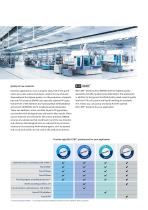
Quality of raw materials Sensitive applications, such as enzyme tests, PCR or the purification of nucleic acids and proteins, require the use of plastic disposables of the highest quality. For the production of pipette tips and PCR products BRAND uses specially selected PP types that are free of the additives di(2-hydroxyethyl) methyldodecylammonium (DiHEMDA) and 9-octadecenamide (oleamide). These two additives, which are often found in PP granulates, can interfere with biological tests and lead to false results. When source materials are selected for life science products, BRAND ensures any...
Open the catalog to page 5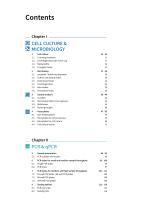
Cell culture Counting chambers Centrifuge tubes with screw cap Media bottle Cryogenic tubes Microbioloy seripettor® bottle-top dispenser Culture and sample tubes Erlenmeyer flasks Centrifuge tubes Petri dishes Inoculation loops 3 Sample analysis 3.1 Cuvettes 3.2 Microscope slides | Cover glasses 3.3 Slide boxes 3.4 Staining troughs Assay plates Non-treated plates Microplates for immunoassays Microplates for cell culture Cell culture inserts PCR & qPCR 5 Sample preparation 5.1. PCR-suitable microtubes 6 PCR tubes for small and medium sample throughput 6.1 Single PCR tubes 6.2. PCR strips 7 7.1...
Open the catalog to page 6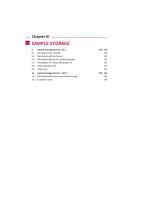
Sample storage down to -80 °C Microtubes with snap lid Microtubes with lid closure Microtubes with screw cap and plug seal Microplates, PP | Deep-well plates, PS Deep-well plates, PP Tube racks 10 Sample storage down to -196 °C 10.1 Microtubes with screw cap and silicone seal 10.2 Cryogenic tubes
Open the catalog to page 7
CELL CULTURE & MICROBIOLOGY Identifying unknown pathogens and understanding cell signaling pathways (e.g. tumor biology or neurodegenerative diseases) are ongoing sources of scientific challenges for researchers. More and more, interdisciplinary research is being used to search for previously undiscovered active ingredients and innovative potential therapies through combining cellular and microbiological methods. The only way to achieve the clear results essential to this research is by using the highest-quality consumable materials possible. To offer the best possible quality and purity for...
Open the catalog to page 8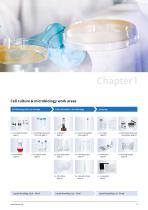
Chapter I Cell culture & microbiology work areas Cell banking and cryo storage Cell cultivation | microbiology 1.1 Counting chambers page 11 1.2 Centrifuge tubes with screw cap page 17 2.2 Culture and sample tubes page 30 3.2 Microscope slides and cover glasses page 44 1.3 Media bottle page 20 1.4 Cryogenic tubes page 22 2.3 Erlenmeyer flasks page 32 2.4 Centrifuge tubes page 34 3.3 Slide boxes page 45 3.4 Staining troughs page 46 2.5 Petri dishes page 36 2.6 Inoculation loop page 36 4. Assay plates page 47
Open the catalog to page 9
Cell culture 1. Cell culture Analyzing cell cultures (from cell lines or primary cells) can provide information on the effects of active ingredients, help interpret physiological conditions, and help explain pathophysiological changes. Monitoring cell numbers using a hemocytometer (counting chamber) is an essential preparatory step for any cell culture. Only by determining these initial values researchers can calculate generation times or check cell densities before seeding them in culture vessels or put them for cryopreservation. To support a wide range of experimental conditions, assay plates...
Open the catalog to page 10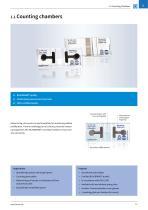
4 BLAUBRAND® quality 4 Outstanding measurement precision 4 100% certified quality Chamber bottom with two counting grids Information on counting grid engraving Determining cell counts is a key foundation for monitoring cellular proliferation. From microbiology to cell cultures, precision measuring equipment like BLAUBRAND® counting chambers ensure precise cell counts. Size of the smallest squares + Quantifying bacteria and fungal spores + Specialized optical glass + Counting plant pollen + Certified BLAUBRAND® quality + Determining cell counts of cultivated cell lines and primary cells + In accordance...
Open the catalog to page 11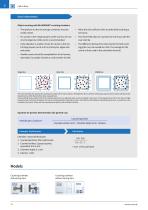
Cell culture User information Object counting with BLAUBRAND® counting chambers • The aperture on the microscope condenser must be nearly closed. • Allow the cells sufficient time to settle before starting a cell count. • For counts in the 4 large squares at the corners, the use of a 10x objective (100x zoom) is recommended. • The more fields that are counted, the more accurate the count will be. • A 40x objective is a better choice for counts in the central large square (such as for erythrocytes, algae cells and yeast). • The difference between the total counts for both counting grids may not...
Open the catalog to page 12
Technical information & Ordering data Large square Mini square (Sub-unit of the group square) Group square Large central square Neubauer improved Neubauer improved bright-line area of 1 mm2 each with 16 group squares of 0.0625 mm2 each area of 1 mm2 each with 16 group squares of 0.0625 mm2 each area of 1 mm2 each with 16 group squares of 0.0625 mm2 each Large central square area of 1 mm2 each with 25 group squares of 0.04 mm2 each area mini square: 0.0025 mm2 area of 1 mm2 each with 25 group squares of 0.04 mm2 each area mini square: 0.0025 mm2 area of 1 mm2 each with 25 group squares of 0.04...
Open the catalog to page 13All BRAND catalogs and technical brochures
 Product Range BRAND_2023
198 Pages
 accu-jet® S
8 Pages
 HandyStep_touch
12 Pages
 Dispensette® S
8 Pages
 The Tip System from BRAND
17 Pages
 HandyStep® S
4 Pages
 BRAND General Catalog 900
354 Pages
 EASYCAL
2 Pages
 Dispensette
6 Pages


Archived catalogs
 Product Range BRAND
192 Pages
 PLT unit
4 Pages
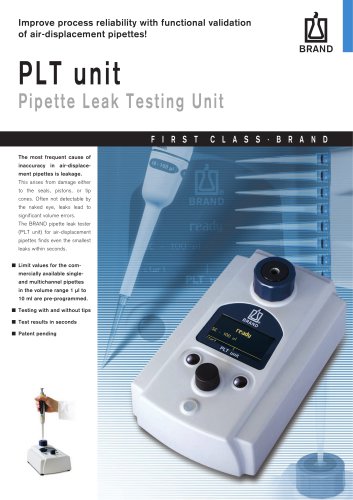 PLT unit_2014
4 Pages
 Dispensette TA
4 Pages
 General Catalog 2010
322 Pages