

LEFC

LEFC
- Precision ground heat-treated spool for durability.
- Diamond honed spool bore for consistent fit and low leakage.
- Each LEFC is tested for linearity and pressure compensation.
- Standard 3-port design allows pressure compensated flow from two ports.
- Optional manual override available for power loss situations.
- Maximum cartridge input pressure: 3000 psi.
- Tank port: #4 SAE with a maximum back pressure of 10 psi.
- Weight: 32.75 lbs (14.9 kg).
- Filtration requirement: 25-Micron or better.
- Coil specifications: 12 VDC standard, 10.4 Ohms, 14 Watts, 1.15 Amp max, rated for 100% continuous duty cycle.
- Operating temperature range: -20°F to 210°F (-30°C to 100°C).
- Cast iron body.
- Heat-treated steel spools.
- Buna N O’Rings.
- Standard port size: #16 SAE (1 5/16 – 12).
- Flow settings: 0-45 gpm (0-170.3 lpm) and 0-55 gpm (0-208.2 lpm).
- Coil voltage options: 12 VDC and 24 VDC.
- Coil terminal options include double lead, double spade, Din 43650, female shroud with male pin, and male tower with female pin.
Catalog excerpts

LARGE ELECTRONICALLY ADJUSTABLE PROPORTIONAL PRESSURE COMPENSATED FLOW CONTROL “LEFC” CONTROLLED FLOW (CF) TANK (10 PSI MAX BACK PRESSURE) PRECISION GROUND HEAT TREATED SPOOL that assures long life. DIAMOND HONED SPOOL BORE provides consistent spool fit with low leakage. EVERY LEFC IS TESTED for linearity and pressure compensation. STANDARD 3-PORT allows for pressure compensated flow out of two ports. OPTIONAL MANUAL OVERRIDE when electrical power is lost. See flow chart for capacity. Max. 3000 psi cartridge input pressure. Nominally Rated for 3000 psi (207 bar). Tank Port - #4 SAE (10 psi (0.69 bar) MAX. back pressure) Weight 32–3/4 lbs. (14.9 kg). 25-Micron Filtration or Better. Coil 12 VDC standard. 10.4 Ohms. 14 Watts. 1.15 Amp max. Rated 100% continuous duty cycle Pulse Frequency (90 to 110 Hz) Operating Temperature: -20 to 210F (-30 to 100C) Cast Iron Body. Heat Treated Steel Spools. Buna N O’Rings.
Open the catalog to page 1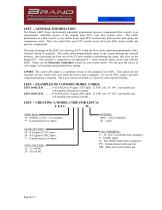
LEFC – GENERAL INFORMATION The Brand, LEFC (large electronically adjustable proportional pressure compensated flow control) is an electronically controlled version of the original large FC51 style flow control valve. The LEFC performance as a flow control is very similar to the large FC51 because they both use the same spring and compensator spool. Thus, the control flow port (CF) and the excess flow port (EX) remain usable and pressure compensated. The main advantage of the LEFC over the large FC51 is that the flow can be adjusted proportionally with a solenoid instead of manually. The orifice...
Open the catalog to page 2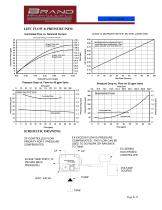
LEFC FLOW & PRESSURE INFO: Current vs. Dial Plate for EC-12-01, EC-12-01L and EC-12-02 Controlled Flow vs. Solenoid Current 45 gpm Valve with 50 gpm Input Solenoid Current (amps) Pressure Drop vs. Flow for 45 gpm Valve 0 SCHEMATIC DRAWING: CF-CONTROLLED FLOW PRIORITY PORT, PRESSURE COMPENSATED Pressure Drop vs. Flow for 55 gpm Valve Dial Plate (Percent) EX-EXCESS FLOW IS PRESSURE COMPENSATED. THE FLOW CAN BE USED TO DO WORK OR RAN BACK TO TANK. EC-SERIES ELECTRONIC CONTROLLER #4 SAE TANK PORT (10 PSI MAX BACK PRESSURE) VOLTAGE SOURCE PUMP LEFC VALVE Readings may vary slightly for every control...
Open the catalog to page 3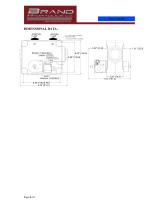
DIMENSIONAL DATA: CONTROL FLOW EXCESS FLOW 6.00" [152.4] #4 SAE TANK PORT (10 PSI MAX BACK PRESSURE) INLET MANUAL OVERRIDE
Open the catalog to page 4All BRAND HYDRAULICS catalogs and technical brochures
 V0200100000
3 Pages
 V0100080000
3 Pages
 V0100060000
3 Pages
 V0100040000
3 Pages
 V0100020000
3 Pages
 BRAND Hydraulics - EC-12-02
4 Pages
 FC 0-30 gpm (0-114 lpm)
4 Pages
 BRAND Hydraulics - SHV
1 Page
 Series 84
1 Page
 BRAND Hydraulics - DS
7 Pages
 RP01000003
5 Pages
 RP01000002
5 Pages
 84 series
1 Page
 83 series
1 Page
 V100
V1003 Pages
 RP01000001
5 Pages
 POC76
POC761 Page
 SEFC
SEFC2 Pages
 36EFC
36EFC4 Pages
 Series38
10 Pages
 Series 36
10 Pages
 Series 34
10 Pages
 MS6
MS62 Pages
 Series 21
7 Pages
 DS
DS7 Pages
 BRAND Hydraulics - MS
2 Pages
 SDCF
SDCF4 Pages
 45 and 120 gpm (170-454 lpm)
3 Pages
 30-45 gpm (114-170 lpm)
2 Pages
 0-30 gpm
4 Pages
 0-90 gpm (0-341 lpm)
2 Pages
 Custom Electronic Packages
3 Pages
 EC20300
10 Pages
 EC20100
7 Pages
 EC0004A
7 Pages
 EC20400
8 Pages
 EC20200
8 Pages
 EC-12-02
4 Pages
 EC-12-01
4 Pages
 DC
DC4 Pages
 AO
AO4 Pages
 B300
B3001 Page
 B series
2 Pages
 FG
FG2 Pages
 INTERFACE CARD
7 Pages
 "TS" Catalog
5 Pages
 PC - Pilot check valve
2 Pages


- Electrically operated valve
- Flap valve
- Check valve
- Directional control valve
- Hydraulic pump
- Direct-operated solenoid valve
- Hydraulic directional control valve
- Hydraulic piston pump
- Spool hydraulic directional control valve
- Relief valve
- Electrically-operated hydraulic directional control valve
- Manual hydraulic directional control valve
- Hydraulic check valve
- Manually-controlled hydraulic pump
- Compact hydraulic directional control valve
- Pilot-operated relief valve
- Compact check valve
- Hydraulic solenoid valve
- 4-way hydraulic directional control valve
- 3-way hydraulic directional control valve