
- Catalogs
- BOVIAR SRL
- Flat-jack testing Boviar

Flat-jack testing Boviar

Flat-jack testing Boviar
Flat jacks are utilized for diagnosing buildings and masonry to determine the actual static conditions of structures. They are also applicable for measuring stress in situ, such as in tunnels and bridge piers. The single-jack test involves altering the stress state at a point by making a perpendicular cut, measuring the closure of the cut with a strain gauge, and inserting a flat jack to restore the original state by applying pressure.
Two parallel jacks are used to conduct a mono-axial compression test to assess deformability characteristics. Flat jacks can be installed permanently or temporarily, with the option to cement them for long-term pressure monitoring.
For creating cuts, a widia chain saw is used for soft materials, while a hydraulic shear with diamond disks is employed for harder, irregular masonry like limestone.
Various models are available, including rectangular and semicircular designs, with calibration certificates provided for each production lot. Sizes range from 240 x 120 x 4 mm to 400 x 200 x 4 mm.
Extensometric Measurements: The MAYES precision strain gauge is used for measurements, offering a resolution of 2 x 10⁻³ mm.
Transmitted Pressure: Glötzl oil-pressure pumps with precision manometers are used to apply and measure pressure, with options for different measurement ranges.
Catalog excerpts

FLAT JACKS Pagina 1 di 2 FLAT-JACK TESTING > WHOS IT DOES Control of the tension stress state and of deformability characteristics on masonry > DESCRIZIONE Flat jacks are mainly used in the diagnosis of buildings and masonry with the purpose of establishing experimentally the actual static conditions of the structure under investigation. Other possible applications regard the measurement of stress in situ (e.g. in tunnel’s lining and in bridge piers). The single-jack test methodology is based on the variation of the stress state in a point of the structure under examination due to a plane cut executed in the direction perpendicular to the surface. The stress release causes the cut to be closed to an extent which is assessed through convergency measurements between one or more points, situated in a symmetrical position with respect to the cut itself by using a high-precision strain gauge (see Mayes strain gauge). A special flat jack is then inserted within the cut and gradually put under pressure with a special hydraulic pump (see M2H16 Glötzl hand pump) until the previously measured convergency is eliminated. In these conditions the pressure within the jack is equal to the pre-existing force on the masonry, minus a constant that takes into account the relation between the area of the load jack and the area of the cut and the jack’s stiffness coefficient (Km). Two parallel jacks installed at about 50 cm from one another are used and the volume of material delimited by them is submitted to a mono-axial compression test to identify the deformability characteristics. The employment of flat jacks can involve both a recovery installation and a disposable installation: in this case the jack is cemented to the cut and will serve for the medium and long-term measurement of the pressure in the point of installation. > CUT For the realization of cuts where the jacks are housed, depending on the material that is under test, a saw with a widia chain can be used for soft materials (bricks, tuff, mortar, etc.); a particular hydraulic shear (K950-ring) with diamond disks that allows performing semicircular cuts of 260 mm in depth in very short times, for which special models of jacks are available (see the card) can be employed for less regular masonry, e.g., limestone ashlars.
Open the catalog to page 1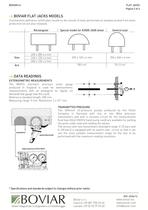
FLAT JACKS BOVIAR FLAT JACKS MODELS Commented calibration certificates issued on the results of tests performed on samples picked from every production lot are also released. DATA READINGS EXTENSOMETRIC MEASUREMENTS The MAYES mechanic precision produced in England is used for measurements with an analogical demand) dial gauge (see the card). Reference standard length: 200 mm. Measuring range: 5 mm. Resolution: 2x10" strain gauge TRANSMITTED PRESSURE Two different oil-pressure pumps produced by the Glotzl Company in Germany with one or two Wika precision manometers and with a recovery circuit...
Open the catalog to page 2All BOVIAR SRL catalogs and technical brochures
 GPR C-THRUE
4 Pages
 Stream X
4 Pages
 Stream C
4 Pages
 SRS SafeRailSystem
4 Pages
 OPERA DUO
4 Pages
 IBIS Guardian TrueVector
2 Pages
 RIS Hi-Pave
4 Pages
 FLAT JACK TESTING EQUIPMENT
6 Pages
 Quick Beton
2 Pages
 IBIS-FB
2 Pages
 Leica Pegasus:Stream
2 Pages
 RIS MF Hi-Mod
4 Pages
 RIS One & RIS Plus
4 Pages
 RIS HI-BRIGHT
4 Pages
 PIT-PILE INTEGRITY TEST
2 Pages
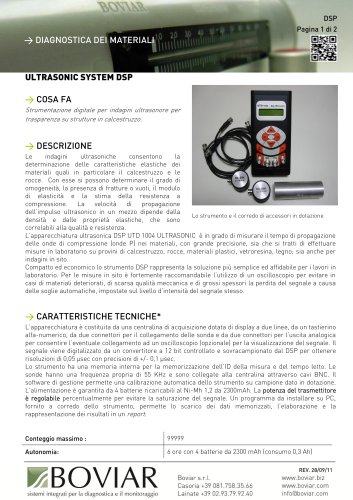 DSP ultrasonic system
2 Pages
 Digital crackmeter
1 Page


Archived catalogs
- Automation software solution
- Management software solution
- Analysis software solution
- Cloud-based software
- Monitoring software solution
- Interface software
- Visualization software solution
- Manual test equipment
- Portable test equipment
- Data acquisition unit
- High-performance software
- Data analysis software
- Digital test equipment
- Storage software
- Extensometer
- Compact test kit
- SCADA software
- Web browser software
- Electrical resistance test kit