
- Catalogs
- Bordo Industrial Pty ltd
- Bordo Buyer

Bordo Buyer

Bordo Buyer
- Delta Point Drills: These drills feature a unique multi-faceted cutting tip, offering faster drilling and longer lifespan compared to conventional drills. They are suitable for various materials including ferrous and non-ferrous metals, timber, and plastics.
- Jobber Drills: Available in metric and fractional sizes, these drills are designed for high performance and durability.
- Impact Driver Hex Shank Accessories: Includes a variety of drills and countersinks designed for use with impact drivers.
- 135º Split Point: Ideal for harder steel materials and deep hole applications, offering faster penetration and reduced abrasion.
- 118º Split Point: Suitable for mild steel and cast iron, providing self-centering and reduced friction.
- Bright Finish: No surface treatment, suitable for non-ferrous applications.
- Black Finish: Steam tempered for ferrous applications, aiding in chip flow and heat dissipation.
- Bronze Finish: Used for cobalt tools, providing identification and increased tool life.
1. Black Finish Tools: Recommended for ferrous applications, the oxide layer aids in chip flow and heat dissipation, enhancing tool life.
2. Violet/Grey Finish (TiAlN): This coating offers higher hardness and oxidation stability due to a thin aluminium oxide film. It is suitable for high-temperature operations, increasing speeds and feeds, especially useful for machining cast iron and tough steels.
1. Panel Drills: Used in sheet metal fabrication for drilling rivet holes. They are designed for shallow holes and require tight chuck jaws to prevent damage.
2. Centre Drills: Used with lathes for centering stock and starting holes in milling machines. They provide a bearing surface for lathe centers.
3. Spotting Drills: Designed for creating precise spot holes to prevent twist drill wandering.
4. Spot Weld Drills: Ideal for vehicle body repairs, designed to cut through spot welds efficiently.
1. High-Speed Steel (HSS): Commonly used for various drill types due to its durability.
2. Tungsten Carbide: Known for its hardness and abrasion resistance, suitable for machining hard materials like ceramics and stainless steel.
3. TiAlN Coating: Provides high performance in high-temperature environments, extending tool life.
1. Lubrication: Essential for extending tool life, particularly in drilling operations involving hard materials.
2. Drill Point Types: 135° split points are recommended for harder steels, while 118° notched points are suitable for general-purpose drilling in various materials.
- Designed for optimal lubrication to extend drill life and performance.
- Effective in hard materials by grinding rather than drilling.
- Specifications include cutter sizes from 5.0 to 24.0mm with varying rotation speeds.
- Ideal for repetitive drilling in thin materials like steel and plastic.
- Made from high-speed steel with double fluted edges.
- Benefits include no pilot hole requirement, easy sharpening, and burr-free drilling.
- Coated with Titanium Aluminium Nitride (TiAlN) for high-temperature resistance.
- Manufactured from HSS-Co5 steel, enhancing heat resistance and tool life.
- Convert standard round shank drills to 1/4” hex shank for quick change adaptors.
- Guidelines for use include selecting the correct size and securing the drill with a spanner.
- Available in various types including cross hole, single, and triple flute.
- Designed for use in timber and plastics, not suitable for metal.
- Tools made from materials like HSS, HSS-Co5, and Tungsten Carbide.
- Coatings such as TiAlN provide enhanced performance in high-temperature environments.
- Products are available in various packaging options including injection molded cases and clam shells.
- Pricing details are provided for individual items and sets.
- Auger bits are made from high carbon steel with bright or black surface finishes.
- Power-Bore drills are constructed from HSS for extreme performance.
- Quad Max cutters and self-feeding wood bits are forged from high carbon steel for maximum strength.
- Products are available in various packaging options including hang tubes and clam shells.
- Merchandiser options are available for different product lines, providing organized displays for retail environments.
- Auger bits are suitable for a range of wood types and applications, including deep hole drilling and use in timber with strong grain.
- Recommended speeds for Quad Max cutters vary by size, ensuring optimal performance and finish.
Bordo SDS Vacuum Masonry Drill Bits are designed to reduce airborne silica dust by extracting it at the point of drilling. The drill bits feature holes at the tip and a hollow shaft design for efficient dust extraction, enhancing productivity by eliminating the need for the traditional "blow-brush-blow" method. The quad cutter tungsten carbide tip ensures durability in both standard concrete and concrete with embedded rebar. A universal vacuum adapter fits most common dust extractor attachments.
Specifications:
- Material: Chrome, Nickel, Moly Steel Alloy
- Shank Type: SDS Plus, SDS Max
- Surface Finish: Sheet Peened
- Packaging: Hang Tab
Product Variants:
The document lists various drill bit sizes, types, and their corresponding part numbers and prices. For example, a 250mm point type drill bit is priced at $33.94 with part number 2546-PX250.
Countersinks:
All Bordo Countersinks are made from 100% M35 cobalt high-speed steel, offering increased wear and heat resistance. Titanium Nitride (TiN) Coated Countersinks have a hard gold-colored surface finish, reducing friction and increasing tool life. The document details different types of countersinks, including single flute, triple flute, and cross hole, each suited for various materials and applications.
Merchandiser Contents:
The document includes a list of merchandiser contents with part numbers and prices for countersinks and step drills, indicating the variety of tools available for different drilling and countersinking needs.
- Materials: Most products are made from chrome alloy, known for its durability and resistance to wear.
- Thread Types: The document covers several thread types, including Metric Coarse, Metric Fine, BSW, BSF, BSP, BSPT, and NPT, each with specific applications and characteristics.
- Dimensions: Detailed dimensions are provided for each product, including diameter, pitch, and overall length.
- BSW: Developed by Sir Joseph Whitworth in 1841, featuring rounded roots and crests with a 55º thread angle.
- BSF: A finer version of BSW, introduced in 1908, offering greater tensile stress area and resistance to stripping.
- BSP/BSPT: Used for mechanical coupling and sealing pipe ends, with a 55º thread angle.
- NPT: A US standard for tapered threads, requiring thread seal tape or compound for leak prevention.
- Includes detailed tables listing product numbers, dimensions, and prices for various taps and dies.
- Products are categorized by type (e.g., button dies, die nuts) and thread form (e.g., Metric Coarse, Metric Fine).
- Taper Taps: Used for starting threads in difficult or high-precision holes.
- Intermediate Taps: Suitable for general-purpose applications.
- Bottoming Taps: Used for tapping to the bottom of blind holes, typically following a taper or intermediate tap.
- Products are available in various packaging options, including clam shell and bulk merchandiser packs.
- Merchandiser sets include a variety of taps and dies, providing a comprehensive solution for threading needs.
- Metric Threads: These are specified by diameter and pitch, commonly measured in millimeters. The document highlights the benefits of larger root radius and lower thread height for increased strength.
- UNC Threads: Introduced in 1948, these threads are standardized in the USA, Canada, and the UK. They are described by major diameter and threads per inch (TPI), suitable for lower tensile strength materials.
- UNF Threads: Similar to UNC but with a finer pitch, offering greater tensile stress area and better resistance to stripping.
- UNEF Threads: A subset of UNF with more TPI, used where high stress is encountered.
- UNS Threads: Special threads with more TPI than standard UNF or UNEF, used in high-stress applications.
- Taper Taps: Used as starting taps with a lead of eight threads, suitable for medium tensile materials.
- Intermediate Taps: General-purpose taps with a lead of four threads, used for cutting threads true to a pre-drilled hole.
- Bottoming Taps: Used for minimum thread run-out in blind holes, typically following a taper or intermediate tap.
- Taper Taps: These have a lead of eight threads and are used as starting taps in difficult or high precision holes. They are made from high-speed steel (HSS) and are suitable for medium tensile materials.
- Intermediate Taps: With a lead of four threads, these are used for general-purpose applications to cut threads true to a pre-drilled pilot hole.
- Bottoming Taps: Featuring a lead of two threads, these ensure minimum thread run-out when tapping to the bottom of a blind hole. They are typically used after a taper or intermediate tap.
- These tools allow for drilling, tapping, and deburring in one operation, saving time and ensuring the correct drill size for the tap. They are made of high-speed steel for durability.
- Various types of tap wrenches are available, including bar pattern and T-pattern wrenches, suitable for different tap sizes and applications.
- Several cutting fluids are offered, including Slick DTR, Goliath Semi-Synthetic, Relton Rapid Tap, and A-9 Aluminium Cutting Fluid. These fluids are designed to extend tool life and improve performance.
- The document includes detailed specifications for each product, including size, thread form, material, and pricing.
- For more information, Bordo Industrial Tools can be contacted via email at [email protected] or through their website www.bordo.com.au.
- Material: Tungsten Carbide
- Surface Finish: Bright
- Types: Express Cut, Non-Ferrous Cut
- Styles: Cylindrical, Cylindrical with Ball Nose, Ball, Oval, Tree Radius Nose, 14º Included Angle, Pointed Cone, Inverted Taper
- Packaging: Hang Pack, Telepack, Injection Molded Case
- Harder materials require slower running speeds.
- Smaller burrs require faster running speeds.
- Long shank burrs require slower speeds for safety reasons.
- Apply constant movement and light pressure when using the burr.
- Running below the optimum speed will cause chipping, while running above it will cause premature tooth wear.
- Allowing the burr to become too hot may cause the braze to soften, leading to the head detaching from the shank.
- Using worn tools and collets will cause chipping.
- Do not sink the burr for more than one third of its periphery.
- Material: Tungsten Carbide Tipped
- Features: Heavy-duty construction with abrasion-resistant teeth for cutting materials that dull normal saws quickly. Large gullets for easy slug removal.
- Applications: Suitable for cutting timber, composite boards, MDF, wood laminates, plywood, insulation, and fiber cement sheets.
- Packaging: Available in blow-molded kit boxes and merchandisers.
- Material: Vacuum Brazed Diamond
- Features: Strong bond between diamond particles and saw, superior performance, and longer life than traditional saws. Slotted cutting edge for water entry to extend tool life.
- Applications: Ideal for cutting ceramics, tiles, porcelain, and stone. Can be used with angle grinders and drills.
- Packaging: Available in hang boxes and merchandisers.
- Material: Tungsten Carbide Grit
- Features: No teeth to dull or chip, high heat and abrasion resistance, smooth cutting, and high wear resistance.
- Applications: Recommended for cutting laminates, fiberglass, ceramic tile, marble, slate, cast iron, and fiber cement sheets.
- Packaging: Available in hang boxes and merchandisers.
- Material: Tungsten Carbide Grit
- Features: Hard-wearing, smooth cutting edge, high heat and abrasion resistance.
- Applications: Suitable for cutting plasterboard, fiber cement sheet, and composites.
- Includes replacement blades, pilot drills, and mandrels suitable for various hole saws.
XP2 TCT hole saws are designed with 3-edged cutters to balance cutting effort, providing smoother boring, greater control, and reduced drag. They are particularly suitable for curved surfaces like metal pipes due to their deep body design.
- Non-uniform separation of tungsten carbide teeth and integrated mandrel minimizes vibration.
- Long service life without the need for cutting fluids.
- Equipped with a heavy-duty plug ejector spring.
- Ideal for repetitive cutting in steel plate, stainless steel plate, sheet metal, and other hard or abrasive materials.
- Steel: 23mm
- Stainless Steel: 3mm+
- Aluminium: 3mm+
The document provides a detailed table listing the diameter, pack quantity, price, and part numbers for various sizes of hole saws, ranging from 12mm to 60mm.
Annular cutters are designed for burr-free finished holes without pre-drilling. They are faster and more accurate than standard HSS twist drills, featuring CNC ground multi-cut geometry for smooth and fast cutting. The precision ground flutes ensure efficient chip removal.
- Increased cutting speed and reduced tooth load.
- Minimized tool wear and extended tool life.
- Close tolerance drilling without runout, producing reamed quality, burr-free finished holes.
- Resharpenable and compatible with most standard machines.
These pins perform centering, allow cutting lubricant flow, and facilitate slug ejection. They are sold separately and available in various sizes.
- Diameter: 160mm to 355mm
- Tooth Count: Varies by blade type
- Kerf Thickness: Ranges from 1.8mm to 3.2mm
- Body Thickness: Ranges from 1.2mm to 2.4mm
- Bore Sizes: Multiple options available
- Tradecut: High-performance blades for timber, featuring anti-kickback tooth shoulders and diamond ground carbide teeth for improved cutting efficiency.
- Opticut: Precision thin kerf blades for smooth cutting in timber, with a focus on reduced stock wastage and crisp cuts.
- Rapidcut: Designed for fibre cement and composite timber, offering fast cutting with low dust production.
- Multicut: Versatile blades suitable for cutting timber, steel, aluminium, and other materials, featuring titanium carbide teeth for long life.
- Alucut: Specialized for aluminium and non-ferrous metals, with triple chip tungsten carbide teeth for smooth cutting.
- Heavy-duty anti-kickback tooth shoulders for safety and performance.
- Fully hardened and tempered steel bodies to resist warping.
- Corrosion-resistant coatings for extended blade life.
- Precision balanced for smooth operation.
- SE10 Swivel Blade: Heavy-duty HSS blade for deburring materials with spiral chips. Available in TiN coated and cobalt versions for extended life and durability.
- SE111 Swivel Blade: Thin-nosed HSS blade suitable for holes with a minimum diameter of 1.5mm.
- SE20 and SE35 Swivel Blades: Designed for materials with powdery chips, suitable for right and left-hand use.
- NB Series Blades: Standard HSS blades for various deburring applications, including spiral and powdery chip materials.
- Scraper Blades (C40, C42): Triangular HSS blades for precision cleaning and deburring.
- Countersink Blades (F20, F30): HSS two-flute countersinks for deburring and chamfering holes up to 30mm in diameter.
- Specialty Blades (D80, G10, G30C, R10, K10): Tungsten carbide and HSS blades for specific applications such as sheet metal, slots, corners, and flat surfaces.
- Products are available in clam shell packs, bulk per blade, and display boxes.
- Pricing varies based on packaging type and blade specifications, with detailed part numbers provided for ordering.
- Blades are suitable for use on a variety of materials including steel, aluminum, copper, brass, stainless steel, cast iron, and plastics.
- Specific applications include straight edge, hole edge, cross hole, and back edge deburring.
- Counter displays and wall mounts are available for showcasing the most popular deburrers and blades.
- Merchandiser contents include a selection of swivel deburrers, telescopic deburrers, scraper deburrers, and countersink deburrers.
- Blade changing tools and adaptors are available for both SE heavy-duty and NB standard blades.
- Extensions and guards are offered for various blade types to enhance usability and safety.
1. Helix Angle: The angle formed by the leading edge of the land and the plane containing the axis of the drill.
2. Land: The peripheral portion of the body between adjacent flutes.
3. Lead of Helix: The distance measured parallel to the axis between corresponding points on the leading edge of the land in one turn of the drill.
4. Lip Clearance Angle: The angle formed between the outer corner of the lip and a plane at right angles to the axis of the drill.
5. Lips: The cutting edges of a two flute drill extending from the chisel edge to the periphery of the drill.
6. Overall Length: The total length measured from the extreme point to the end of the shank.
7. Point: The sharpened end of the drill comprising the cutting lips, chisel edge, lands, and the web.
8. Point Angle: The included angle between the cutting lips.
9. Relative Lip Height: The relative position of the lips measured at the outer corners in a direction parallel to the drill axis.
10. Recess: The section of reduced diameter between the shank and the body of a drill.
11. Shank: The part of the drill by which it is held and driven.
12. Tang: The flattened end of a taper shank intended to fit into a driving slot in a socket.
13. Web (Core): The central portion of the drill that joins the land. The end of the web forms the chisel edge on a two flute drill.
14. Web (Core) Thickness: The minimum dimension of the web measured at the point of the drill.
1. Steel ≤500 N/mm²: Feed rates range from 35-45 mm/min with RPMs from 1250 to 430 depending on the diameter.
2. Steel 500–800 N/mm²: Feed rates range from 20-30 mm/min with RPMs from 800 to 260.
3. Steel 800–1000 N/mm²: Feed rates range from 15-20 mm/min with RPMs from 520 to 180.
4. Stainless Steel 1000–1300 N/mm²: Feed rates range from 12-15 mm/min with RPMs from 380 to 140.
5. Cast Iron: Feed rates range from 15-25 mm/min with RPMs from 1200 to 210.
6. Aluminium: Feed rates range from 50-60 mm/min with RPMs from 1600 to 600.
7. Brass/Bronze: Feed rates range from 20-30 mm/min with RPMs from 1200 to 260.
8. Copper: Feed rates range from 20-30 mm/min with RPMs from 800 to 260.
9. Laminates: Feed rates range from 50-100 mm/min with RPMs from 3200 to 1000.
10. Plastics: Feed rates range from 50-100 mm/min with RPMs from 3200 to 1000.
1. Mild Steel (<700 N/mm²): Feed rates range from 20-25 mm/min with RPMs from 1900 to 600.
2. Mild Steel (>700 N/mm²): Feed rates range from 16-20 mm/min with RPMs from 1500 to 500.
3. Alloy Steel (1000 N/mm²): Feed rates range from 10-16 mm/min with RPMs from 1500 to 500.
4. Cast Iron (<250 N/mm²): Feed rates range from 12-25 mm/min with RPMs from 1190 to 400.
5. Cast Iron (>250 N/mm²): Feed rates range from 8-12 mm/min with RPMs from 800 to 230.
6. Stainless Steel: Feed rates range from 5-12 mm/min with RPMs from 500 to 300.
7. Aluminium Alloy (<11% Si): Feed rates range from 10-16 mm/min with RPMs from 1990 to 550.
8. Thermoplastic: Feed rates range from 12-25 mm/min with RPMs from 1590 to 450.
9. Wood: Feed rates range from 40-100 mm/min with RPMs from 3000 to 1000.
1. Cutting Speeds and Feeds for M2 HSS Step Drills: Specific RPM and feed rates are provided for various materials and drill sizes.
2. Cutting Speeds and Feeds for HSS-Co5 Bright Finish Countersinks: Example provided for countersinking in Stainless Steel with specific SMM, feed rate, and RPM.
3. Metric Coarse and Fine (ISO) Specifications: Detailed tables with diameter, pitch, overall length, and drill sizes.
4. British Standard Pipe (BSPF and BSPT) and National Pipe Thread (NPT) Specifications: Tables with diameter, TPI, overall length, and drill sizes.
5. Unified National Fine (UNF) and Coarse (UNC) Specifications: Tables with diameter, TPI, overall length, and drill sizes.
6. British Standard Whitworth (BSW) and Fine (BSF) Specifications: Tables with diameter, TPI, overall length, and drill sizes.
7. Unified National Extra Fine (UNEF) and Dryseal (NPSF and NPTF) Specifications: Tables with diameter, TPI, overall length, and drill sizes.
1. Grit Edge Hole Saws: RPM speeds for various materials like brick, ceramic, slate, and reinforced plastics.
2. Tungsten Carbide Burr Speeds: Recommended operating speeds for different materials and burr head diameters.
3. Vx Cobalt Bi-Metal Hole Saw Speeds: RPM speeds for materials like mild steel, tool steel, stainless steel, cast iron, brass, and aluminium.
4. Annular Cutter Speeds: Surface metres per minute speeds for various materials including magnesium, aluminium, brass, bronze, and different types of steel.
Reaming speeds should be approximately half of those used for drilling the same material. High-speed steel reamers have specific speed guidelines, while carbide or diamond-tipped reamers can operate faster. For close tolerances and fine finishes, slower speeds are necessary. Feeds in reaming are generally higher than drilling, ranging from 0.04MM to 0.10MM per flute per revolution. The goal is to use the highest feed possible while maintaining required finish and accuracy.
Reamer Tolerances:
Bordo reamers are designed to produce holes to H7 tolerance. The tolerance limits vary based on the nominal reamer diameter, with specific increments provided for different diameter ranges.
Conditions of Sale:
Prices exclude GST and are subject to change. Orders over $250 are freight-free, while those under incur delivery costs. Payment is due within 30 days from the invoice month-end. Bordo is not liable for delivery delays or damages unless specified. Goods must be returned within 14 days for credit, with a 15% restocking fee for correctly supplied items.
Credit Information and Retention of Title:
Bordo may obtain credit information for assessing applications. Title to goods remains with Bordo until full payment is received. Customers must keep goods separate and maintain Bordo's labeling.
Personal Property Securities Act (PPSA):
The PPSA applies to these terms, with Bordo holding a security interest in goods supplied. Customers must assist in maintaining this interest.
Credits/Returns Policy:
Authorization is required for returns. Goods must be returned freight paid within 14 days, with a restocking fee for correctly supplied items. Warranty returns require a Return Authorization Number and are the customer's responsibility for transport costs.
Liability:
Bordo's liability is limited to statutory guarantees under the ACL. They are not liable for indirect or consequential losses. Customers must ensure goods are suitable for their use.
Disclaimer:
Bordo accepts no liability for loss or damage from the use of information or products. All information is believed accurate at the time of printing.
- Goods returned with no fault found may incur a minimum administration fee of $25.00 plus GST per item.
- All credit requests must be directed to your account/sales representative or Bordo Customer Service.
- Returned goods must have a Return Authorisation Number (RA) to be processed.
- Non-stock items specifically ordered are not eligible for credit.
- Credit issuance is at Bordo International's discretion, and re-stocking fees may apply.
- Goods must be returned unopened, undamaged, and in original packaging within 14 days of receipt.
- Transport charges are the customer's responsibility unless otherwise agreed in writing.
- Available in military standards MA3279, MA3280, MA3281, NASM122076–124850, MA3329, MA3330, MA3331, and NASM21209.
- Includes Drill, STI Tap, Inserts, Installation Tool, and Tang Break-Off Tool.
- Features over 140 Thread Repair Kits with various thread forms and tools.
- Benefits include lighter and cheaper inserts, improved thread strength, and reduced wear due to friction.
- Products are sold to distributors only.
- Design features include stackable cases, full-color labels, and flexible rubber tool holders.
- Includes hanger slide latch for secure display and internal ribs for insert storage.
- Bordo International is committed to excellence in industrial cutting tools and threading products.
- Founded in 1987, it remains a 100% family-owned Australian company.
- Mission is to provide high-quality, reliable cutting tools and unmatched service.
- Offers a comprehensive range of industrial cutting tools and power tool accessories.
- Committed to improving and expanding product range with high service levels.
- Supported by technical and production experts to meet customer specifications.
- Maintains a 'quality without compromise' ethos, sourcing from the world's finest manufacturers.
- Ensures reliable and competitive products for customers.
Catalog excerpts

All prices in this Bordo Buyer’s Guide are shown in AUSTRALIAN DOLLARS and exclude GST. Prices throughout this document are ‘recommended retail prices’ and there is no obligation for distributors or retailers to comply with the pricing recommendations. Bordo International continues to make a significant commitment to environmental awareness and sustainability. Wherever possible we avoid creating emissions, we continue to reduce the emissions that we make and we offset the emissions that we can’t avoid. • Wherever possible we utilise recyclable packing and implement a strict recycling program...
Open the catalog to page 2
Jobber Drills Metric - Delta Point2 Jobber Drills Metric6 Jobber Drills Fractional9 Jobber Drills Gauge10 Jobber Drills Bulk Merchandisers11 Jobber Drills Clam Shell & Trade Packs Metric 15 Jobber Drills Clam Shell Metric Merchandisers 16 Jobber Drills Clam Shell & Trade Packs Fractional 18 Jobber Drills Clam Shell Fractional Merchandisers 19 Jobber Drill Sets and Refill Sets20 Jobber Drill Set Caddies24 Reduced Shank Drills and Drill Sets25 Long Series Drills20 Extra Long Drills31 Extra Deep Hole Drills33 Aircraft (Long Reach) Drills30 Colour Band Drills34 Stub Drills40 Panel Drills40 Centre...
Open the catalog to page 3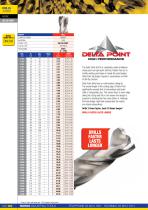
* Sizes 2.5mm and below are 135° standard chisel point. The Delta Point drill bit is completely unlike traditional chisel point and split point drill bits. Rather than try to modify existing point types or tweak the grind angles, Delta Point tip design required a revolutionary re-think of drill tip function. Delta Point drills have a multi-faceted cutting tip. The overall length of the cutting edge of Delta Point significantly exceeds that of conventional split point drills of comparable size. This means there is more edge doing the cutting and this is one reason the design is superior to anything...
Open the catalog to page 4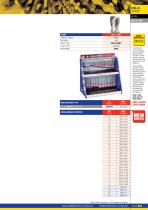
GROUP DELT / PANL SURFACE FINISH POINT TYPE DELTA POINT* FLUTE TYPE BULK MERCHANDISER TYPE METRIC BRIGHT 230 PIECES MERCHANDISER CONTENTS QTY EACH * Sizes 2.5mm and below are 135° standard chisel point. DRILLS JOBBER METRIC DELTA POINT DIN338 The productivity gains from a Delta Point drill speak for themselves, but what about drill bit life? During independent drill bit lifetime testing, using 20mm mild steel plate as a reference material, Delta Point drill bits drilled ten times more holes than conventional split point drill bits. Drills 2 times faster, lasts 10 times longer! DRILLS FASTER LASTS...
Open the catalog to page 5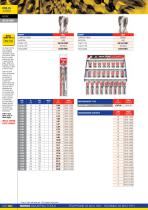
The Delta Point drill bit is completely unlike traditional chisel point and split point drill bits. Rather than try to modify existing point types or tweak the grind angles, Delta Point tip design required a revolutionary re-think of drill tip function. Delta Point drills have a multi-faceted cutting tip. The overall length of the cutting edge of Delta Point significantly exceeds that of conventional split point drills of comparable size. This means there is more edge doing the cutting and this is one reason the design is superior to anything that has come before it. Although the final design...
Open the catalog to page 6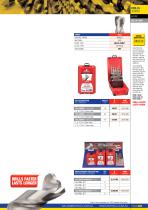
SURFACE FINISH MATERIAL POINT TYPE FLUTE TYPE PACKAGING BRIGHT HSS DELTA POINT* 30° HELIX SET DRILLS JOBBER METRIC DELTA POINT METRIC JOBBER DRILLS DIN338 Delta Point drills are nearly twice as fast as conventional split point drills in mild steel. The time savings in stainless steel, aluminium and wood are even more significant. The productivity gains from a Delta Point drill speak for themselves, but what about drill bit life? During independent drill bit lifetime testing, using 20mm mild steel plate as a reference material, Delta Point drill bits drilled ten times more holes than conventional...
Open the catalog to page 7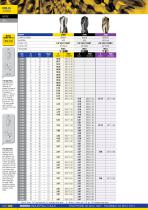
METRIC BULK 118° Split Point (crankshaft point) Split point is self centering and reduces the need for end thrust. Friction at workpiece is reduced. 118° point angles are ideal for use in materials such as mild steel and cast iron. The 118° point creates easily controlled chips which are wide and thin. 135° Split Point (crankshaft point) Split point is self centering and the short distance from the drill axis to the outer corners results in faster penetration, reducing the need for end thrust. The 135° point should be used to cut harder steel materials especially in deep hole applications. In...
Open the catalog to page 8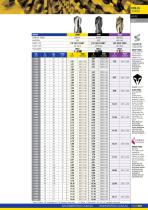
* Sizes 3.40mm, 1/8" and below are 118° standard chisel point. t 1.00mm, 1.50mm and 1/16" are 135° standard chisel point. BLACK FINISH (also called blue finish) A black finish is achieved by steam tempering, athermal process resulting in a porous tool coating. This surface helps to keep lubricant on the tool, earticulsrly importantonthe cutting ecOGhus reducing friction and cold welding. The result is increased tool life. Black finish tools are generally recommended for ferrous applications where the oxide ® layereidschiuflow and heat dissipation. BRONZE FINISH (gold oxide) This metallic brown coloured...
Open the catalog to page 9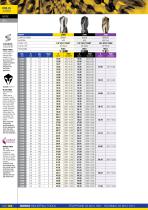
DRILLS JOBBER METRIC BULK QUICK SILVER BRIGHT FINISH A bright finish tool has no surface treatment and is COBALT supplied in the TOUGH as-ground condition. These tools are suitable for general purpose use, particularly for non-ferrous applications. BLACK FINISH (also called blue finish) A black finish is achieved by steam tempering, a thermal QUICK process resulting®in a SILVER porous tool coating. This surface helps to keep lubricant on the tool, particularly COBALT important on the TOUGH cutting edges, thus reducing friction and ® BLACK KNIGHT cold welding. The result is increased tool life. Black...
Open the catalog to page 10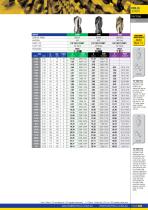
118° Split Point (crankshaft point) Split point is self centering and reduces the need for end thrust. Friction at workpiece is reduced. 118° point angles are ideal for use in materials such as mild steel and cast iron. The 118° point creates easily controlled chips which are wide and thin. 135° Split Point (crankshaft point) Split point is self centering and the short distance from the drill axis to the outer corners results in faster penetration, reducing the need for end thrust. The 135° point should be used to cut harder steel materials especially in deep hole applications. In these situations...
Open the catalog to page 11All Bordo Industrial Pty ltd catalogs and technical brochures
 Buyers guide 03/2016
316 Pages


- Solid milling cutter
- Steel milling cutter
- Solid drill bit
- Metal milling cutter
- Clamping milling cutter
- Milling cutter with cylindrical shank
- Cast iron milling cutter
- Ball nose milling cutter
- Multi-purpose drilling tool
- Metal saw blade
- High-speed steel drill bit
- Aluminum milling cutter
- Stainless steel milling cutter
- Carbide saw blade
- Wood saw blade
- Steel drill bit