

Balanced Receivers

1 / 8 PagesView full catalog
Balanced Receivers
Product catalog summary
Overview: This document provides comprehensive specifications and operational details for various models of auto-balanced photoreceivers. These devices are engineered to minimize laser noise and improve signal detection in optical experiments.
Specifications:
- Models 20X7: Includes Models 2007 and 2017, featuring a patented auto-balancing circuit that reduces laser noise by 50 dB. They support signal, balanced, and auto-balanced modes, with a 125 kHz bandwidth and a peak conversion gain of up to 1×10⁶ V/W.
- Models 23X7: Large-area balanced photoreceivers with adjustable gain settings, reducing common-mode noise by 40 dB, suitable for coherent heterodyne-detection applications.
- Models 21X7: Higher-gain, lower-bandwidth photoreceivers with adjustable gain and bandwidth settings, offering a 25 dB noise reduction, ideal for Doppler LIDAR and OCT applications.
- Models 18X7: 80-MHz balanced photoreceivers with a 25 dB common-mode rejection ratio, suitable for high-frequency applications.
- 650-MHz & 800-MHz Models: Provide large bandwidths for various laboratory experiments, with a 25 dB common-mode rejection ratio.
Key Features:
- Auto-balancing circuit for noise reduction.
- Multiple operational modes for flexibility in different applications.
- Compatibility with both free-space and FC-fiber inputs.
- Adjustable gain and bandwidth settings for tailored performance.
Recommendations:
- Use the recommended Model 0901 power supply for safe operation.
- Select the specific model based on required bandwidth and application needs.
Graphical Data: Includes graphs demonstrating typical responsivity and noise reduction capabilities, emphasizing their effectiveness in reducing laser noise and enhancing signal clarity.
Additional Overview: Discusses the functionality and applications of balanced photoreceivers, focusing on models 1607-AC and 1617-AC, designed to cancel laser intensity noise and enhance sensitivity.
Additional Specifications: Operate by subtracting photocurrents from two matched photodetectors to cancel common-mode noise. Require manual power equalization between signal and reference beams. Key specifications include:
- Wavelength Range: 320–1000 nm (1607-AC), 900–1700 nm (1617-AC)
- 3-dB Bandwidth: 40 kHz–650 MHz (1607-AC), 40 kHz–800 MHz (1617-AC)
- Peak Conversion Gain: 350 V/W (1607-AC), 700 V/W (1617-AC)
- Typical Maximum Responsivity: 0.5 A/W (1607-AC), 1.0 A/W (1617-AC)
- Power Requirements: ±15 V, <200 mA
Applications: Useful in absorption spectroscopy, heterodyne detection, and ellipsometric measurements, designed to detect small signals by cancelling residual intensity noise.
Design and Features: Feature free-space and FC-connectorized versions, high-bandwidth performance due to unique photodetector packaging, and a low-frequency feedback loop in the Nirvana™ auto-balanced photoreceiver for automatic DC balance.
Technical Insights: Highlights the use of the Nirvana™ photoreceiver in a laser-based atomic-absorption sensor for process control, demonstrating high sensitivity and specificity in real-time control applications.
Conclusion: Balanced photoreceivers provide significant advantages in noise cancellation and sensitivity enhancement, making them valuable tools in various optical measurement applications.
See more
Catalog excerpts
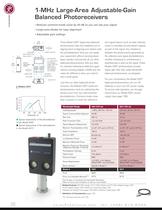
1.16" (29.5) battery check LED photodetectors2x 1.040-32 THDfor mounting Model 1280 Filter Holders and Model 1281 FC Fiber Adapters (not included) output BNCgain-setting switchpower switch 4.06"(103.1) external input power (15VDC) 1.00" (25.4)1.25" (31.8)0.585" (14.9)1.33" (33.8) 8-32 (M4) THD0.58" (14.7) Wavelength Range 4001070 nm 800֖1750 nm > Responsivity,A/W 0.00.20.40.60.81.0 3-dB Bandwidth > 1MHz, 200 kHz, 150 kHz 150 kHz, 30 kHz, 30 kHz > 400800120016002000 Typical Common-Mode Rejection 40 dB 40 dB Wavelength, nm Rise Time 500 ns 3.3 Ƶs > Peak Conversion Gain 1.2 10 > 6 V/W 1.6 ח 10 >...
Open the catalog to page 3All Bookham catalogs and technical brochures
 Explorer One Compact
3 Pages
 843-R
843-R2 Pages
 919P-003-10
2 Pages
 HXP100-ELECV6
2 Pages
 INT1-36-6-A
2 Pages
 15RP52-2
2 Pages
 R-30602
2 Pages


Archived catalogs
 Closed-loop Actuators
6 Pages
 Picomotor™ Actuators
6 Pages
 Beam-Position Photoreceivers
6 Pages
 Power Sensors
4 Pages
 Amplitude Modulators
2 Pages
 Phase Modulators
6 Pages
 Optical Choppers
2 Pages
 Single-Wavelength Lasers
4 Pages
 Multipurpose
6 Pages
 Swept Wavelength
4 Pages
 OEM Tunable Laser Modules
2 Pages


*Prices are pre-tax. They exclude delivery charges and customs duties and do not include additional charges for installation or activation options. Prices are indicative only and may vary by country, with changes to the cost of raw materials and exchange rates.
About DirectIndustry
DirectIndustry is a marketplace that offers B2B players a complete experience, from product sourcing to purchase. DirectIndustry is an entity of VirtualExpo Group.
Are you a buyer?
Are you a supplier?