
- Catalogs
- Bollegraaf Recycling Solutions
- Lubo Vibro-Air Sort


Lubo Vibro-Air Sort

Lubo Vibro-Air Sort
- Operating Voltage: 3x400 V, 50/60 Hz
- Electrical Power: 3.8 kW + 4 kW (fan)
- Adjustable Air Stream: 500 - 4500 m3
- Working Width: 900 mm
- Throughput: Up to 6 tons per hour
- Colour: RAL 7021 for both separation and fan units
- Compact construction for easy integration
- Low energy consumption of 7.8 kW
- Versatile for various industries
- Variable settings for effective separation
- Low investment cost
Catalog excerpts

Technical information sheet The Vibro-Air Sort is a smart and compact solution for the separation of fractions based on variations in specific gravity. For example, the Vibro-Air Sort is particularly suited to the removal of polystyrene contamination from sieve sand, or for applications in glass recycling for the removal of contamination by paper and films. Vibro-Air Sort® The system consists of a vibrating conveyor, of The compact construction ensures that the Vibro-Air which the angle is adjustable, linked to a blast Sort can be well-integrated into a new or existing nozzle with variable setting. sorting line. 2 vibration motors ensure the stable and reliable operation of the vibrating conveyor. Fine sieve sand often contains unwanted conta- Also due to the adjustable in-feed, there is a wide mination by insulation material which is released range of applications for the separation of contami- during demolition works. nated fractions. To upgrade this sieve sand in quality it must be purged of the contaminating light particles.
Open the catalog to page 1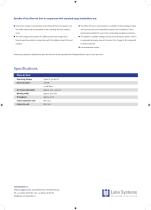
■ Due to the compact construction of the Vibro-Air Sort, the system can be swiftly and easily incorporated in both existing and new sorting lines. ■ The low energy consumption of 7.8kW ensures that energy costs remain very favourable in comparison with the added value of the end product. ■ The Vibro-Air Sort is very versatile. In addition to the purging of sieve sand (construction and demolition waste), the installation is also particularly suitable for use in the composting and glass industries. ■ The system's variable settings ensure that the fraction which is fed in is separated properly,...
Open the catalog to page 2All Bollegraaf Recycling Solutions catalogs and technical brochures
 corporate brochure
4 Pages
 PreZero
4 Pages
 Bollegraaf-ONE
2 Pages
 Lubo Elliptical XL
2 Pages
 Lubo Antares
4 Pages
 Lubo Commingled STARSCREEN
2 Pages
 BALERS 2014 FINAL
2 Pages
 Brochure_Plastics
8 Pages
 PaperSpike
2 Pages
 Lubo Glass Cleaning System
2 Pages
 The Neptunus
4 Pages
 Lubo Air Drum Separator
2 Pages
 HBC balers
5 Pages
 Corporate brochure Bollegraaf
19 Pages
 De-inking solutions
5 Pages



Archived catalogs
 Archive shredding solutions
5 Pages
 RoBB QC sorting robot
2 Pages
 PaperMagnet
2 Pages
 Glass Breaker Screen
2 Pages
 ONP StarScreen
2 Pages
 OCC StarScreen
2 Pages

- Transport rail conveyor
- Belt conveyor
- Monitoring analyzer
- Horizontal conveyor
- Solids separator
- Screening unit
- Solids analyser
- Process analyzer
- Feeder
- Baler
- Bulk material screening machine
- Continuous analyzer
- Roller conveyor
- Centrifugal classifier
- Sorting machine
- Real-time analyzer
- Chain conveyor
- Modular conveyor
- Cascade separator