


DS-2 dryer

DS-2 dryer
The BOGE DS-2 series represents a new generation of refrigerant dryers, emphasizing energy efficiency and reduced operating costs. These models are designed for global use with dual frequency capabilities (50/60 Hz) and are suitable for a wide range of ambient and inlet temperatures.
Key Features
- Digital Control: All models include digital control features such as status display, alarm contact, and maintenance reminders, which were previously optional.
- Efficient Drying: The series uses a high-efficiency aluminum heat exchanger, reducing refrigerant needs and minimizing performance losses.
- Bi-Frequency Design: Suitable for global use, accommodating both 50 Hz and 60 Hz frequencies.
- Energy Saving: Models with capacities of 2.6 m³/min and above offer additional energy-saving options under partial load conditions.
Technical Specifications
The series includes models with varying flow capacities, maximum pressures, and power consumption. For example, the DS 4-2 model has a flow capacity of 0.4 m³/min, while the DS 100-2 model offers up to 10 m³/min. All models are designed to facilitate easy maintenance with removable side panels.
Operating Principle
The integrated heat exchanger operates through a sequence of air/air and air/refrigerant sections, a demister condensate drain, and a moisture collection container. Condensate is discharged via an electronically regulated outlet.
Contact Information
BOGE Compressed Air Systems GmbH & Co. KG, Bielefeld, Germany. For more information, visit their website or contact them via phone or email.
Catalog excerpts

BOGE DS-2 – the new refrigerant dryer generation Outstanding efficiency meets top CO2balance! energyEven more economical with min ! saving option from 2,6 m³/ EFFICIENT DRYING The new DS-2 series features a high-efficiency aluminium heat e xchanger, which minimises performance losses in the refrigeration c ircuit while requiring less refrigerant than comparable ranges. In conjunction with economical power consumption this means that no other product can compete with the low running costs. BI-FREQUENCY DESIGN With these models it does not m atter where they are installed: O ffering dual frequency as standard, this series is designed for use all over the world – whether 50 or 60 Hz is required. Maximum flexibility is also ensured thanks to the wide range of recommended ambient temperatures (5 – 50° C) and inlet temperatures (5 – 65° C). ON A MISSION TO SAVE ENERGY Although all DS-2 models are extremely undemanding in terms of energy consumption under partial load, the models with capacities of 2.6 m³/min and above go one better: If required, they can reduce power consumption even further by cooling the compressed air entering the system by the mass of the heat exchanger in partial load mode. DIGITAL CONTROL All models in the new series come with digital control, including f unctions that were previously s ubject to an extra charge in some cases. However, in everyday operation they soon pay for themselves – such as the status display, the p otential-free alarm contact or the m
Open the catalog to page 1
The new DS-2 series from BOGE has now raised the bar for refrigerant dryers: Thanks to the fully integrated design of its highly efficient heat exchanger, the DS-2 upstages all other refrigerant dryers in terms of energy efficiency -with significantly reduced refrigerant consumption. The overall operating costs are indeed unbeatable, and the CO2 balance isn‘t to be sneezed either. And it‘s not by chance that the new DS-2 models are designed for both 50 and 60 Hz (230 V) - there is no problem about using them anywhere in the world. BOGE Compressed Air Systems GmbH & Co. KG P. O. Box 10 07 13 ■...
Open the catalog to page 2All BOGE catalogs and technical brochures
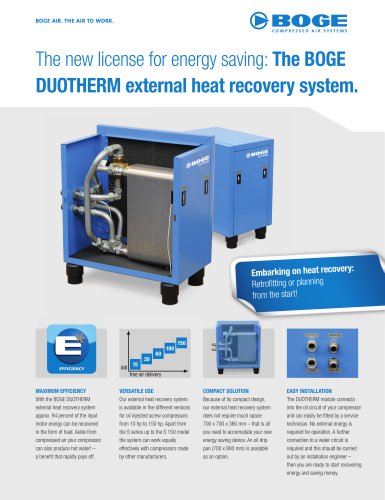 BOGE DUOTHERM
2 Pages
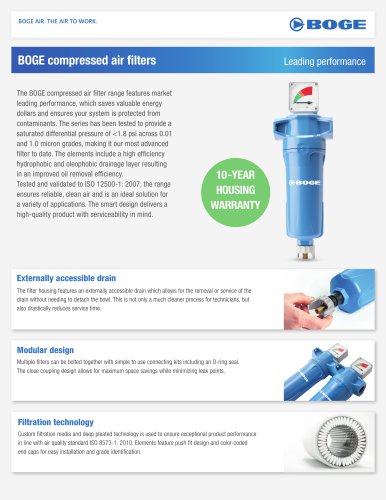 BOGE compressed air filters
2 Pages
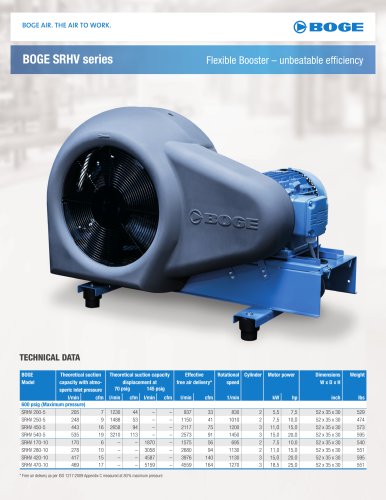 BOGE SRHV series
1 Page
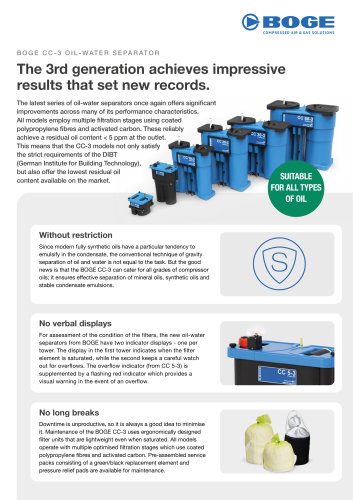 BOGE CC-3
2 Pages
 C- 2 SERIES
7 Pages
 BOGE DS-2 Refrigerant Dryers
2 Pages
 BOGE Condensate Drain CCD
2 Pages
 SCREW COMPRESSORS C - USA
20 Pages
 BOGE - Duotherm
2 Pages

Archived catalogs
 BOGE Filter
2 Pages
 BOGE Refrigerant Dryers
2 Pages
 BOGE CC Oil Water Seperator
2 Pages
 BOGE cyclone separator
2 Pages
 ACTIVATED CARBON ADSORBER
2 Pages
 Air treatement dryers
20 Pages
 SCREW COMPRESSORS OIL-FREE
12 Pages
 Po series
8 Pages
 EO Series
4 Pages
 BOGE SRMV / SRHV series
7 Pages
 NITROGEN GENERATOR
4 Pages
 BOGE LPT 150
4 Pages
 BOGE S- 4 Series
7 Pages
 BOGE C series
7 Pages
 BOGE - CONVERTER BLUEKAT
2 Pages
 AIRTELLIGENCE PROVIS 3.0
5 Pages
 PISTON COMPRESSORS
20 Pages
 Product portfolio EN
4 Pages
 BOGE C PM series
3 Pages
 DASZ-P
2 Pages
 S-3 New generation
8 Pages
 AIRTELLIGENCE PLUS_2016
2 Pages
 SCREW COMPRESSORS C
24 Pages
 BOGE COMPRESSED AIR TREATMENT
36 Pages
 Marine Compressors
4 Pages
 BOGE BLUEKAT
4 Pages
 BOGE PO Snow
2 Pages
 BOGE Genuine Parts
4 Pages
 PLANT ENGINEERING
8 Pages
 Energy Efficient Solutions
20 Pages
 BOGE - The Company
22 Pages
 BOGE airstatus
2 Pages
 FLEXPET BFPO
2 Pages
 C4 - C15 DR
2 Pages


- BOGE compressor
- Vessel
- BOGE air compressor
- BOGE positive-displacement compressor
- BOGE stationary compressor
- BOGE industrial compressor
- BOGE electrically-powered compressor
- BOGE piston compressor
- Filter with cartridge
- Metal tank
- BOGE lubricated compressor
- BOGE oil-free compressor
- Pressure separator filter
- BOGE compact compressor
- BOGE screw compressor
- Stainless steel pre-filter
- Centrifugal classifier
- Vertical tank
- Liquids separator
- Filter housing