
- Catalogs
- Böllhoff Verbindungstechnik GmbH
- WELTAC® Resistance element welding

WELTAC® Resistance element welding

WELTAC® Resistance element welding
WELTAC® is a resistance element welding technology designed for modern multi-material designs, enabling the joining of lightweight materials such as aluminum, sandwich materials, and polymers with steel. It is compatible with existing spot welding systems, providing flexibility and reliability in body construction.
The WELTAC® process involves a two-stage method: punching in the element and welding. It is particularly suited for car bodies with multi-material designs, overcoming the limitations of traditional resistance spot welding.
WELTAC® offers high-strength joints, compatibility with existing spot welding equipment, a wide application range for various material qualities and thicknesses, and compatibility with RIVSET® systems. It also supports prototypical component production with portable tools.
WELTAC® supports a wide range of material combinations, including aluminum sheets, extruded profiles, die castings, and various steel types, accommodating different material thicknesses and combinations.
The standard portfolio includes six geometry variants with varying shank lengths, diameters, and head heights to meet different mechanical joint requirements. Elements are heat-treated and surface-coated for durability.
WELTAC® provides robust joint qualities, capable of handling shear loads and cross-tension effectively, ensuring reliable performance in various applications.
This technology is ideal for body construction, allowing the joining of aluminum car body parts with steel structures, including side panels, roofs, and structural components like C- and D-pillars.
The system is modular, allowing configuration for specific requirements and supporting various joining processes. It is designed for high productivity, energy efficiency, and minimal maintenance.
Key components include setting tools with electrical control, modular C-frames, and advanced control units, supporting efficient element feeding and processing.
Böllhoff offers comprehensive support through sales, product and project management, design and development, and production. The company emphasizes innovation, technical potential, and customer satisfaction, with a global presence across four continents.
Böllhoff offers practical training programs in a modern training center, featuring machine presentations, robot cell training, and a combination of theory and practice. The training is designed for equipment manufacturers, service personnel, and experts.
The company provides comprehensive after-sales services, including system commissioning, external repairs, on-site maintenance, spare parts supply, production support, joint evaluation, maintenance concept preparation, remote servicing, and a 24-hour hotline.
Böllhoff provides industry-specific catalogues and videos for various joining technologies such as WELTAC®, RIVSET®, RIVCLINCH®, and RIVTAC®, tailored for the automotive industry and e-mobility.
Böllhoff positions itself as an innovative partner in joining technology, offering assembly and logistics solutions. Contact details for all locations worldwide are available on their website.
Catalog excerpts

WELTAC® Resistance element welding for modern multi-material designs
Open the catalog to page 1
WELTAC® Spotlight You want to join lightweight materials (aluminium, sandwich materials, polymer materials) with steel of all grades? And you also want to continue to use your existing spot welding system for modern body construction and, if required, combine different degrees of multi-material designs on the same body construction line? Your solution: WELTAC® Resistance element welding for modern multi-material designs.
Open the catalog to page 2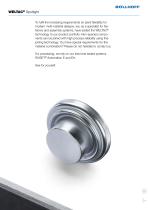
WELTAC® Spotlight To fulfil the increasing requirements on plant flexibility for modern multi-material designs, we, as a specialist for fasteners and assembly systems, have added the WELTAC® technology to our product portfolio. Non-species components can be joined with high process reliability using this joining technology. You have special requirements for the material combination? Please do not hesitate to contact us. For processing, we rely on our tried and tested systems RIVSET® Automation E and EH. See for yourself.
Open the catalog to page 3
WELTAC® Resistance element welding Welcome. We are your expert for fastening and assembly.
Open the catalog to page 4
BULLHOFF WELTAC® Spotlight Our InfoPoint provides additional information in the form of further brochures and/or videos at the end of this brochure.
Open the catalog to page 5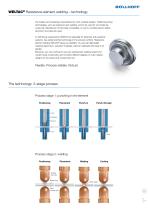
WELTAC® Resistance element welding – technology Car bodies are increasingly characterised by multi-material designs. Traditional joining technologies, such as resistance spot welding, cannot be used for car bodies because the materials are not thermally compatible, or only to a limited extend. Mainly aluminium and steel are used. To fulfil those requirements, Böllhoff, the specialist for fasteners and assembly systems, has added another technology to the product portfolio. Resistance element welding WELTAC® gives you flexibility: You can join lightweight materials (aluminium, sandwich materials,...
Open the catalog to page 6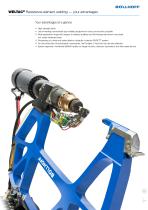
WELTAC® Resistance element welding — your advantagesYour advantages at a glance: ■ High-strength joints ■ Use of existing conventional spot welding equipment in body construction possible ■ Wide application range with respect to material qualities and thicknesses (aluminium and steel) incl. press-hardened steel ■ Processing on a tried and tested electric-hydraulic or electric RIVSET® system ■ For the production of prototypical components, the Portable C hand tool can be also selected ■ System approach: worldwide Bollhoff quality for design of joints, element, automation and after-sales service...
Open the catalog to page 7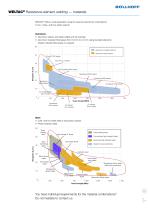
WELTAC® Resistance element welding — materials WELTAC® offers a wide application range for steel and aluminium combinations in two-, three- and four-sheet variants: Aluminium Aluminium sheets, extruded profiles and die castings Aluminium material thicknesses from 0.8 mm to 3.2 mm using standard elements (higher material thicknesses on request) 60 Aluminium wrought products Aluminium cast products Pure Al (1000 series) Pure Al (1xx.x series) 40 Mg-Si-alloyed (6000 series) 30 Mg-alloyed (5000 series) Cu-alloyed (2000 series) Tensil strength [MPa] Mg-alloyed (5xx.x series) Steel Cold- and hot-rolled...
Open the catalog to page 8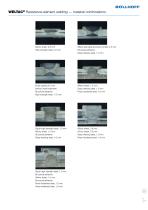
Al5xxx sheet, 0.8 mm High-strength steel, 2.0 mm Al6xxx extruded aluminium profile, 2.5 mm Structural adhesive Deep-drawing steel, 1.0 mm Al die casting 3.0 mm (without heat treatment) Structural adhesive High-strength steel, 1.75 mm Al6xxx sheet, 1.2 mm Deep-drawing steel, 1.0 mm Press-hardened steel, 1.6 mm Super-high-strength steel, 1.5 mm Al5xxx sheet, 1.5 mm Structural adhesive Deep-drawing steel, 1.0 mm Al5xxx sheet, 0.8 mm Al7xxx sheet, 2.0 mm Deep-drawing steel, 1.0 mm Press-hardened steel, 1.6 mm Super high-strength steel, 1.5 mm Structural adhesive Al5xxx sheet, 1.5 mm Structural adhesive...
Open the catalog to page 9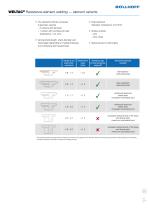
■ Self-produced in cold forging ■ The standard portfolio comprises 6 geometry variants - 5 versions with flat head - 1 version with countersunk head (interference < 0.4 mm) ■ Varying shank length, shank diameter and head height depending on material thickness and mechanical joint requirements Range of use Interference Clamping ring1 Version/mechanical sheet thick- head for loss protection strength flat head/low mechanical load high head/high mechanical load reinforced head and shank area/ increased mechanical load reinforced head and shank area/ increased mechanical load increased reinforcement...
Open the catalog to page 10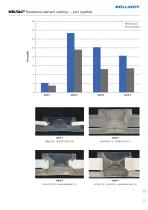
WELTAC® Resistance element welding — joint qualities 16 n Shear load n Cross-tension AL 6016 [1.0] - AL 6016 [2.0] – press-hardened steel [1.5] INDE
Open the catalog to page 11
The WELTAC® technology was specifically developed to fulfil the special requirements in body construction. All multi-material components can be joined with WELTAC® with high process reliability. For example: Aluminium car body shell parts (thin sheet) on steel structures Aluminium surface components surrounded with steel Aluminium structural components surrounded with steel Functionally integrated aluminium die castings (different material states) surrounded with steel ■ Hinge knot rear lid
Open the catalog to page 12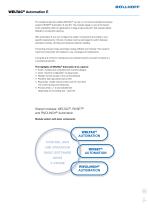
WELTAC® Automation E For resistance element welding WELTAC®, we rely on our tried and tested processing systems RIVSET® Automation E and EH. The modular design is one of the factors which predestine them for applications in large-scale production that require highest flexibility in production planning. With Automation E you can configure the system components according to your specific requirements. Only few modules must be exchanged to switch between self-pierce riveting, clinching and resistance element welding. The joining process is fully automated, energy-efficient and modular. This results...
Open the catalog to page 13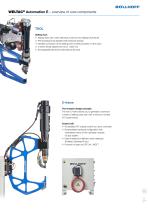
WELTAC® Automation E - overview of core components TOOLSetting tool: ■ Setting tools with 100% electrical control for the setting force 80 ■ Pre-clamping force adjusted with pressure springs ■ Variable connection of the setting tool for perfect position on the ■ C-frame throat depths from 50 to 1,000 mm ■ Exchangeable die dome (with/without die lock) C-frameThe modular design principle: The new C-frame allows you to generate a maximum number of setting tools even with a minimum number of C-base frames. Control unit ■ “Embedded PC”-based control incl. servo controller ■ Decentralised hardware...
Open the catalog to page 14All Böllhoff Verbindungstechnik GmbH catalogs and technical brochures
 TEPRO® K' in K'
16 Pages
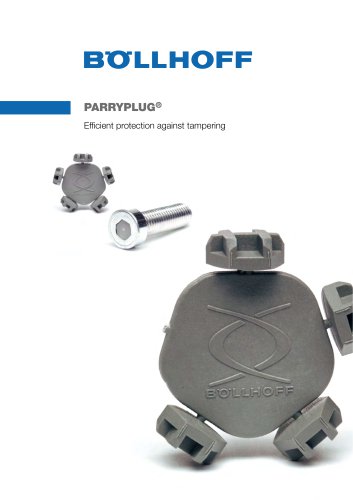 PARRYPLUG®
8 Pages
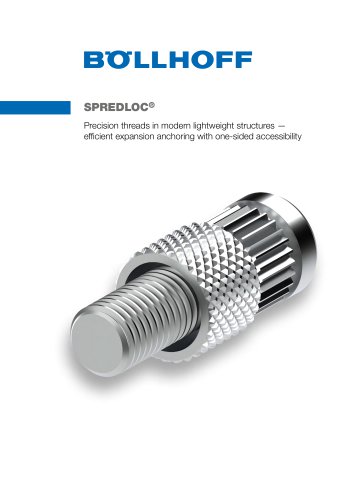 SPREDLOC®
12 Pages
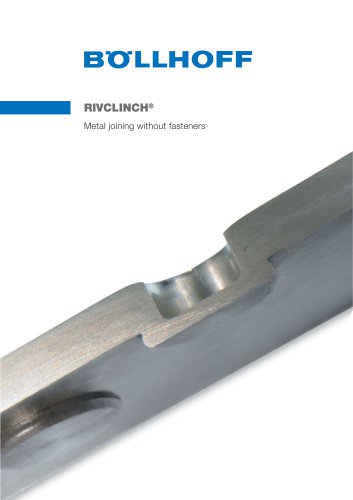 RIVCLINCH®
16 Pages
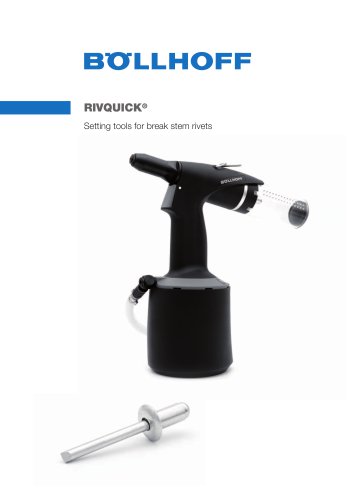 RIVQUICK®
12 Pages
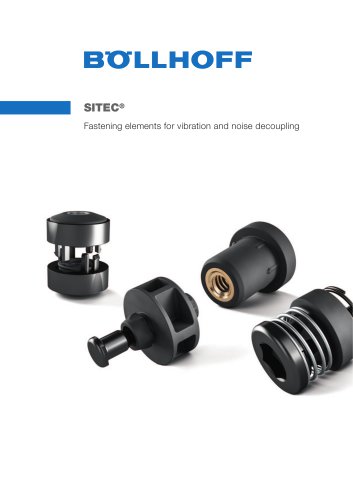 SITEC®
40 Pages
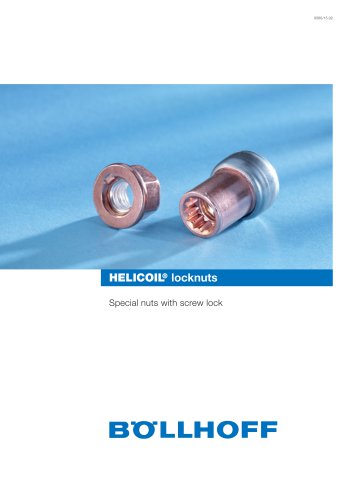 HELICOIL® locknuts
8 Pages
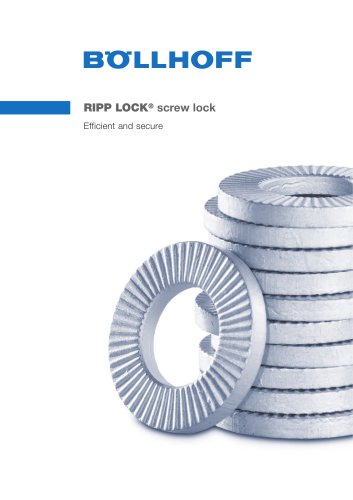 RIPP LOCK®
16 Pages
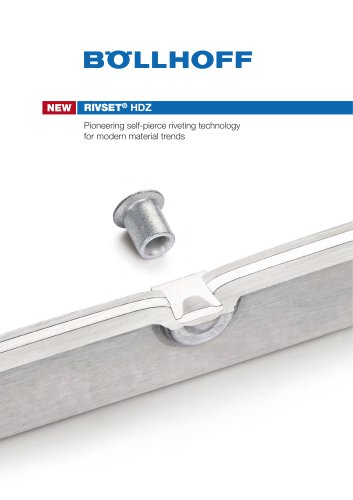 RIVSET®HDZ
4 Pages
 ONSERT®
28 Pages
 SEAL LOCK® Sealing nuts
8 Pages
 IMTEC® Moulded inserts
16 Pages
 HELICOIL® Plus
82 Pages
 RIVTAC®
14 Pages
 Products and Services
40 Pages
 QUICKLOC®
20 Pages
 HELICOIL® Smart
28 Pages
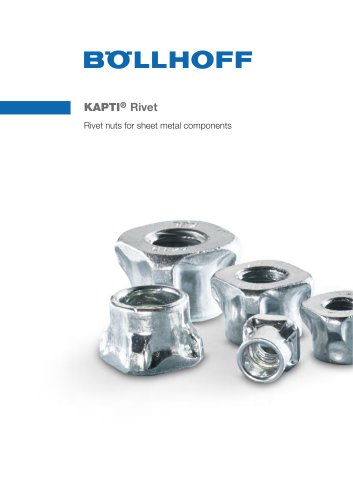 KAPTI® Rivet - Captive nuts
4 Pages
 Product Guide
20 Pages


