

SITEC®
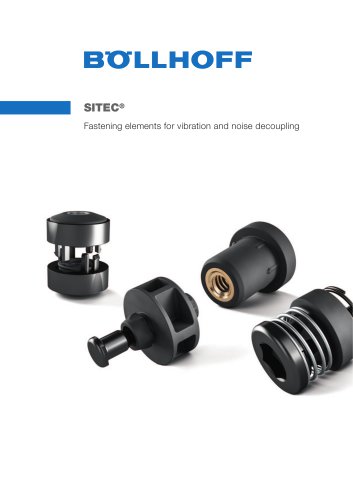
SITEC®
SITEC® provides innovative fastening solutions aimed at reducing vibration and noise, which are critical for Noise, Vibration, Harshness (NVH) development in industries such as automotive, household appliances, and energy technology. These solutions enhance product performance and longevity by minimizing mechanical failures due to excessive noise and vibration.
SITEC® focuses on vibration and noise decoupling through damping and isolation. Damping converts kinetic vibration energy into thermal energy using technical elastomers, while isolation reduces vibration amplitude through elastic fasteners.
SITEC® offers various product variants like rivets, pins, clips, and springs, each tailored for specific applications and connection types, including plug-in connections and screw joints.
SITEC® fastening elements are made from technical elastomers, chosen based on operating temperature and Shore hardness. These materials resist temperature, chemicals, oils, and weathering, ensuring durability and performance.
SITEC® products are used in automotive (e.g., engines, electronics, cooling systems) and industrial applications (e.g., pumps, fans, heat exchangers). Custom solutions are available for specific project needs.
The SITEC® Rivet, available in standard and special designs, provides vibration and noise decoupling with options for internal or external threads. It features a metal sleeve covered with elastomer, forming a reliable blind rivet joint with damping properties, available in various sizes and materials.
SITEC® fastening elements effectively reduce noise and vibration across industries, enhancing product quality and performance through innovative design and material selection.
The SITEC® Rivet HT is a special decoupling blind rivet nut for high-temperature applications, combining a metal bush with an elastomer or thermoplastic elastomer covering and an additional sleeve. It withstands high loads and temperatures while decoupling components, suitable for one-sided installation.
Installation of the SITEC® Rivet HT involves screwing the component and pressing it into the receiving part, designed for easy one-sided accessibility and offering a detachable joint with optimized geometry.
This variant, made entirely of plastic, is used with thread-forming screws for vibration and noise decoupling, suitable for thin-walled components. Installation involves inserting the rivet into a hexagon socket and fastening with a thread-forming screw.
The SITEC® Rivet with a pre-installed screw offers shorter installation times and is designed for intelligent fastening, compensating radial tolerances and suitable for different grip lengths.
The SITEC® Pin is a detachable plug-in connection for damping applications, consisting of a plastic stud and a soft damping element, suitable for lightweight applications, offering easy tool-free installation.
The SITEC® Clip is a two-part system for screw joints, providing fast and easy installation for vibration damping, compensating radial tolerances, suitable for medium-size applications.
The SITEC® Spring is designed to isolate vibration in large applications, offering various fastening options and compensating radial tolerances, with tool-free installation and adjustable vibration-isolating properties.
Böllhoff provides engineering, innovation, logistics, and distribution services, with in-house production, quality management, and customer-specific development parts. Their global presence ensures efficient consulting and after-sales service.
Catalog excerpts
Fastening elements for vibration and noise decoupling
Open the catalog to page 1
Silence – a quality factor. NVH development (NVH = Noise, Vibration, Harshness) is becoming increasingly important. It is present in all industrial sectors from washing machines to vehicles, aircrafts and wind turbines. NVH stands for: The development is about avoiding vibration and is among the quality characteristics of a product which are most frequently directly observed. Excessive noise and vibration cause problems. They can affect the performance of a product negatively if it wears out earlier as a result, shows a less efficient performance or – in extreme cases – has a shorter product...
Open the catalog to page 3
Contents Page SITEC® Variants - an overview 6 SITEC® Branches and applications 10 Standard design ■ with internal thread 14 ■ without internal thread 17 ■ Item codes and specifications 20 Special versions ■ with pre-installed screw 25
Open the catalog to page 4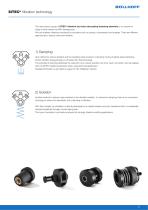
SITEC® Vibration technology The new product group of SITEC® vibration and noise decoupling fastening elements is our answer to today’s trend toward the NVH development. We only address vibrations produced by actuators such as pumps, compressors and engines. There are different approaches to reduce noise and vibration: 1) Damping One method to reduce vibration and the resulting noise emission is damping. During material-based damping, kinetic vibration energy/energy is converted into thermal energy. The principle of damping describes the reduction of an output quantity over time. Such conversion...
Open the catalog to page 5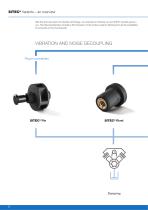
SITEC® Variants – an overview After this short excursion into vibration technology, we would like to introduce our new SITEC® product group to you. The following illustration provides a first impression of the product variants. Starting point are the possibilities of connection to the mounting part: VIBRATION AND NOISE DECOUPLING Plug-in connection SITEC® Rivet
Open the catalog to page 6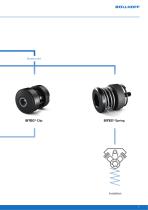
Screw joint SITEC® Clip SITEC® Spring
Open the catalog to page 7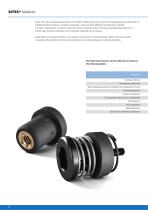
SITEC® Materials Apart from the sophisticated geometry of the SITEC® fastening elements, the technical elastomers are the basis for intelligent joining solutions in vibration technology. There are three different manufacturing materials. The main characteristic on which to base the choice of material is the continuous operating temperature. In a further step, the Shore hardness of the individual materials can be chosen. Depending on the requirements for your product, we decide on the appropriate material. Since we closely cooperate with leading raw material manufacturers, new perspectives are...
Open the catalog to page 8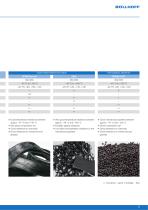
Cross-linked elastomers/rubber Thermoplastic elastomer ■ Good temperature resistance between approx. -40 °C and +140 °C ■ Very good compression set ■ Good resistance to chemicals ■ Good resistance to mineral oils and greases ■ Very good temperature resistance between approx. -40 °C and +180 °C ■ Excellent ageing resistance ■ Low effect of temperature variations on the mechanical properties ■ Good mechanical properties between approx. -40 °C and +100 °C ■ Good resistance to chemicals ■ Good resistance to mineral oils and greases ++ very good, + good, 0 average, - bad
Open the catalog to page 9
SITEC® Branches and applications Within the framework of a project, new developments according to your application-specific requirements can be realised at any time. We precisely incorporate your concepts and ideas to be able to offer you the best solution for your application. Automotive applications ■ Auxiliary heating system ■ Circulating water pump
Open the catalog to page 10
■ Public health engineering
Open the catalog to page 11
BOLLHOFF Page SITEC® Variants - an overview 6 SITEC® Branches and applications 10 Standard design ■ with internal thread 14 ■ without internal thread 17 ■ Item codes and specifications 20 Special versions ■ with pre-installed screw 25
Open the catalog to page 13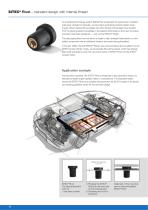
SITEC® Rivet – standard design with internal thread As a fastening technology expert, Böllhoff has recognised the special role of plastics quite early. Already for decades, we have been producing precision plastic parts. It goes without saying that synergies with other joining technologies have resulted from the growing expert knowledge in the plastics technology so that new innovative products have been developed — such as the RIVKLE® Elastic. This decoupling blind rivet nut allows to fasten a high-strength thread body to a thinwalled component with an additional vibration and noise decoupling...
Open the catalog to page 14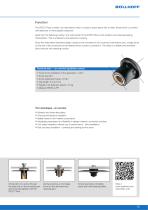
Function The SITEC® Rivet consists of a metal sleeve which is usually a brass sleeve with a metric thread which is covered with elastomer or thermoplastic elastomer. Apart from the fastening function, the main benefit of the SITEC® Rivet is the vibration and noise decoupling characteristic. This is achieved by the elastomer covering. Since the metal sleeve (standard design: brass) is only connected to the covering in the bottom part, a bulge forms on the rear of the component to be fastened when a screw is screwed in. The result is a reliable and reversible blind rivet joint with damping function....
Open the catalog to page 15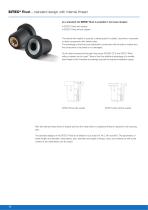
SITEC® Rivet – standard design with internal thread As a standard, the SITEC® Rivet is available in two basic designs: n SITEC® Rivet with washer n SITEC® Rivet without washer The variant with washer is used as a damping joint for plastic, aluminium, composite or steel components with slotted holes. The advantage is that the force distribution is improved with the built-in washer and the component to be joined is not damaged. To join steel components (through hole as per DIN ISO 273), the SITEC® Rivet without washer can be used. There is then the additional advantage of a smaller head height...
Open the catalog to page 16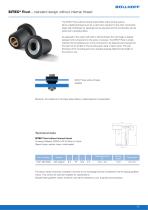
SITEC® Rivet - standard design without internal thread The SITEC® Rivet without internal thread offers further joining options. Since a fastening thread (such as a weld nut) is required on the other component, larger wall thicknesses (or spacings) can be spanned and the components can be joined with a damping effect. As opposed to the variant with built-in internal thread, the rivet bulge is shaped between both components in the screw-in process. The SITEC® Rivet is simply i nserted into the existing bore on the component to be fastened and screwed into the weld nut (or similar) on the mounting...
Open the catalog to page 17All Böllhoff Verbindungstechnik GmbH catalogs and technical brochures
 TEPRO® K' in K'
16 Pages
 PARRYPLUG®
8 Pages
 SPREDLOC®
12 Pages
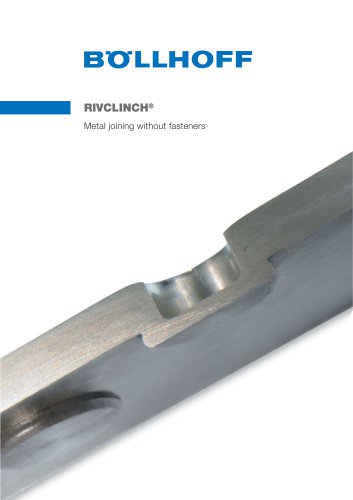 RIVCLINCH®
16 Pages
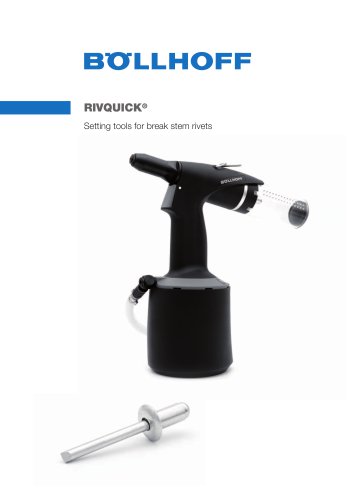 RIVQUICK®
12 Pages
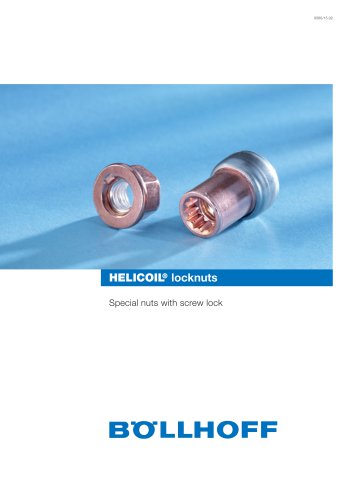 HELICOIL® locknuts
8 Pages
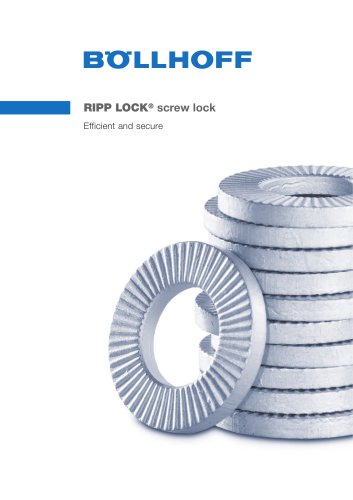 RIPP LOCK®
16 Pages
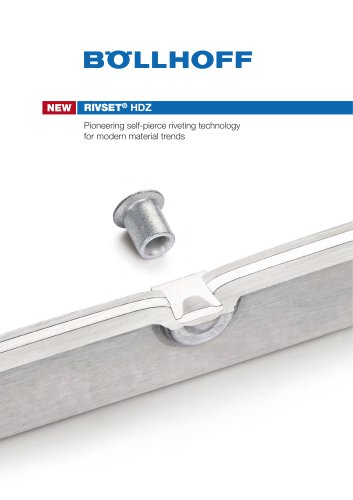 RIVSET®HDZ
4 Pages
 ONSERT®
28 Pages
 SEAL LOCK® Sealing nuts
8 Pages
 IMTEC® Moulded inserts
16 Pages
 HELICOIL® Plus
82 Pages
 RIVTAC®
14 Pages
 Products and Services
40 Pages
 QUICKLOC®
20 Pages
 HELICOIL® Smart
28 Pages
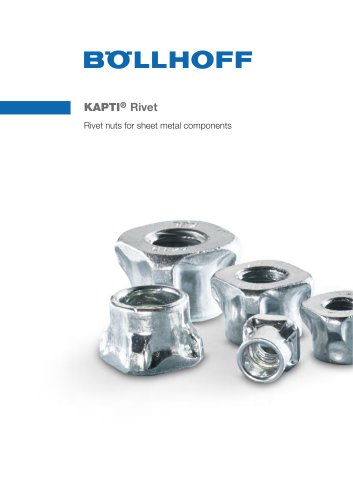 KAPTI® Rivet - Captive nuts
4 Pages
 Product Guide
20 Pages


